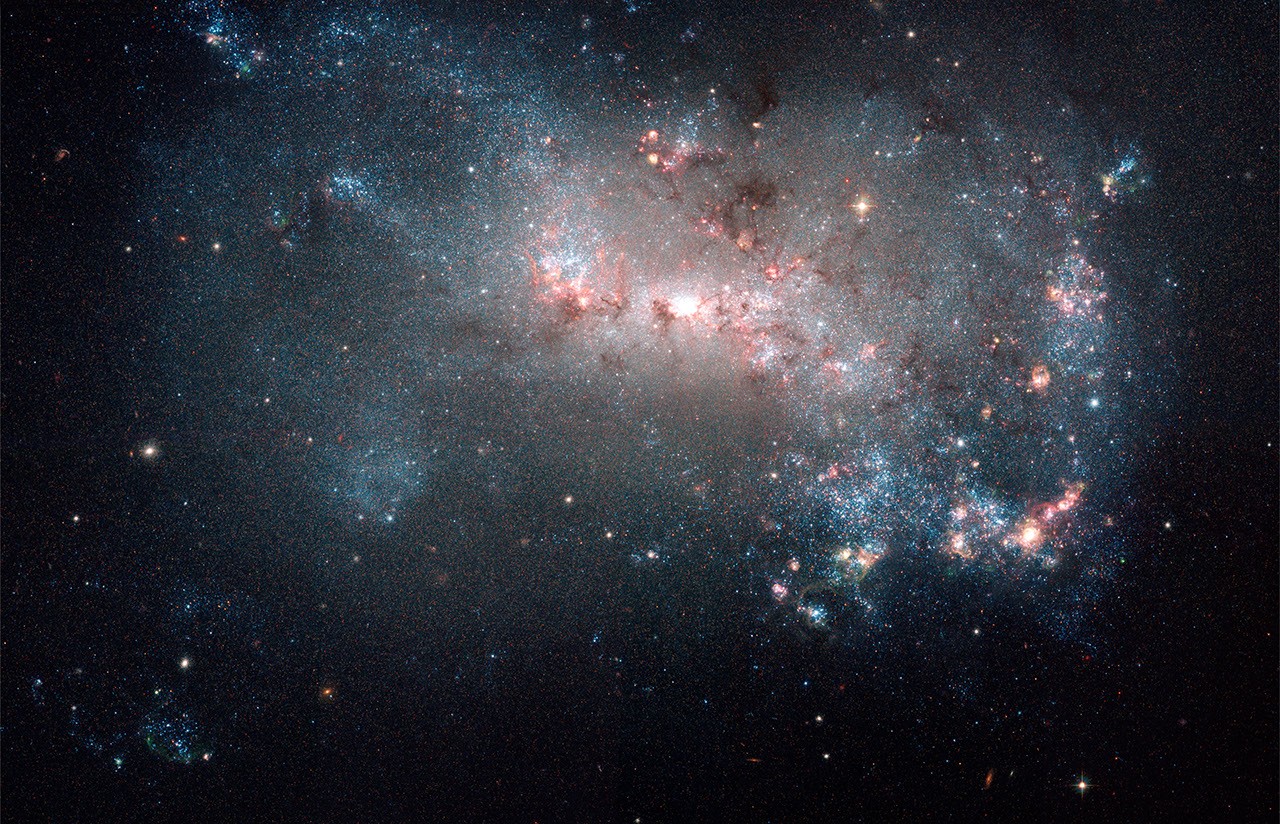
NASA's Hubble Space Telescope found that dwarf galaxies are missing far more oxygen than current models predict. Researchers studying 37 nearby dwarf galaxies in the Galaxies Losing Oxygen via Winds (GLOW) project discovered that these small galaxies hold onto only a small fraction of the oxygen produced by their stars.
The oxygen must have been ejected from the galaxies. "Oxygen is produced by stars, which are inside of galaxies. We know that the oxygen had to be inside of the galaxies at some point in the past, so the oxygen must have been ejected," said Grace Telford, assistant professor in the Department of Physics and Astronomy at the University of Utah.
The research, published Monday in The Astrophysical Journal, found that galactic winds unleashed by supernovae are more effective at removing oxygen from low-mass galaxies than simulations predict. The team traced oxygen to understand how it distributes within stars, in gas between stars, and in the space between galaxies.
Oxygen serves as a reliable tracer because it is the most abundant element after hydrogen and helium and its production is well understood. Kristen Wingfield McQuinn, GLOW principal investigator and associate professor at Rutgers University, explained that understanding oxygen distribution helps reveal "how much galaxies are enriching the space between galaxies, called the intergalactic medium."
The study combined archival Hubble optical imaging data with observations from NASA's retired Spitzer Space Telescope and ground-based radio telescopes. The selected dwarf galaxies were close enough for Hubble to resolve their individual stars. McQuinn has an approved program to use the Nancy Grace Roman Space Telescope to study even lower-mass galaxies and then obtain deeper observations with Hubble and the James Webb Space Telescope.