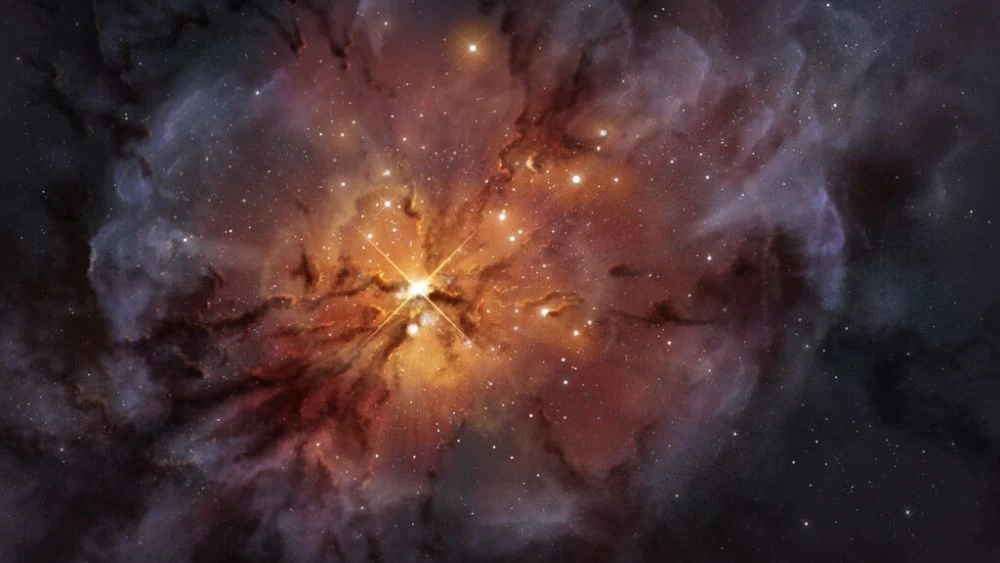
A new study explains why early galaxies observed by the James Webb Space Telescope appear brighter and form stars in unusually dense clusters. Researchers Shyam H. Menon of the Flatiron Institute's Center for Computational Astrophysics and Aaron Smith of the University of Texas at Dallas found that Lyman-Alpha radiation, produced when electrons in hydrogen atoms transition to their ground state, plays a key role.
The JWST revealed that galaxies only 460 million years after the Big Bang concentrate star formation in compact, dense clusters. Dense gravity in these regions resists radiation pressure, but Menon and Smith's calculations showed that Lyman-Alpha radiation becomes powerful enough to blow away surrounding diffuse gas and dust once star formation reaches saturation in the clusters.
"When the density is low enough, the Lyman-alpha radiation can push the gas to really high speeds, launching explosive winds that can shoot material clear out of the galaxy," Menon said. "That cleared away the gas obscuring the dense clusters, making them visible."
The researchers used the COLT Monte Carlo code (Cosmic Lyman-Alpha Transfer), developed by co-author Smith, to analyze snapshots from radiation-hydrodynamic simulations of star-forming clouds. Their work, published in The Astrophysical Journal, shows that Lyman-Alpha radiation pressure cannot prevent efficient star formation in dense filaments but can drive significant outflows from the surrounding lower-density gas, allowing early galaxies to become observable.