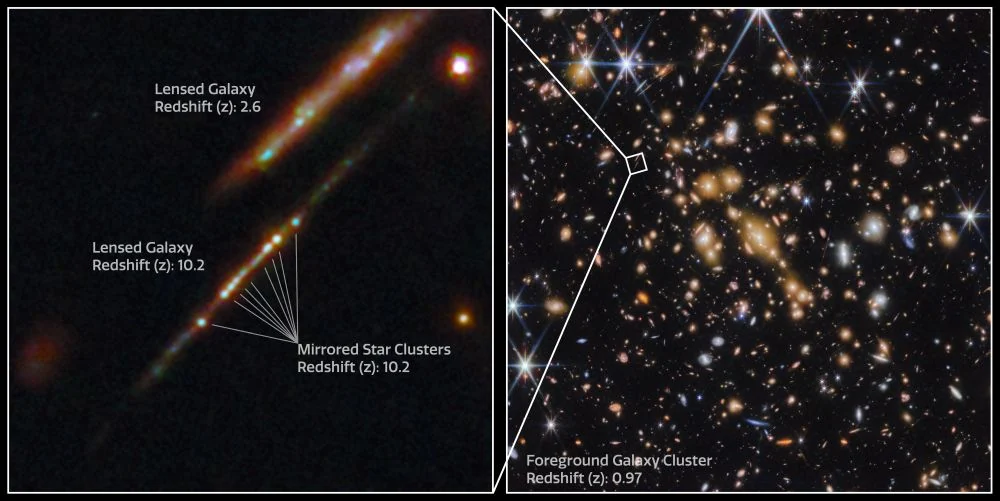
The James Webb Space Telescope has identified dense stellar systems in the early Universe that could serve as birthplaces for intermediate-mass black holes (IMBHs), according to research published in Astronomy and Astrophysics. Lead author Viola Bocchi of Sapienza University of Rome and her team studied young massive clusters (YMCs) discovered by JWST in two gravitationally lensed galaxies.
The Cosmic Gems arc, observed when the Universe was roughly 460 million years old, contains five YMCs with masses between 100,000 and 10 million solar masses. The Firefly Sparkle, imaged about 600 million years after the Big Bang, holds ten YMCs. Both systems show the extreme density and low metallicity needed for IMBH formation through runaway stellar collisions.
Using collision-based models and stellar-wind mass-loss calculations, the researchers estimated IMBH masses. The Cosmic Gems clusters, with radii of approximately one parsec, produced the heaviest seeds, ranging from 1,600 to 2,700 solar masses. The Firefly Sparkle's larger, less compact clusters generated lighter seeds of roughly 180 to 810 solar masses.
The low metallicity of these young clusters proved critical. Because few stars have lived and died within them, insufficient heavy elements exist to drive significant mass loss through stellar winds. This retention of mass allowed colliding stars to build more massive black hole seeds.
The authors note that their estimates carry uncertainties. Unknown cluster properties including rotation and internal structure could alter outcomes. An unknown initial mass function, possibly skewed toward massive stars, could favor even heavier IMBH formation than their models show.
The researchers suggest these dense, metal-poor clusters could supply the heavy seeds required to grow into the supermassive black holes observed in the early Universe, including those powering the JWST's unexplained "Little Red Dots."