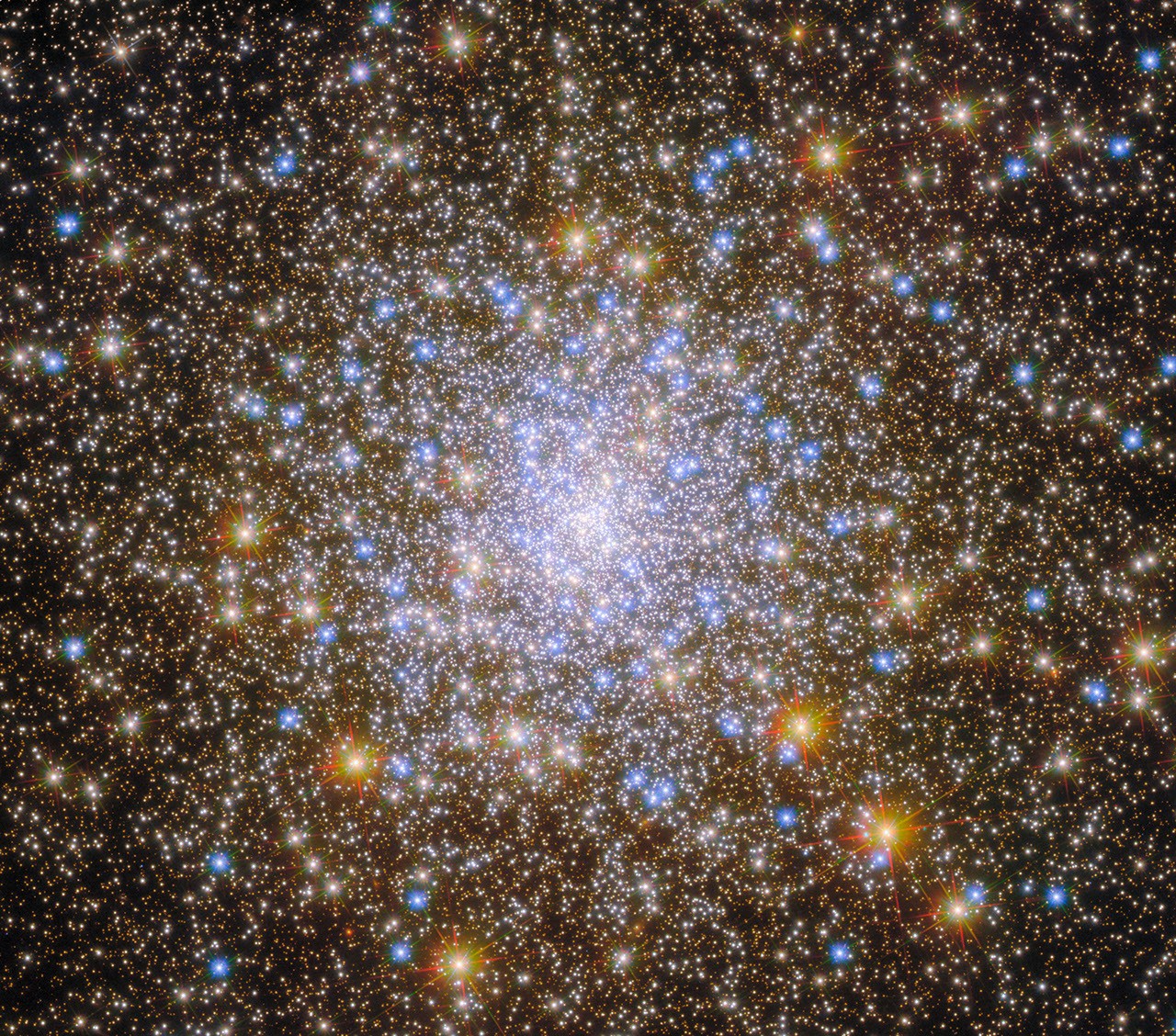
The Hubble Space Telescope has captured new observations of Messier 30 (M30), a globular cluster located 27,500 light-years away in the constellation Capricornus. The cluster contains tens of thousands to millions of stars held together in a roughly spherical grouping.
Globular clusters orbit in the outer regions of galaxies, and astronomers estimate their ages between 11.5 to 13.5 billion years, making them nearly as old as the universe itself. Because they are so ancient, these clusters serve as time capsules that reveal the original chemistry of galaxies during their youth.
M30 and many other globular clusters orbit in the opposite direction from their host galaxy's rotation. This retrograde motion suggests the Milky Way may have captured these clusters in the distant past rather than forming them internally.
Hubble observed M30 across three separate observing programs spanning 15 years. The first program used the Advanced Camera for Surveys to reveal stars down to 20% of the Sun's mass. A second program employed the Wide Field Camera 3 to study blue straggler stars and multiple stellar populations within the cluster. The most recent observations tracked how different stellar populations moved over those 15 years.
The latest image combines data from all three programs, capturing ultraviolet, visible, and near-infrared wavelengths. Each wavelength provides distinct information about how the cluster's stars formed and evolved.