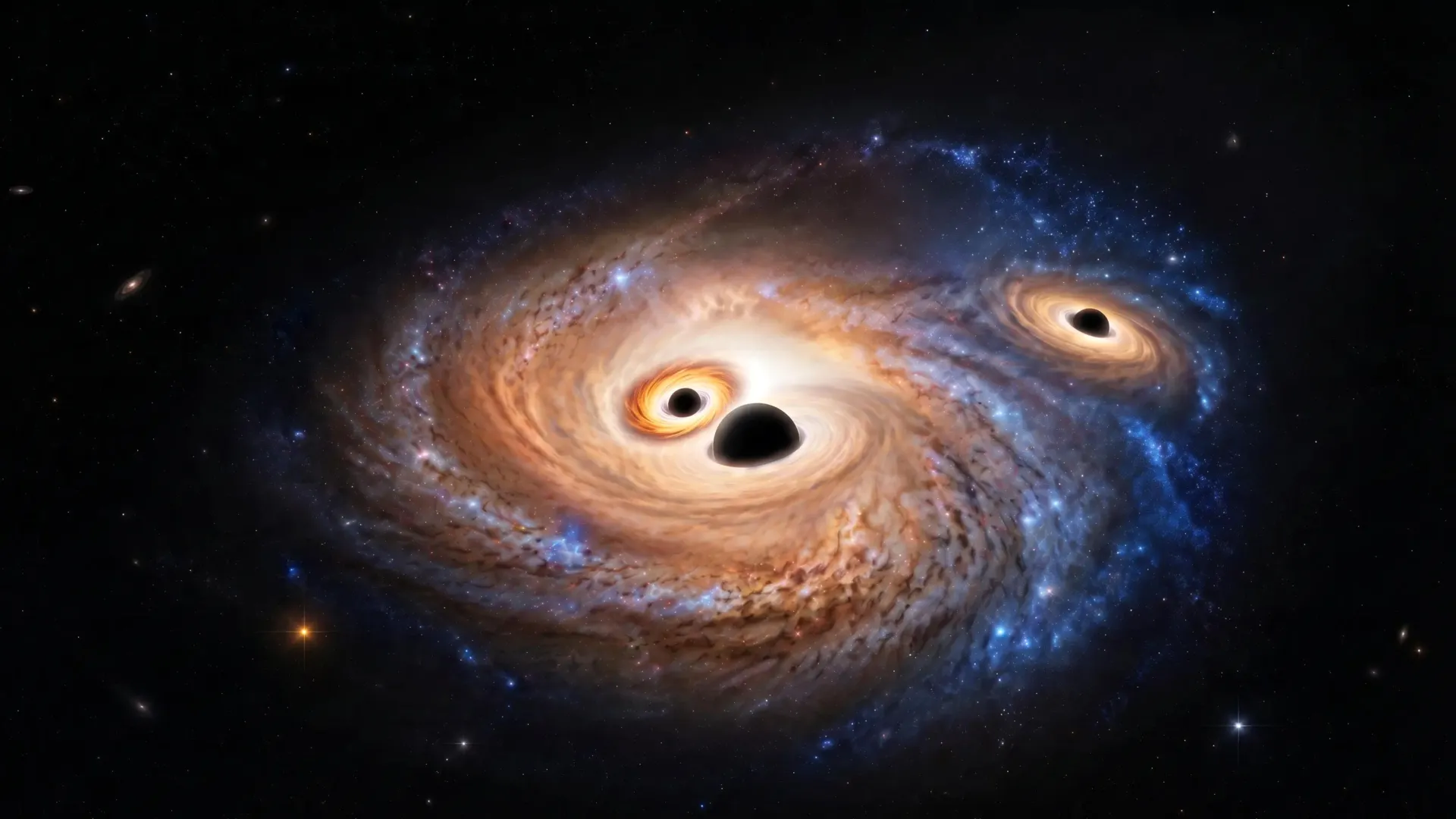
An international research team led by the Max Planck Institute for Extraterrestrial Physics discovered three actively feeding supermassive black holes in the galaxy J0148-4214, located more than 12.5 billion light-years from Earth. The light from this galaxy traveled approximately 12.5 billion years before reaching Earth, meaning astronomers observe it as it existed just 1.2 billion years after the Big Bang.
Two of the black holes lie near the galaxy's center, separated by a projected distance of 620 light-years. The third sits approximately 5,500 light-years from the center. The researchers identified them by examining distinctive patterns in hydrogen gas emissions using spectro-astrometry, a technique that tracks subtle changes in spectral emission positions across the galaxy.
The three black holes have remarkably different masses. Calculations show they are approximately 80 million, 600,000, and 2 million times the mass of the Sun. The smallest of the three central black holes feeds most aggressively, accumulating matter at a rate that exceeds the maximum predicted by standard black hole growth models.
"This is the first evidence of three active black holes in a single galaxy in the distant Universe," says Hannah Übler, research group leader at MPE and lead author of the study.
The James Webb Space Telescope's Near Infrared Spectrograph in integral field spectroscopy mode enabled the discovery by separating signals that would otherwise have appeared to come from a single black hole. The two central black holes are expected to merge within the next few hundred million years. The third black hole may be a remnant of an earlier merger that was ejected by gravitational recoil, or it may gradually move toward the galaxy's center.
"It suggests that processes in the early Universe were efficient at bringing massive black holes together, setting the stage for the massive black hole mergers we expect to detect with future gravitational wave observatories," Übler says.