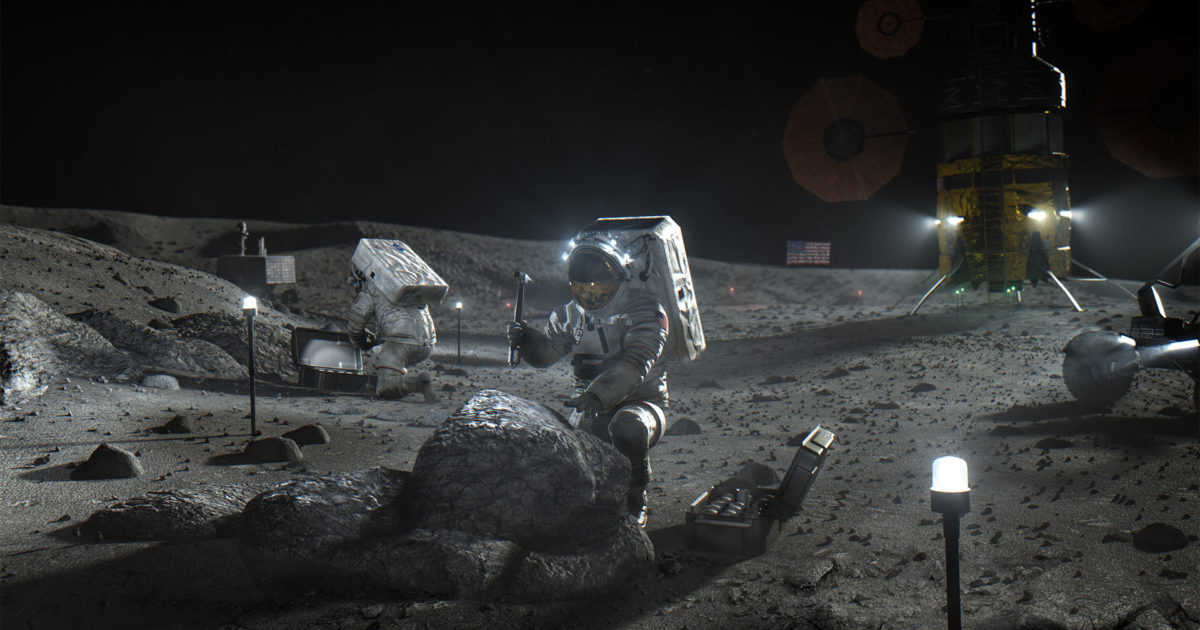
NASA's Artemis IV mission will land two astronauts near the Moon's south pole in 2028 at the earliest, giving them no more than 32 hours total to explore the lunar surface. Brett Denevi, principal investigator of the Artemis IV Geology Team at Johns Hopkins Applied Physics Laboratory, is coordinating the scientific objectives for this exploration.
The crew will have up to four excursions of eight hours each across an area roughly twice the size of Central Park. Denevi's team is pre-mapping locations and planning tasks to answer fundamental questions about lunar science.
One priority is understanding the Moon's origin. Scientists believe a giant collision between Earth and a protoplanet called Theia, roughly 4.5 billion years ago, ejected debris that formed the Moon. However, rocks from Apollo missions show chemical signatures surprisingly similar to Earth's outer layers, which is difficult to explain if most lunar material came from Theia. The south pole's South Pole-Aitken basin offers what may be the deepest and oldest lunar rock from this collision. Finding pristine crust samples there could reveal the Moon's earliest history and Theia's chemical fingerprint.
Artemis IV will also test a major theory about the Late Heavy Bombardment, a period roughly half a billion years after Earth formed when thousands of large asteroids and comets struck both worlds. Apollo data suggested this happened, but other measurements have cast doubt on the concept. Denevi said that testing this hypothesis is "almost the easiest big hypothesis to either topple or prove," and Artemis IV's location away from the Imbrium basin that affected Apollo sites should provide a clearer answer.
The mission will scout the south pole's potential for sustained human habitation. Water ice exists in permanently shadowed regions near the lunar poles, but scientists do not know how much ice is present, how deep it lies, or how it arrived there. If ice is abundant, future missions could convert it into rocket propellant and extract drinking water and nutrients for growing food.
The crew will attempt to enter permanently shadowed regions, collect vacuum-sealed soil samples, and return them to Earth for analysis. If the lander cannot reach these areas, an electric sensor experiment led by the University of Tokyo and JAXA will measure subsurface properties from the landing site. Three instruments will be deployed during Artemis IV or Artemis V: the sensor experiment, a plant-growth study, and the Lunar Environment Monitoring Station, which will measure moonquakes and lunar subsurface structure.