# New Lunar Crater Offers Keys to Moon's Shallow Subsurface
Fresh asteroid impacts on the Moon create temporary windows into the lunar subsurface, exposing materials that normally remain buried beneath regolith and dust. Scientists leverage these natural excavations to map compositional changes, understand impact mechanics, and refine models of the Moon's geological evolution.
When asteroids strike the lunar surface at velocities ranging from 20 kilometers per second or higher, they excavate material from depth. The ejected debris, called ejecta blankets, exposes pristine samples alongside disturbed regolith layers. This process effectively provides geologists with a cross-sectional view of the Moon's upper crust without requiring drilling or extensive human presence.
Recent crater analysis has revealed compositional stratification in the lunar subsurface. Using spectroscopic data from instruments aboard the Lunar Reconnaissance Orbiter and other orbital assets, researchers identify minerals and rock types at varying depths. These observations confirm predictions about how the Moon's crust differentiated billions of years ago, following the giant-impact hypothesis that formed the Moon around 4.5 billion years ago.
Impact craters also illuminate the Moon's response to collision events. The shock pressures generated during formation alter mineral structures and create temporary melting. By studying the spatial distribution of these changes within and around craters, scientists understand how energy dissipates through the lunar regolith and bedrock. This knowledge supports long-term human habitation plans, since future habitats must account for structural stability and seismic hazards from ongoing meteorite bombardment.
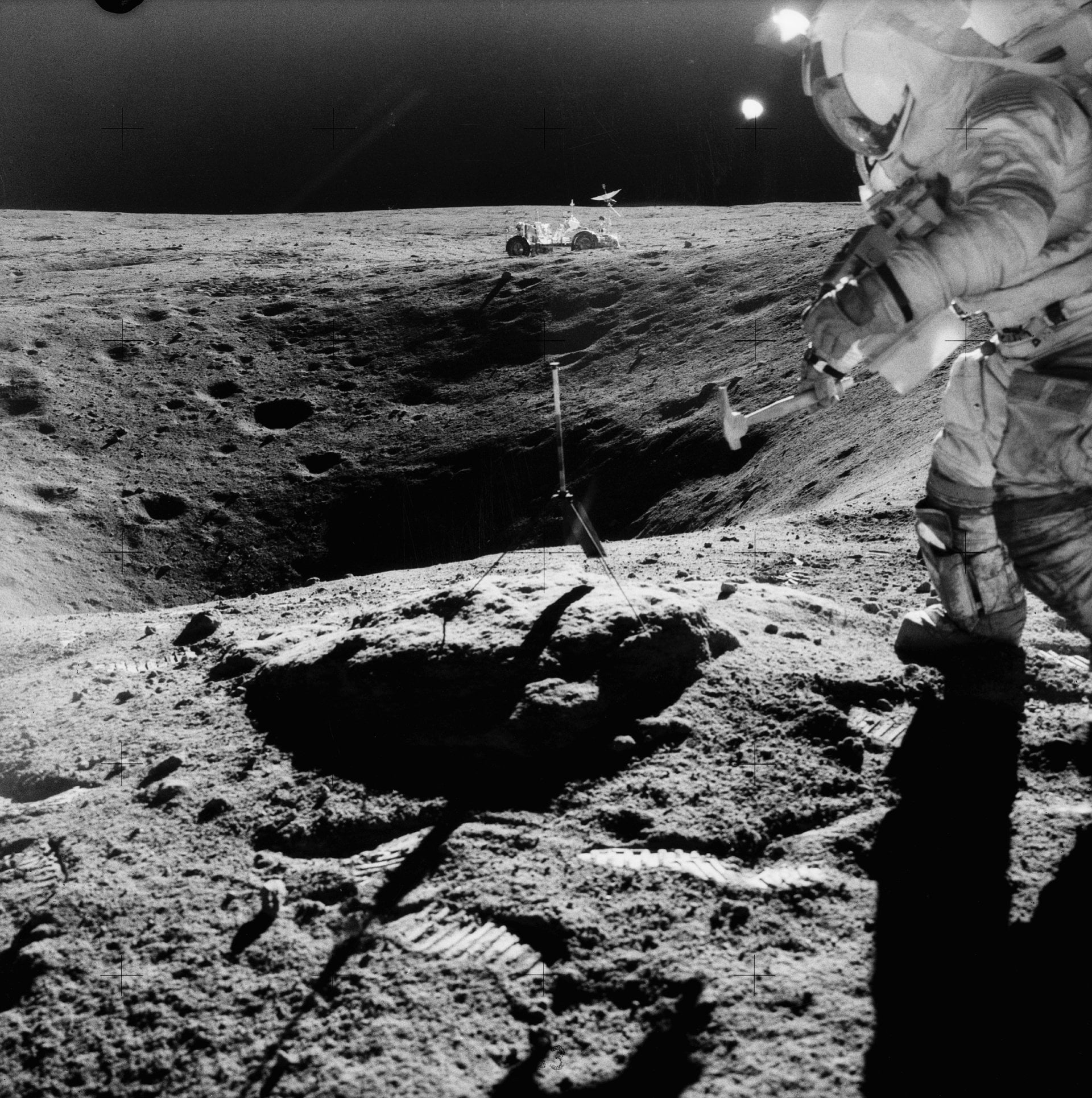
The Apollo 16 mission in 1972 centered on exactly this science. Astronaut John W. Young and geologist Charles M. Duke explored the Descartes highlands, a region selected for its diverse geological formations. Young collected samples from Plum Crater and nearby stations, providing ground truth for orbital measurements. That dataset, acquired over fifty years ago, continues to calibrate modern lunar remote sensing tools and validates crater excavation models.
Monitoring new craters holds particular value for future lunar operations. The Artemis program aims to establish sustained human presence on the Moon, potentially including research stations at the lunar south pole. Understanding subsurface composition and structure informs site selection for long-term infrastructure. Water ice deposits, suspected in permanently shadowed regions, require knowledge of how impacts disturb these volatile-rich zones.
Modern detection systems now spot fresh impact craters within days or weeks of formation. The Lunar Reconnaissance Orbiter's high-resolution camera reveals crater rims and ejecta patterns with meter-scale precision. These observations feed into a growing inventory of young impact sites, each providing a natural laboratory. Scientists can observe how craters of different sizes and ages weather under lunar conditions. Older craters lose their sharp features and bright ejecta halos as solar wind processes and micrometeorite erosion modify the surface over millions of years.
This crater population also reveals impact rates and hazard assessments. By counting new craters in defined areas and calculating their formation rates, scientists estimate asteroid flux in the Earth-Moon system. These statistics inform planetary defense strategies and lunar safety protocols for human operations.
The Moon's continued geological activity, driven by incoming asteroids, transforms it from a static museum of ancient geology into a dynamic natural laboratory. Each new crater contributes data that sharpens our understanding of impact processes, subsurface conditions, and the Moon's long-term evolution. For lunar science and exploration, these fresh scars on the landscape represent opportunities, not merely damage.