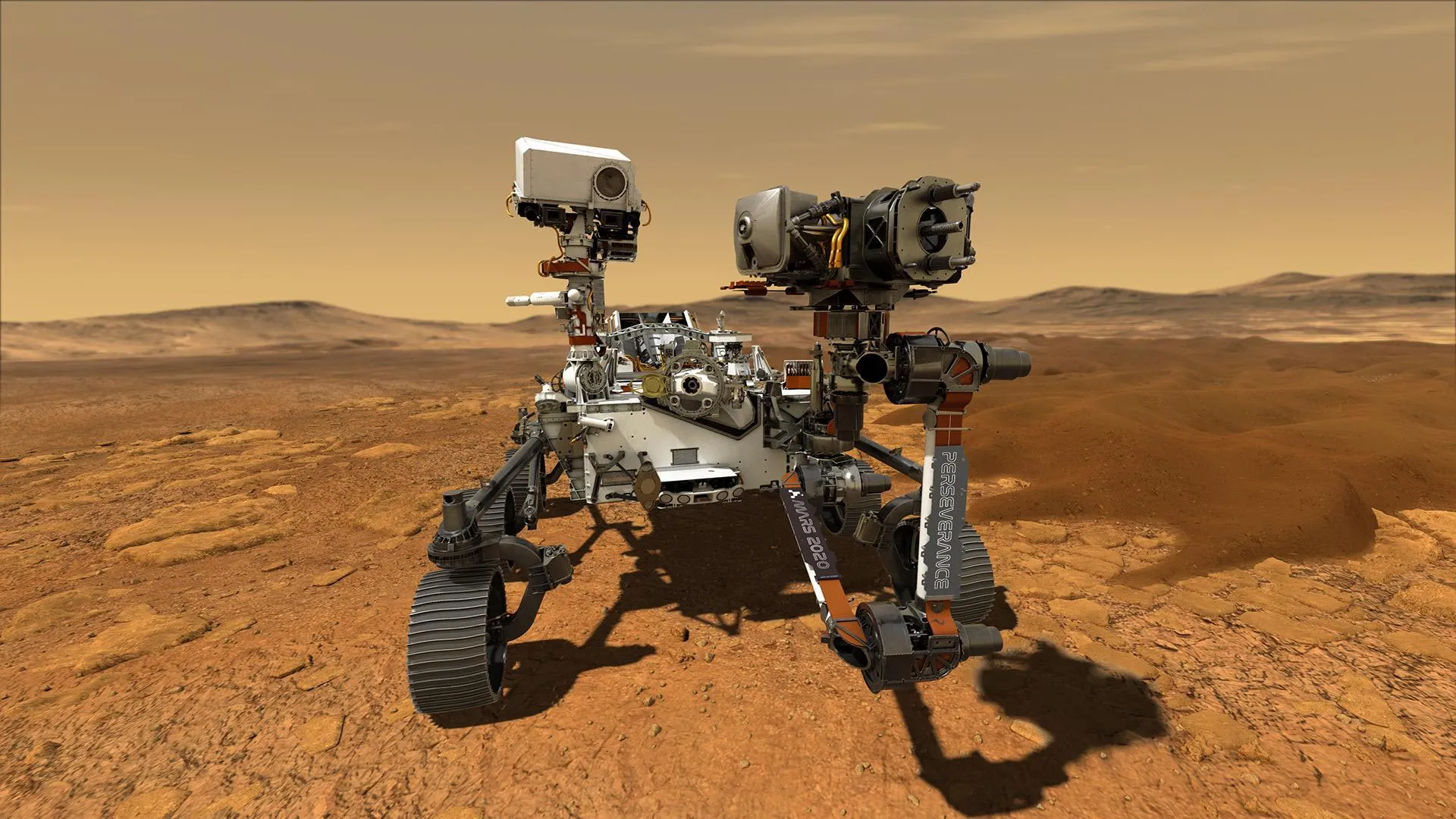
NASA's Perseverance rover reached 28.10 miles (45.22 kilometers) of driving on October 11, breaking the all-time off-world driving record previously held by NASA's Opportunity rover at 28.06 miles (45.16 kilometers). Perseverance accomplished the milestone in five and a half years on its 2,006th Martian sol, while Opportunity needed nearly 15 years to set the previous record.
The rover achieved this through AutoNav, its autonomous driving system. AutoNav allows Perseverance to navigate the Martian landscape without waiting for detailed instructions from Earth. As it moves, the system continuously captures images, constructs three-dimensional maps of obstacles, and selects safe routes. AutoNav evaluates approximately 600,000 terrain points with each assessment. More than 90% of Perseverance's total distance involved AutoNav navigation, compared to only about 5% for Opportunity and Spirit.
Perseverance covered as much as 1,351 feet (412 meters) in a single Martian day. Steven Lee, project manager of the Curiosity and Perseverance rovers at NASA's Jet Propulsion Laboratory, said: "The original mission called for no more than 12.4 miles of driving. We've blown well past that, and with all mobility systems fully operational and favorable extended-ground-life test results, we expect Perseverance to keep adding to this record for many years to come."
The rover traveled toward Idubi, a location in Lac de Charmes beyond Jezero Crater's western rim. This region contains terrain scientists believe may be among the oldest examined in the solar system. At Idubi, researchers hope to find evidence of ancient hydrothermal systems where heated water once circulated through rocks and potentially created conditions suitable for life.
NASA approved Perseverance's first mission extension beginning in October, allowing the rover to continue investigating Jezero Crater's rim through approximately the end of 2028. Perseverance has gathered 29 rock and regolith samples from several distinct environments, including the crater floor, an ancient river deposit, and the crater rim.
Engineers continue improving Perseverance's navigation. Mark Maimone, deputy team chief for robotic operations, noted that new software teaches the rover to steer less and roll more, and to check its position against orbital maps mid-drive. One challenge remains: bright sunlight can interfere with navigation cameras, currently forcing mission planners to stop driving by mid-afternoon when traveling toward the Sun.