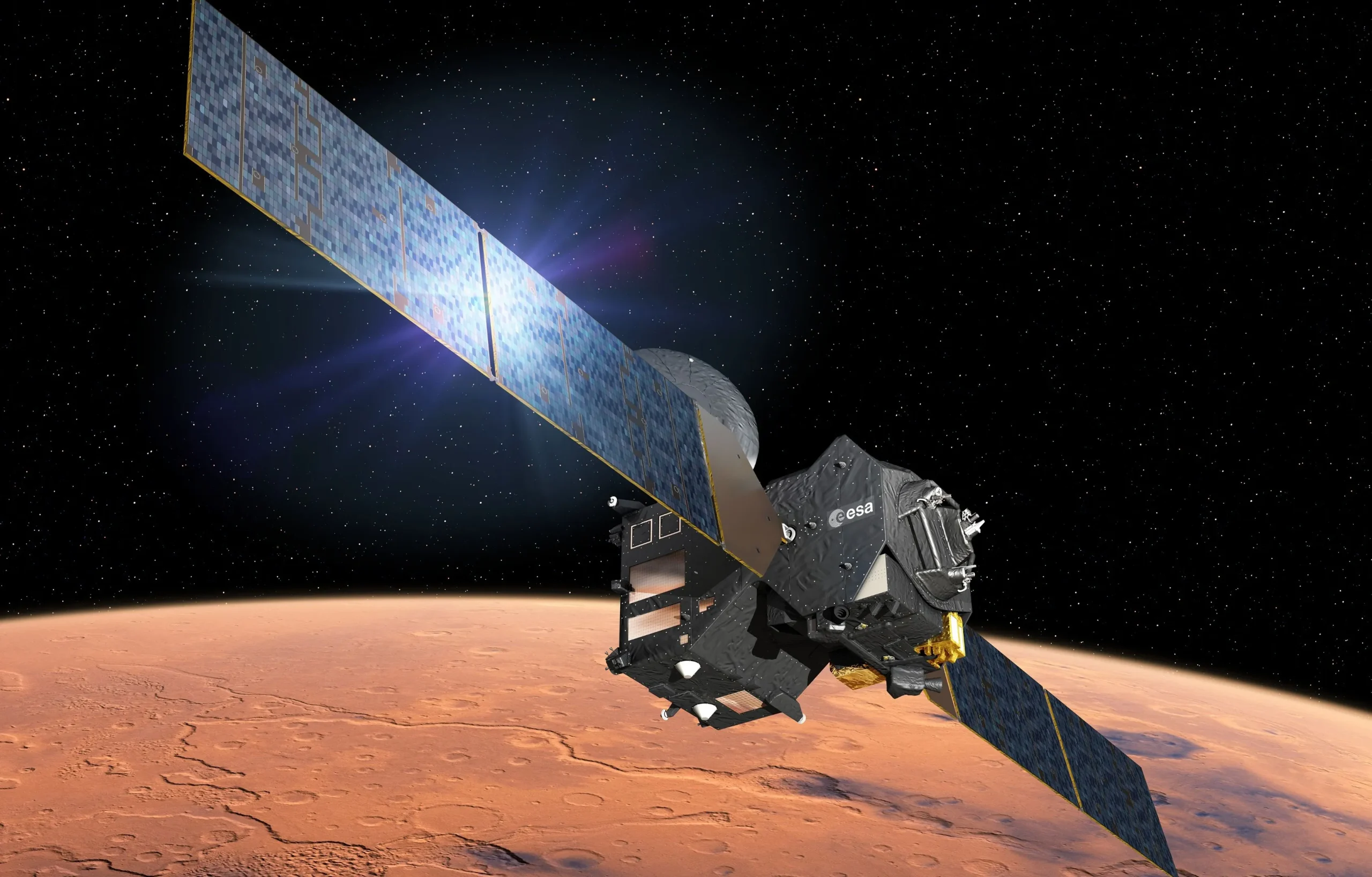
The ExoMars Trace Gas Orbiter has detected hydrogen chloride emissions in Mars' atmosphere that point to active volcanic venting near Alba Mons in the northern Tharsis region. Scientists observed sharp spikes in the gas during early summer in the Martian northern hemisphere, a seasonal pattern they traced to young fissures in the surface around the volcano.
The orbiter's Atmospheric Chemistry Suite instrument localized the hydrogen chloride emissions, while its Colour and Stereo Surface Imaging System revealed narrow fissures spanning tens to hundreds of meters. These openings appear to seal with ice during winter at temperatures as low as -120 degrees Celsius, then release trapped gases when the ice melts in early summer.
Hydrogen chloride is typically found within magmatic vents in volcanic regions on Earth, suggesting the same source on Mars. The team's analysis indicates the gases rise from a dormant magma chamber beneath Alba Mons, with surface color changes near the fissures consistent with deposits left behind by escaping volcanic gases. "Our findings suggest that Mars has retained enough internal heat to support volcanic activity until recently, and possibly still does," said Daniel Mège of the Polish Academy of Sciences, a co-author of the study.
Alba Mons is Mars' largest volcano by surface area, with some surrounding deposits over three billion years old. While orbiters have captured imagery suggesting some Martian volcanoes were active only a few million years ago and NASA's InSight lander recorded thousands of marsquakes, no volcanic eruptions have ever been observed on the red planet.
If hydrothermal systems become active where subsurface magma interacts with groundwater, these fissures could create small habitable regions. Mège noted that searching for Martian microbial life in Alba Mons' seeping fissures would make sense, as active hydrothermal systems could provide the ingredients and energy needed for microorganisms while shielding them from the hostile surface environment.
The Trace Gas Orbiter, a joint European Space Agency and Roscosmos mission, launched in March 2016 and reached Mars orbit in October 2016. The findings were published in Science Advances on November 4.