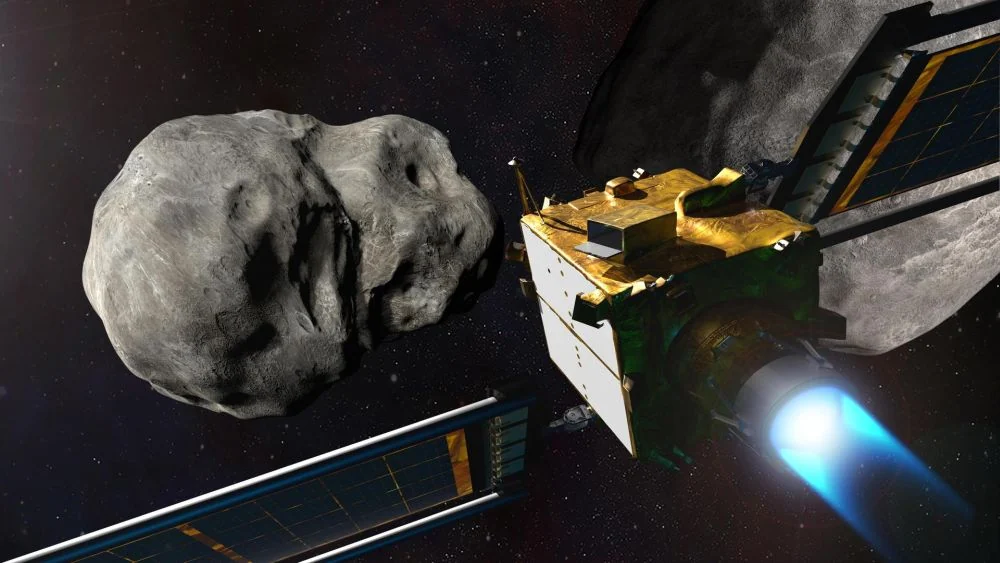
Asteroids lack the uniform shapes of planets because they are too small to round themselves through gravity. Their irregular geometries pose a major challenge for deflecting hazardous asteroids using nuclear radiation, according to new research published in Icarus by Nathan Moore and colleagues at Sandia National Laboratories.
The study examined how pulsed radiation from a nuclear detonation near an asteroid could alter its trajectory. Unlike surface explosions, stand-off detonations release radiation without creating atmospheric shock waves, potentially allowing controlled deflection with less structural disruption and reduced debris hazard to Earth.
Moore's team developed a new algorithm that runs 1,600 times faster than previous models, enabling simulations of asteroids with irregular shapes rather than simplified spherical approximations. The researchers modeled three known asteroids: (101955) Bennu, (25143) Itokawa, and (6489) Golevka.
The orientation of an asteroid during impact proved far more critical than anticipated. Depending on which surface faced the radiation blast, deflection velocity varied by up to five times. "We expected aim to matter," Moore said. "What surprised us was how much."
The simulation accounts for rapid surface vaporization, which produces most of the deflection thrust, along with internal shock waves and surface fracturing. The model can work on any asteroid previously mapped by spacecraft and can calculate deflection velocity, rotation rate, and potential surface breakup before a theoretical intercept.
The research acknowledges limitations. The model cannot yet accurately predict breakup of an entire asteroid body, only surface rock displacement. The interior structure of asteroids remains beyond current modeling capabilities.
The authors note that high-resolution topographic characterization of an incoming asteroid before any deflection attempt could substantially improve accuracy. Obtaining such data would require spacecraft reconnaissance before a nuclear device detonation.