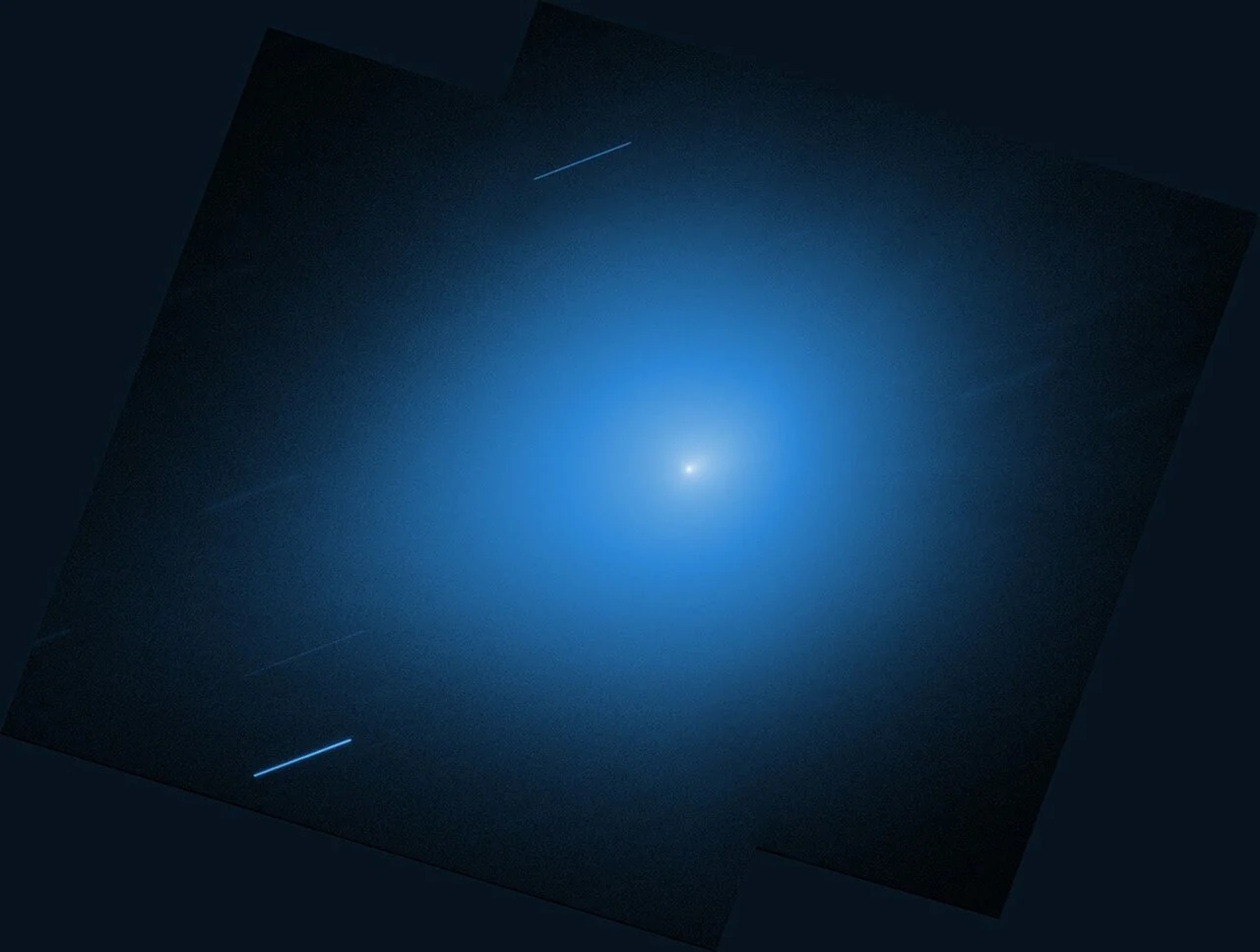
When the third interstellar object, 3I/ATLAS, was discovered in July 2025, astronomers hoped the James Webb Space Telescope would finally give us a clear look at a visitor from beyond our solar system. Instead, JWST revealed something far more valuable: a fundamental misunderstanding about how we've been interpreting cometary data all along. The new paper from Dr. Silvia Protopapa's team at NASA's Goddard Space Flight Center and the Southwest Research Institute, published in The Astrophysical Journal Letters, doesn't just explain 3I/ATLAS—it forces us to reconsider what we thought we knew about icy bodies throughout the cosmos.
The initial observations puzzled researchers. JWST clearly detected the 3.0 micron absorption line characteristic of water ice, but the expected 1.5 and 2.0 micron lines were surprisingly weak or absent. The blue near-infrared continuum slope across 1.15–2.50 microns also didn't match patterns from solar system comets like Hartley 2. Some observers wondered if 3I/ATLAS contained water ice at all. But Protopapa's team solved the mystery through careful modeling: the water ice wasn't pure or neatly organized. Instead, it was locked into microscopic grains mixed with dark rocky minerals like pyroxene and carbon. Light traveling through these aggregates encounters dust before reaching deeper layers, shortening the optical pathway and muting the absorption features at 1.5 and 2.0 microns while allowing the longer 3.0 micron wavelength to pass through.
The research team's observations across three different times during 3I/ATLAS's journey—from about 3.31 astronomical units before perihelion to 5.65 AU past it—revealed even more complexity. After perihelion, larger, micron-sized ice-rich aggregates appeared, and a Fresnel reflection near 3.1 microns indicated crystalline water ice with organized molecular lattices. The Sun's heat either reorganized surface layers into crystals or blasted away outer dust to reveal previously hidden structures underneath.
What makes this discovery truly significant is its connection to our own solar system. The infrared patterns of 3I/ATLAS match certain Trans-Neptunian Objects in the Kuiper belt, those icy planetary leftovers beyond Neptune that JWST has already studied extensively. Researchers had previously attributed similar spectral patterns in these objects to complex hydrocarbons or organics. Now we know those patterns might simply indicate dusty ice, fundamentally reinterpreting what those distant, ancient bodies actually contain.
The implications extend far beyond one interstellar visitor. This discovery suggests water ice behaves consistently across different star systems, and it provides a crucial corrective lens through which we must reexamine decades of cometary observations. As more scientists analyze the data from 3I/ATLAS's passage, we're likely to discover even more about how planetary systems form and evolve—in our cosmic backyard and far beyond.