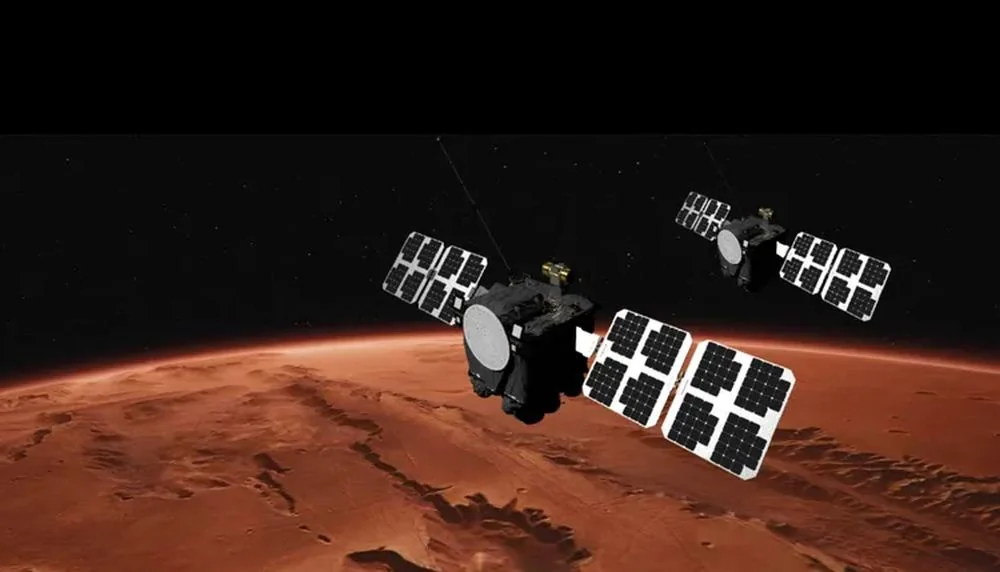
NASA's Escape and Plasma Acceleration and Dynamics Explorers (ESCAPADE)—the twin spacecraft named Red and Blue—are about to execute powered slingshot maneuvers on their way to Mars, and their mission design deserves recognition as a model for planetary science. On November 7th and November 9th, these spacecraft will perform trans-Mars injection burns lasting about 9 minutes each, increasing their speed from approximately 10.14 km/s to 10.78 km/s as they approach Earth between 965 to 1,770 kilometers above the surface. This approach reflects thoughtful mission planning, but more importantly, their formation-flying strategy represents the kind of innovative thinking needed to tackle Mars' most fundamental puzzle: how the red planet lost its ancient atmosphere.
The question driving ESCAPADE is both haunting and essential. Mars was once warm and wet, potentially habitable and even home to simple life. Today it is cold and dead, stripped of the thick atmosphere it once possessed. Scientists postulate that UV radiation from the Sun drove Mars' ancient atmosphere into space after the planet's molten core cooled and its protective magnetic field vanished. While the broad picture is clear, the gritty details remain elusive—details that single spacecraft observations cannot reliably capture. This is where ESCAPADE's dual-spacecraft strategy proves its worth.
NASA's decision to send two spacecraft flying in formation, called the 'String of Pearls,' elegantly solves a fundamental problem in solar wind research. As the report notes, solar wind interactions with magnetic fields change on very short timescales. A lone spacecraft cannot distinguish whether observed changes result from shifting interactions or from its own positional changes. Twin spacecraft flying in the same orbit at varying distances from each other eliminate this uncertainty. During Science Phase A, lasting about 6 months, they will maintain formation. In Science Phase B, extending approximately 5 months until the nominal mission's end, Blue will lower its orbit to about 7,000 km while Red rises to about 10,000 km, allowing independent observations from different vantage points.
The path to Mars also yielded unexpected dividends. Because ESCAPADE launched outside the usual Mars launch window—which occurs every 26 months—the spacecraft loitered near the Earth-Sun Lagrange point 2 before approaching Earth for these slingshot burns. This unconventional trajectory enabled bonus science: the spacecraft became the first to fly through and observe Earth's magnetotail, observations that will soon be shared with the scientific community.
ESCAPADE's mission addresses something profound about our place in the cosmos. There may exist multitudes of planets that were habitable for brief periods, perhaps hosting simple life, before becoming extinct. Mars next door offers a rare opportunity to understand how planetary death occurs. The spacecraft will measure how solar wind interacts with the remnants of Mars' ancient magnetic field—the crustal and remnant magnetic fields still present in patches across the planet. This knowledge matters not only for Mars, but for understanding planetary habitability itself.