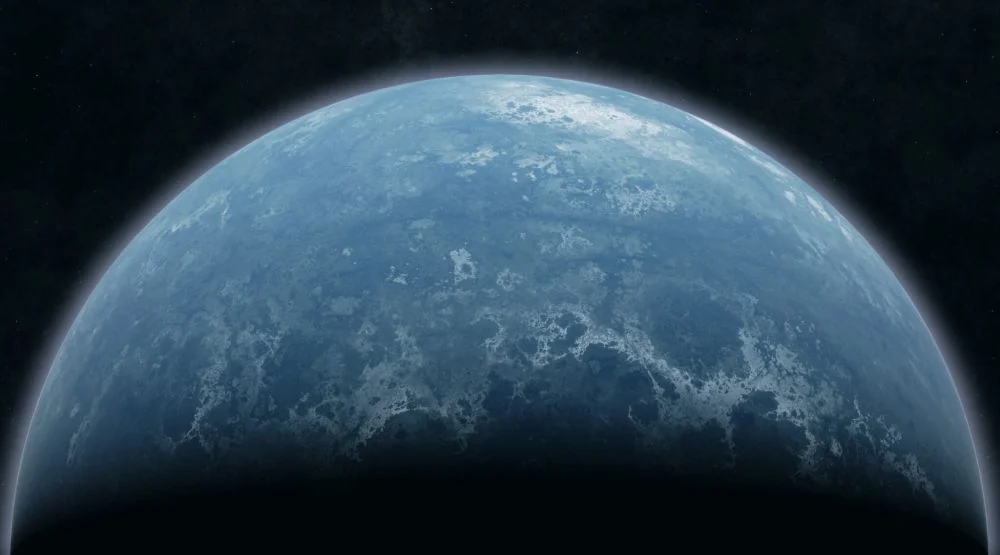
Astronomers struggle to distinguish between habitable exoplanets and those that actually harbor life, since Earth is the only known inhabited world and most rocky planets in habitable zones remain beyond direct study. A new model addresses this challenge.
Samantha Gilbert-Janizek and colleagues at the University of Washington published "A Whole-planet Model of the Earth without Life for Terrestrial Exoplanet Studies" in The Planetary Science Journal. The team built a virtual Earth stripped of all biological processes, modeling planetary evolution from 50 million years to 5 billion years ago. The model reproduces 19 key observations of preindustrial Earth within measurement uncertainties, including atmospheric CO2 and H2O levels, surface temperature, albedo, ocean mass, and mantle heat flow.
The researchers generated reflected-light spectra matching wavelengths the Habitable Worlds Observatory (HWO) will detect, including absorptions from CO2, H2O, O2, O3, and CH4. This virtual lifeless Earth serves as a baseline for comparison. When astronomers observe an exoplanet's atmosphere, Gilbert-Janizek explained, "this tool will help us determine the probability that what we observe indicates life on the surface."
The model can be adjusted for any exoplanet under study by inputting factors like albedo and atmospheric composition. If the model reproduces observed planetary properties, that suggests the world is uninhabited. The work also demonstrates that a planet can maintain habitable conditions for billions of years without life present, a key insight since the HWO must avoid false positives in its search for inhabited worlds.
Senior author Rory Barnes, an associate professor of astronomy at the University of Washington, noted that the model simultaneously reproduces properties of Earth's core, mantle, surface, and atmosphere. Future simulations of exoplanets, he stated, will gain confidence from this calibration.