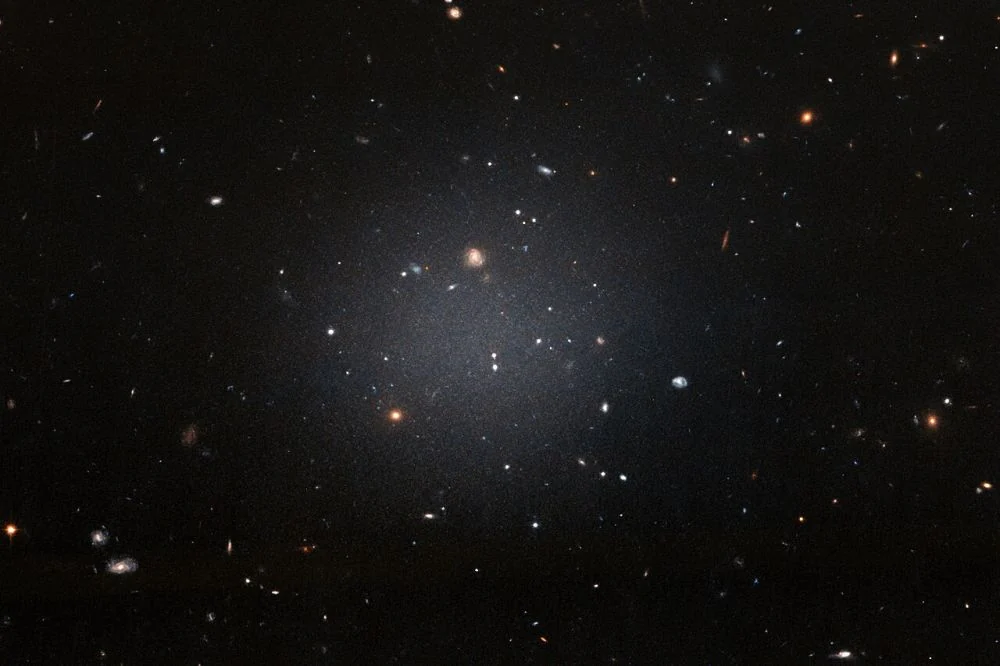
The Extremely Large Telescope will use a proposed instrument called NEXUS@SHARP to study ultra-diffuse galaxies and probe questions about dark matter when the ELT achieves first light in March 2029.
Ultra-diffuse galaxies present a puzzle for the Lambda Cold Dark Matter model of cosmology. These galaxies span sizes comparable to the Milky Way but contain thousands of times fewer stars, spread across larger areas. Their dark matter halos appear too massive for their stellar populations, challenging current galaxy formation theory.
New research published in New Astronomy describes how NEXUS@SHARP, a near-infrared multi-object spectrograph paired with the SHARP spectrograph, can resolve this mystery. Lead author Marco Mirabile, a PhD student at INAF-Astronomical Observatory of Abruzzo and Gran Sasso Science Institute in Italy, and colleagues detail the instrument's capabilities.
The strategy centers on globular clusters orbiting ultra-diffuse galaxies. Globular clusters are brighter than their host galaxies and extend further outward, making them better tracers of dark matter halos. NEXUS@SHARP can observe many globular clusters simultaneously across diverse environments out to 70 megaparsecs with just a few hours of ELT observation time.
By measuring globular cluster velocities and populations, astronomers can calculate dark matter halo masses two independent ways. One measurement derives from how fast globular clusters orbit, revealing the mass needed to hold them. The other comes from globular cluster counts, which scale linearly with halo mass. Comparing these measurements will distinguish between two competing formation scenarios. Ultra-diffuse galaxies may be failed massive galaxies that halted star formation early, or they may be dwarf galaxies that expanded outward through unknown mechanisms. The ELT's 39.3-meter segmented mirror and NEXUS@SHARP's efficiency will enable the large sample sizes needed to test these possibilities.