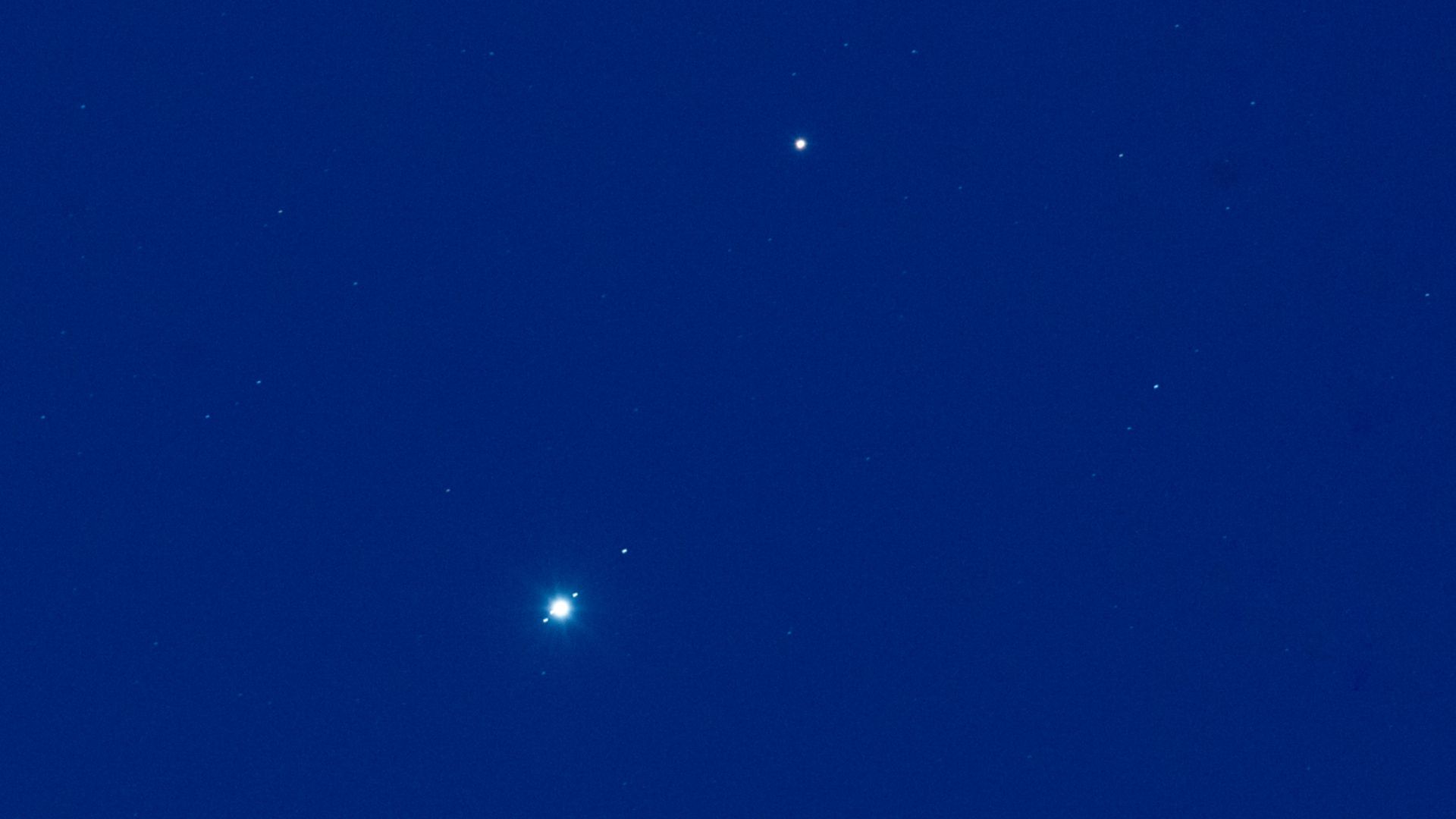
Jupiter and Mars reach their closest apparent separation in Earth's sky at 9:04 p.m. EST on Nov. 15 (0204 GMT on Nov. 16), according to astronomy website In-The-Sky. The planets will be below the horizon for U.S. stargazers at the moment of closest approach, but observers can catch the pair rising above the eastern horizon around midnight local time, just a few hours later.
Jupiter will be the brightest of the pair when it rises a little over 1 degree from Mars, roughly the width of a little finger held at arm's length against the night sky. The bright star Regulus will glow close at hand, forming part of the backward question mark formation of stars that represents the head of Leo.
Mars and Jupiter will be close enough to share the field of view of 10x50 binoculars and will make for a spectacular sight through a telescope eyepiece when viewed separately as they rise away from the horizon. Jupiter's Great Red Spot will rotate into view in the predawn hours of Nov. 16 and will be visible through a backyard telescope with an aperture of just 4 inches. A light green color filter will increase the visibility of the vast storm, while an orange filter will bring out detail in the gas giant's cloud belts.
The two planets will appear to gradually drift apart over the coming weeks and won't appear as close again for another 2.5 years in July 2029, when they appear close together in the constellation Virgo.