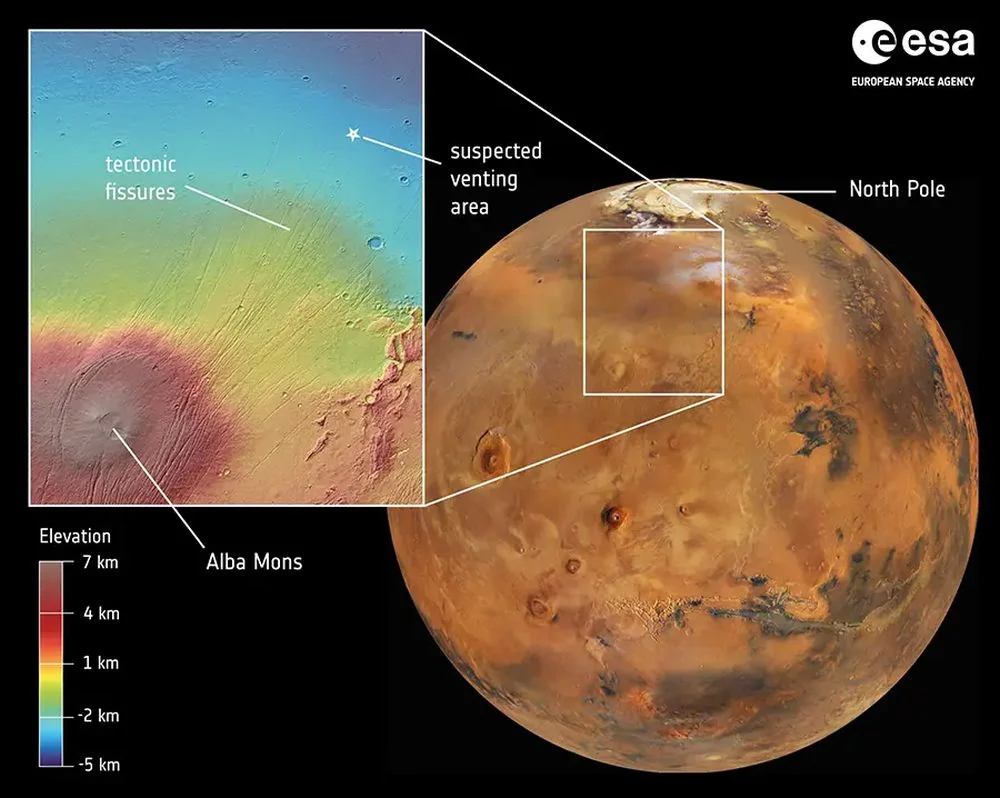
Mars may harbor active magma chambers beneath its surface, according to new research published in Science Advances. The study, led by Alexander Trokhimovskiy of the Space Research Institute at the Russian Academy of Sciences, analyzes unexpected detections of hydrogen chloride (HCl) in Mars' atmosphere.
The ExoMars Trace Gas Orbiter detected HCl at parts-per-billion levels, initially thought to occur only during Mars' perihelion when the planet warms closer to the Sun. New observations from 2025 show HCl detections during aphelion, the planet's coldest season, concentrated over the Alba Mons region. This pattern contradicts seasonal atmospheric explanations.
Researchers identified narrow fissures less than one meter wide near Alba Mons that could serve as pathways for gases seeping from magma bodies at depth. "Detections of HCl at low altitudes, unexplained by observed atmospheric state and models, together with the geological context of the region, hint at an igneous origin of this gas," the authors write.
The team calculated seepage rates needed to produce the observed HCl abundance. Their models rule out atmospheric and aerosol interactions as the source for aphelion detections. The researchers conclude that "ongoing igneous processes in the Martian interior" best explain their findings.
Mars lost its magnetic field billions of years ago as its interior cooled, and the planet is generally considered volcanically dormant. The NASA InSight lander detected over 1,300 Marsquakes, though many were attributed to meteorite impacts. This HCl evidence adds to accumulating observations suggesting some geologic activity persists.