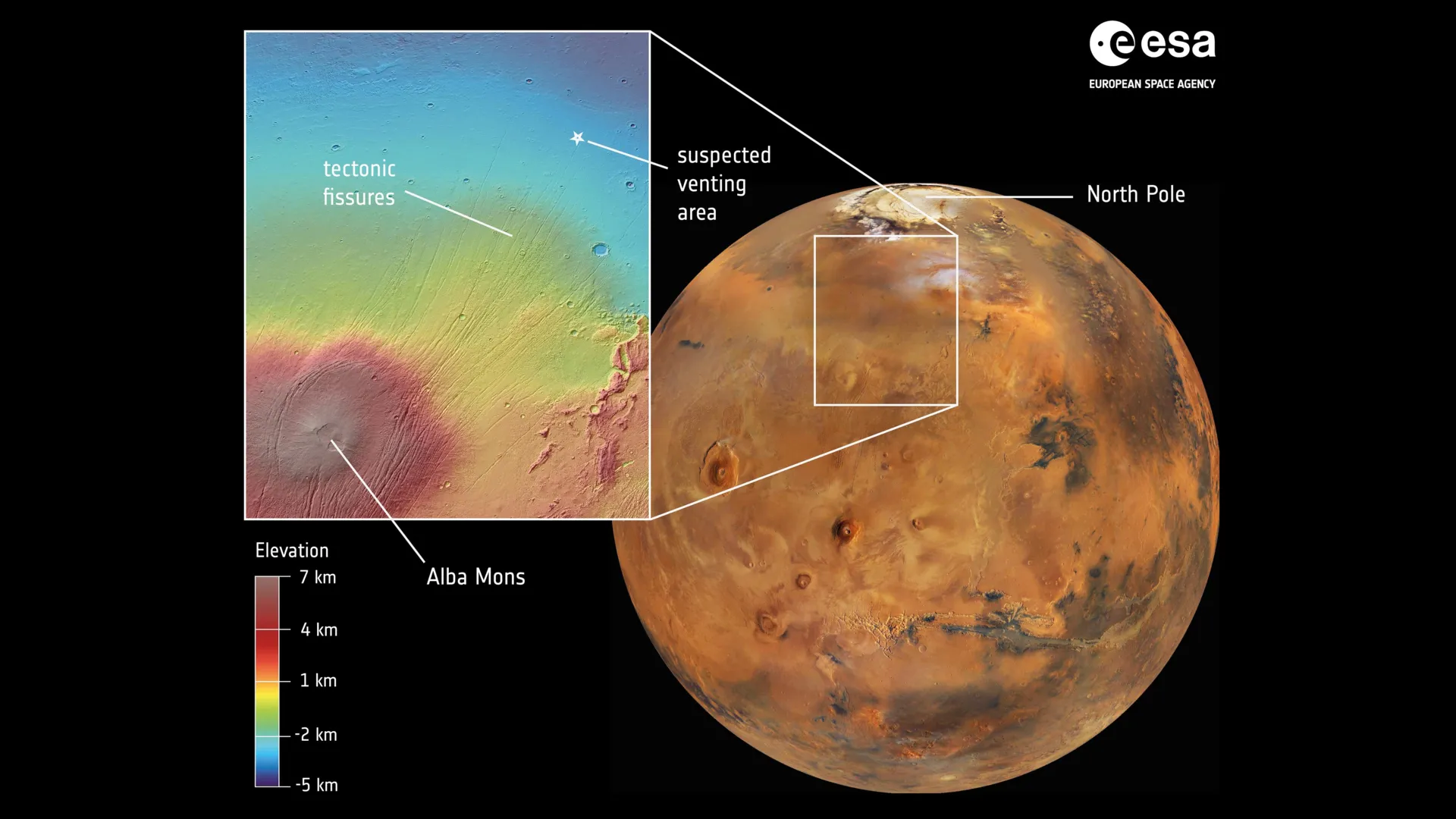
The European Space Agency's ExoMars Trace Gas Orbiter has detected hydrogen chloride gas concentrated above fractures in Alba Mons, a volcanic region on Mars. The gas appears during early summer in the northern hemisphere, defying the seasonal pattern that normally makes hydrogen chloride scarce at that time of year.
An international team led by Alexander Trokhimovskiy proposes that the gas escapes from a dormant magma chamber beneath Alba Mons through cracks in the surface. The team used the orbiter's Atmospheric Chemistry Suite infrared spectrometers to detect the gas and its CaSSIS camera to image relatively fresh fractures in the region. Some fractures extend hundreds of meters. Unusual color changes appear around the cracks.
On Earth, hydrogen chloride releases through openings connected to magma called fumaroles. The researchers suggest that Martian winters, when temperatures drop to minus 120 degrees Celsius, allow ice to seal the fractures. As temperatures rise in early summer, the ice sublimates directly to vapor, potentially opening pathways for underground gases to escape.
The team examined chemical reactions that could produce hydrogen chloride in the Martian atmosphere unrelated to volcanism. After ruling out other explanations, they concluded the evidence points toward volcanic processes still occurring beneath the surface.
"Our findings suggest that Mars has retained enough internal heat to support volcanic activity until recently, and possibly still does," says Daniel Mège, professor at the Space Research Centre of the Polish Academy of Sciences and co-lead author of the study published in Science Advances.
The discovery could inform searches for life on Mars. If volcanic heat warms groundwater underground, hydrothermal systems could provide chemical energy and protection from surface conditions. Daniel Mège states that searching for life in Alba Mons seeping fissures would make sense if such systems remain active.