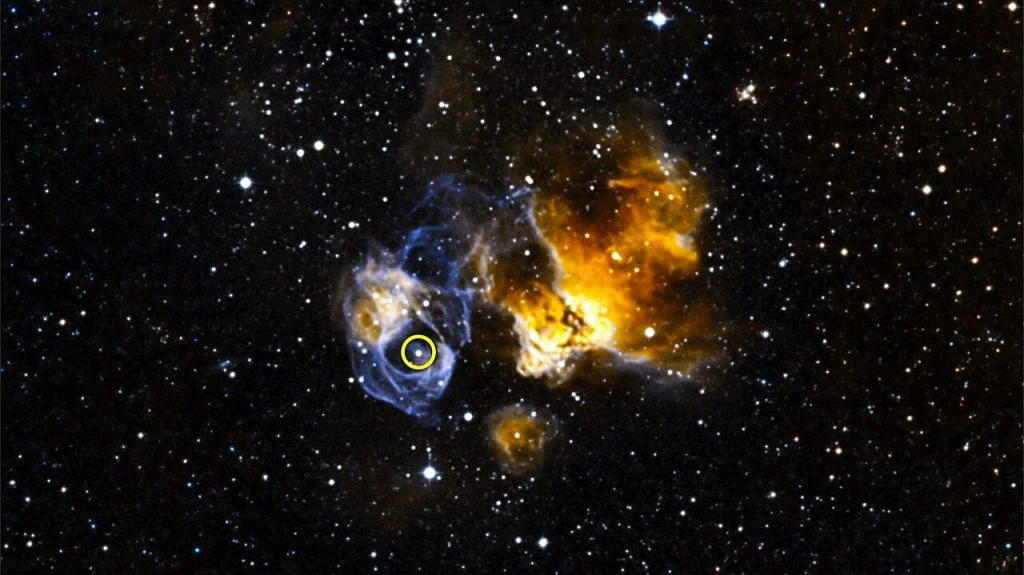
The Atacama Large Millimeter/Submillimeter Array detected a molecular jet extending 26 light-years from LMC P3, a gamma-ray emitting microquasar in the Large Magellanic Cloud. Researchers from Nagoya University and Gifu University found the jet contains cold molecular gas heated to 35 to 60 Kelvin, warmer than the surrounding 15 Kelvin environment. This temperature difference indicates the gas interacts with a high-energy particle jet from a compact object at the system's center.
LMC P3 consists of a giant O-type star and a compact object within a supernova remnant. Astronomers have debated whether the compact object is a neutron star powered by pulsar winds or a stellar-mass black hole in a microquasar system. "We discovered a gigantic molecular jet," said astronomer Yasuo Fukui of Nagoya University. The team's findings support the microquasar model. "It provides very strong support for the possibility that its central object is a black hole," Fukui said.
Black holes generate more powerful jets than neutron stars. LMC P3's particularly high gamma-ray emissions align with predictions for a black hole-powered microquasar. The research paper states the team interprets the high temperatures as shock heating from a microquasar jet, with the molecular jet forming from interaction between the microquasar jet and ambient interstellar medium clouds. The FERMI telescope previously observed a 10.3-day period in the object's gamma-ray emissions. LMC P3 was discovered in 2016 and ranks as the first such gamma-ray object found beyond the Milky Way.