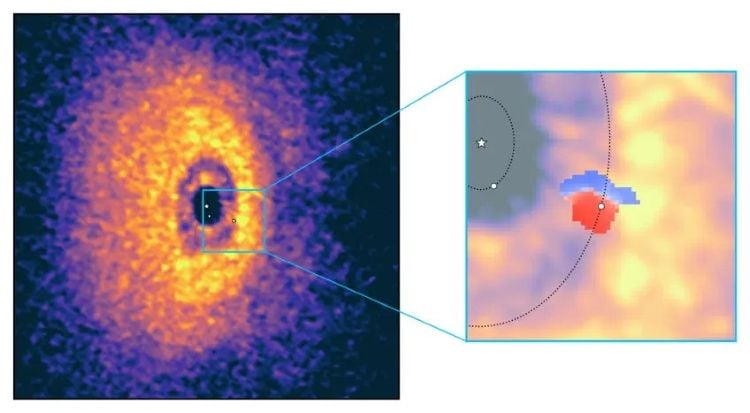
Astronomers using the Atacama Large Millimeter/submillimeter Array (ALMA) in Chile have captured the first direct image of a protoplanet actively accreting gas from its surrounding disk. The protoplanet, WISPIT-2b, appears alongside a younger planetary companion WISPIT-2c in observations that reveal gas flowing directly onto a forming world.
The image shows velocity signatures encoded in color: blue indicates gas moving toward Earth, red indicates gas receding away. This direct detection of material streaming onto WISPIT-2b marks the first time astronomers have visually confirmed this critical stage of planetary assembly. The discovery transforms theoretical models into observable reality, revealing exactly how young planets grow by pulling in surrounding material.
Planet formation unfolds across millions of years through discrete phases. A protoplanetary disk of gas and dust orbits a young star. Rocky particles collide and merge, gradually building planetary cores. Once a core reaches sufficient mass, it begins gravitationally capturing gas from the disk, swelling into a giant planet. This transition from rocky core to gas-rich world represents a threshold moment in planetary evolution. Catching a world mid-transition has proven exceptionally difficult.
WISPIT-2b and WISPIT-2c orbit a young star roughly 4 million years old. The system resides approximately 500 light-years away in the constellation Monoceros. ALMA's millimeter-wavelength sensitivity enabled the team, led by researchers at the Max Planck Institute for Astronomy (MPIA), to detect the faint emissions from accreting gas. The velocity data proved decisive. Rather than seeing only a static protoplanet, the observations revealed kinematic evidence of material actively falling inward.
This discovery addresses longstanding questions about how quickly planets grow and which mechanisms dominate their assembly. Competing formation pathways predict different gas accretion rates and timescales. Direct observations settle these debates. WISPIT-2b demonstrates that gas accretion happens rapidly enough to shape planetary atmospheres and compositions early in a system's history.
The implications extend beyond basic science. Planets formed under different accretion conditions develop distinct atmospheric compositions and initial temperatures, factors that determine habitability billions of years later. By studying how WISPIT-2b captures its surrounding gas, astronomers gain insight into what conditions produce potentially habitable worlds. The chemical composition of accreting material influences whether a planet emerges as a small, rocky world or a massive gas giant.
ALMA's unprecedented resolution at millimeter wavelengths enabled this breakthrough. No other observatory currently operating achieves the sensitivity required to detect such faint velocity signatures. The facility operates across 66 individual antennas spread across the Atacama Desert at 5,000 meters elevation, combining their signals to create effectively the world's largest telescope.
Future observations using ALMA and next-generation instruments will likely reveal additional forming planets actively accreting gas. The James Webb Space Telescope, sensitive to infrared emissions from warm accreting material, should complement ALMA data. Each detection refines models of planetary assembly across diverse stellar systems.
The WISPIT system demonstrates that forming planets remain directly observable during their most active growth phase. Astronomers can now study the mechanisms that build worlds rather than inferring them from statistical models. This transition from theory to direct observation represents a genuine advance in understanding how planetary systems, including those potentially harboring life, originate.