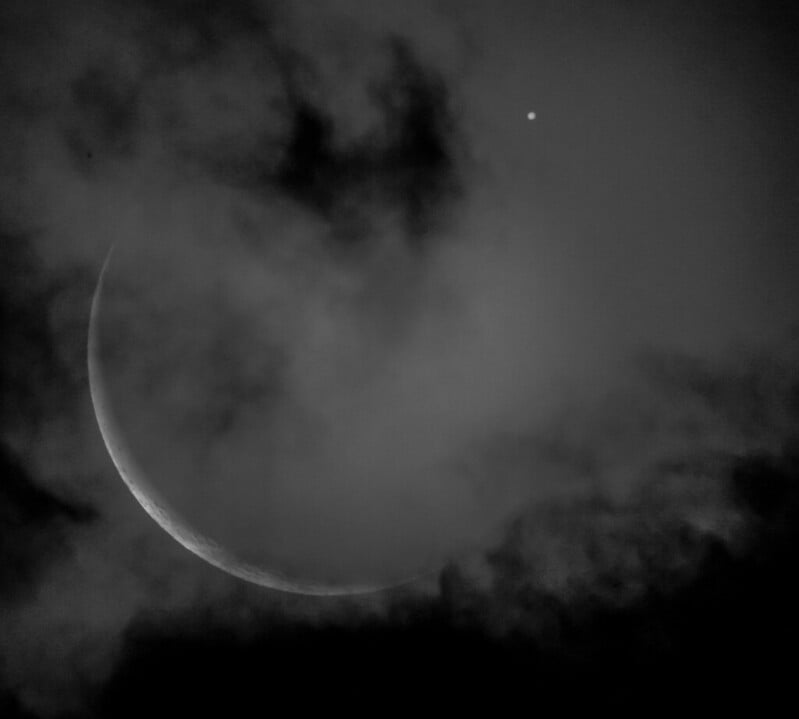
# Jupiter Disappears Behind the Moon in October's Best Skywatching Event
October brings two planetary showstoppers that reward patient observers with binoculars or telescopes. The Moon will occult Jupiter on October 6th, blocking the giant planet from view across North America in one of 2026's premier skywatching events. Days earlier, Saturn reaches opposition, placing the ringed planet directly opposite the Sun in Earth's sky and making it visible all night long.
A lunar occultation occurs when the Moon passes in front of a distant object, briefly erasing it from view. These events happen regularly for stars and occasionally for bright planets, but they remain rare enough to merit special attention. Jupiter occultations specifically take place only when the Moon's orbital path intersects with the gas giant's position. For October 6th, the geometry aligns perfectly for North American observers, making this event one of the year's finest planetary viewing opportunities.
The mechanics are straightforward but dramatic. As the Moon moves eastward against the background stars at roughly its own diameter per hour, its edge will gradually encroach on Jupiter's disk. The planet will vanish behind the Moon's darkened limb, reappear on the opposite side minutes later. Exact timing and visibility depend on the observer's latitude and longitude. Sky watchers in different regions will see the event at slightly different times. Specialized prediction tables exist for calculating these moments for specific locations.
Jupiter reaches magnitude minus 2.5 during October, making it bright enough to spot in daylight with optical aid. Binoculars will show the planet as a distinct disk when it approaches the Moon. Small telescopes reveal Jupiter's four Galilean moons, cloud bands, and the Great Red Spot. During occultation, these details vanish instantaneously as the Moon's airless edge cuts off the light with razor precision. The reappearance proves equally dramatic. Jupiter simply reappears along the Moon's sunlit edge without gradual fading.
Saturn's opposition occurs on October 1st, placing the ringed planet at its closest approach to Earth and highest in the sky. Opposition means Earth sits directly between the Sun and Saturn. During this configuration, sunlight reflects directly back toward us with minimal shadowing. Saturn shines at magnitude 0.5, bright enough to locate without optical aid. Even binoculars reveal the iconic rings as a thin line extending on either side of the planet's disk. Any telescope magnifying 30 times or more shows the rings in their full glory, separated from the planet's equator and displaying subtle color variations across their composition.
Saturn remains visible throughout October nights. It rises at sunset, transits the meridian near midnight, and sets at dawn. The ringed planet presents an ideal target for backyard astronomers during the entire month, with opposition marking the night of optimal viewing conditions.
These two events underscore October's position as peak skywatching season in the Northern Hemisphere. Clear autumn skies, steady air, and the absence of summer heat turbulence combine to produce excellent atmospheric conditions. Observers should plan ahead, check local weather forecasts, and locate viewing sites away from light pollution. The Moon's occultation of Jupiter requires precise timing and position calculations. Websites like Stellarium and SkySafari provide interactive planetarium software showing exact event times for any location on Earth.