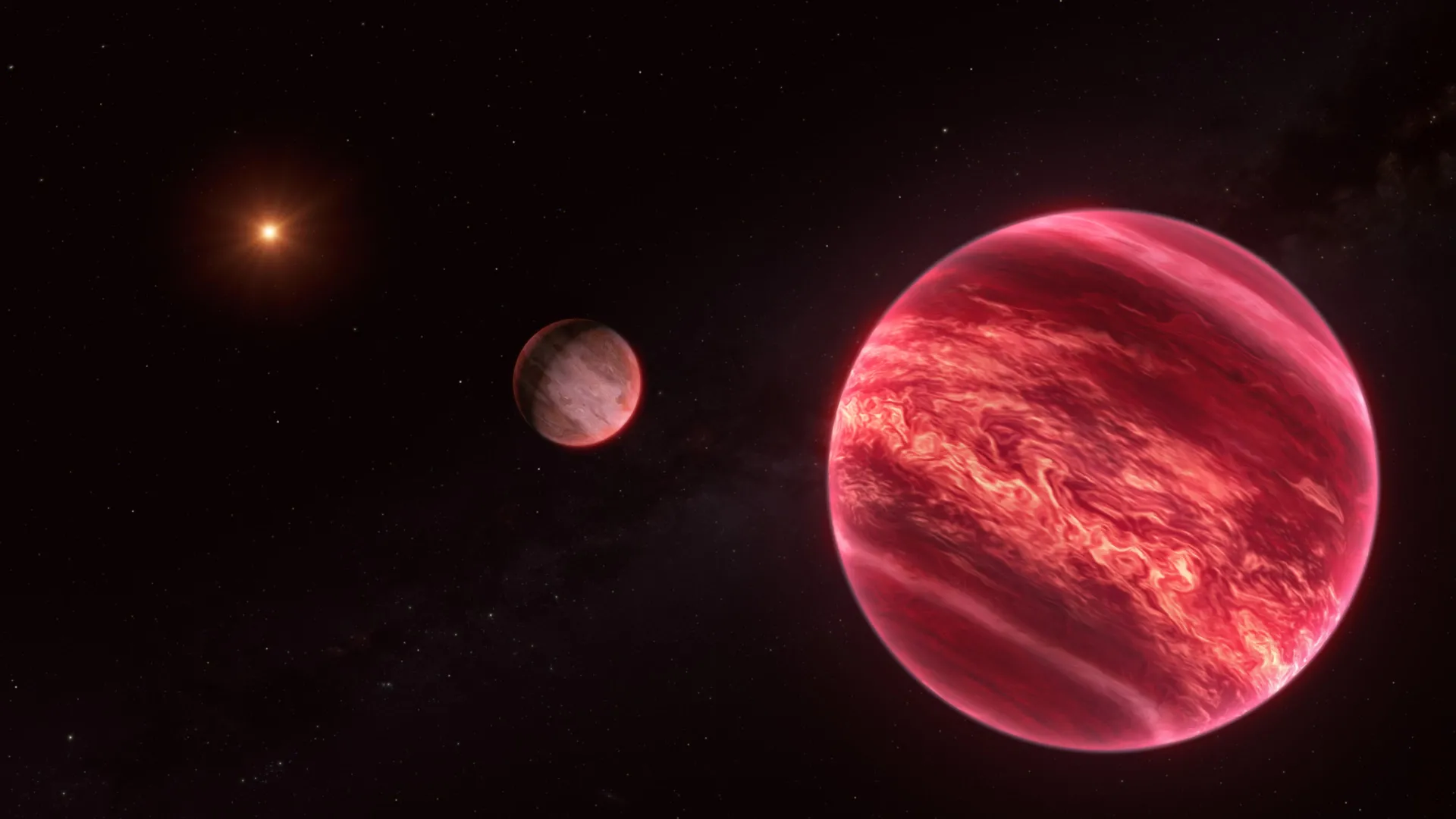
Astronomers using the European Southern Observatory's Very Large Telescope have detected evidence of a massive moon-like body orbiting a brown dwarf in the CD-35 2722 star system. If confirmed, this would mark the first detection of a moon beyond our Solar System.
The object orbits a brown dwarf, which itself circles a star with approximately half the Sun's mass. The suspected exosatellite has at least as much mass as Jupiter, while the brown dwarf it orbits is more than 30 times as massive as Jupiter. This makes the possible moon far more massive than any natural satellite in our Solar System.
Kevin Hoy, an ESO student in Chile and lead author of the study published in Nature, used the CRIRES+ instrument on the Very Large Telescope to measure subtle changes in the brown dwarf's motion using the radial velocity method. The technique detects gravitational wobbles caused by orbiting companions. "This system is somewhat hard to define using Solar-System-based words like 'planet' and 'moon'," Hoy states.
The arrangement challenges traditional definitions. The possible moon is massive enough to be classified as a planet under some schemes, yet it orbits a brown dwarf rather than a star. Astronomers have not established a universally accepted definition of an exomoon. Alice Zurlo, director of the Millennium Nucleus of Young Exoplanets and their Moons in Chile and a collaborator on the study, explains: "The satellite we report is a giant gaseous body orbiting a highly massive companion, itself several times the mass of Jupiter."
Although more than 6,000 exoplanets have been identified, no confirmed exomoon has yet been detected. Earlier in 2026, researchers reported possible signs of a satellite in the HD 206893 star system, but evidence remained limited.
ESO's upcoming Extremely Large Telescope, with its 39-meter mirror, will enable astronomers to detect smaller exomoons currently beyond the reach of existing observatories.