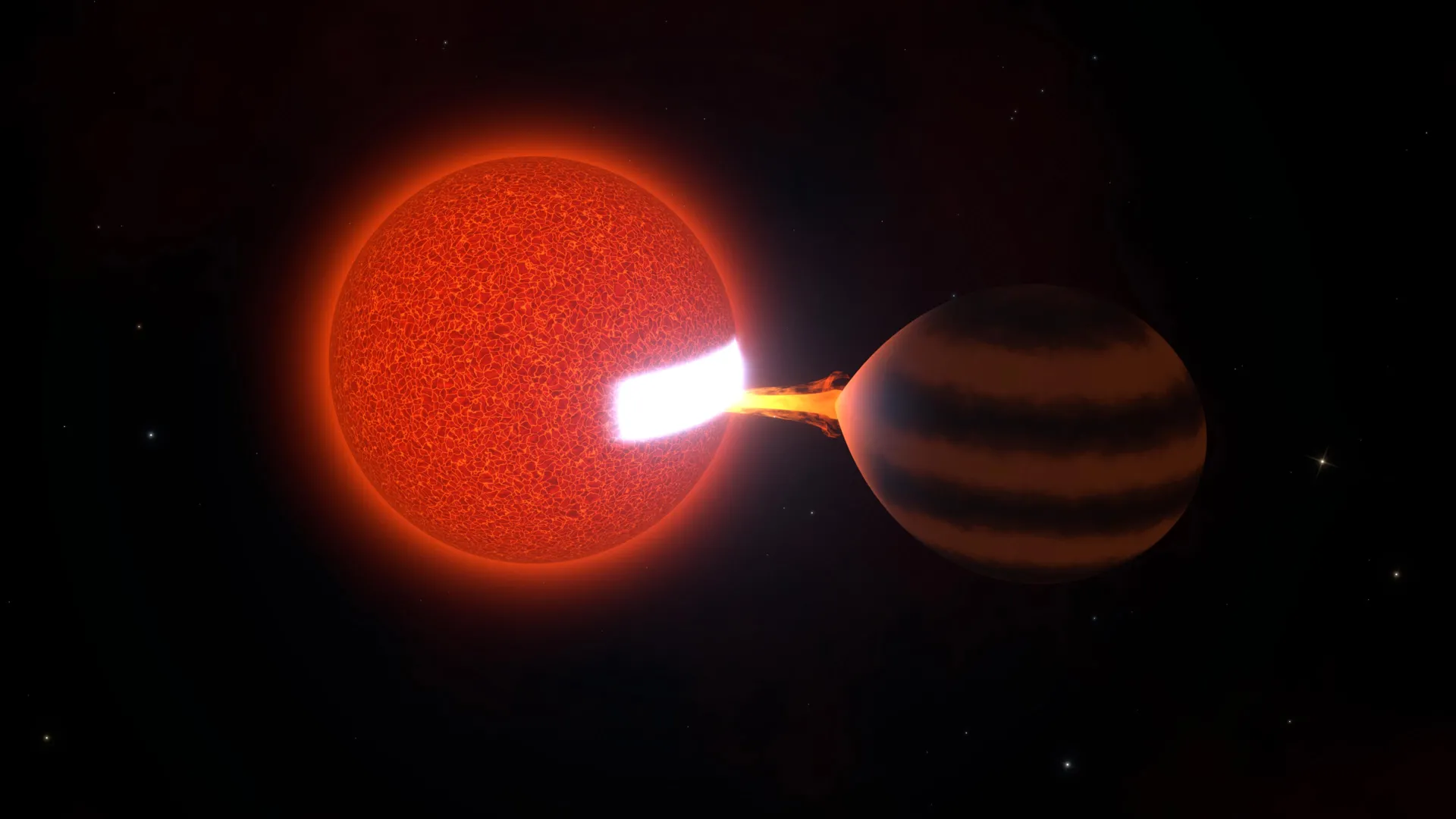
MIT astronomers discovered a star system 300 light-years from Earth where a small star is gradually consuming a brown dwarf over what could last hundreds of thousands of years, potentially billions. The system, designated ZTF J0440+2325, represents the first observed example of a low-mass star steadily drawing material from another low-mass object.
The discovery began when Kevin Burdge, an assistant professor of physics at MIT, noticed an unusual triangular pattern in brightness data collected by the Zwicky Transient Facility, a survey telescope at Palomar Observatory in California. The signal did not match typical characteristics of black widow binaries, systems where neutron stars strip material from companions.
Burdge and Aaron Householder, a graduate student at MIT, traced the source and directed multiple telescopes toward it. Measurements revealed two compact objects orbiting at extremely close range. The central star has approximately 85 times the mass of Jupiter. The brown dwarf weighs about 25 Jupiter masses and completes one full orbit around its host star every 87 minutes, within a distance that would fit inside the Sun's diameter.
The tight orbital configuration suggested the star actively pulls material from the brown dwarf through a process astronomers call accretion. Unlike accretion around black holes or neutron stars, where material forms a disk, the incoming material strikes the star's surface directly at high speeds.
"The difference here is, the thing absorbing matter is not a tiny black hole but a star, which is relatively big in size," Burdge said. "So matter just pummels directly onto the surface, at very high speeds, like an asteroid hitting the Moon."
Computer simulations by the research team, which included Aaron Householder, Kaitlyn Shin, Saul Rappaport, Joheen Chakraborty, and Emma Chickles at MIT, modeled how particles from the brown dwarf would move under gravitational influence from both objects. The study was published October 5 in Nature Astronomy.