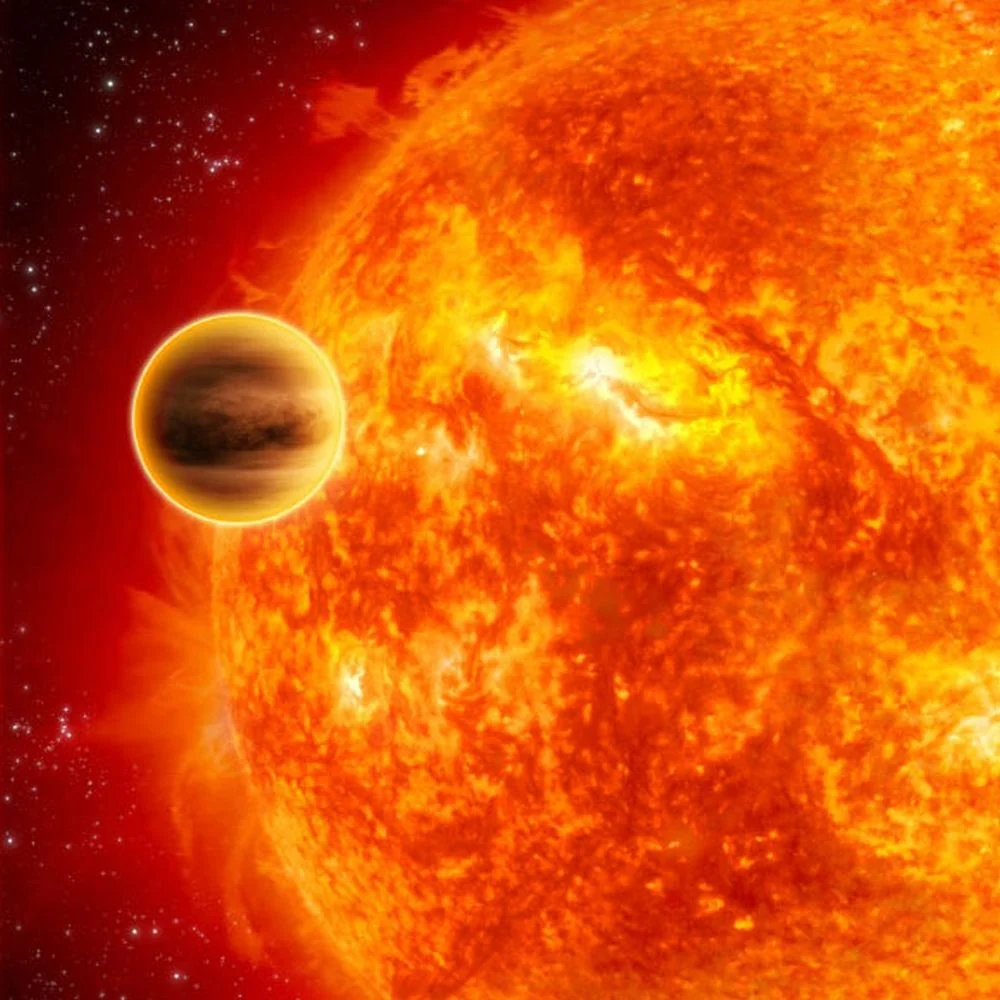
NASA's TESS mission observed a hot Jupiter named TOI-2535b located about 1,000 light years away. The planet's transits across its star were visible for seven years, then disappeared. Astronomers have now determined the planet did not vanish but instead wobbled out of view due to gravitational interactions with a neighboring exoplanet.
Detecting exoplanets requires precise alignment between the planet's orbit and Earth's line of sight. Small shifts in orbital inclination can change transit geometry enough to render a planet undetectable. Research published in The Astrophysical Journal Letters, led by Samuel Yee at UCLA, explains that TOI-2535b's orbit is tilting so rapidly that its transit disappeared during TESS observations.
The cause appears to be a neighboring giant planet of Saturn-mass or greater. This companion pulls on TOI-2535b's orbit, forcing it to precess. The system exhibits the largest Transit Duration Variations and inclination changes ever observed for a planet orbiting a single star, with a precession period measured in decades. The system also shows some of the largest Transit Timing Variations ever detected for a hot Jupiter.
The discovery is unusual because hot Jupiters rarely have close planetary companions, and when they do, those companions are typically much smaller sub-Neptunes or super-Earths. The TOI-2535 system contains two massive gas giants in close proximity. This configuration contradicts standard planet-formation models that invoke high-eccentricity migration to explain hot Jupiters. The researchers propose alternative migration scenarios but acknowledge they lack sufficient understanding of the system's full architecture to confirm any single formation pathway.