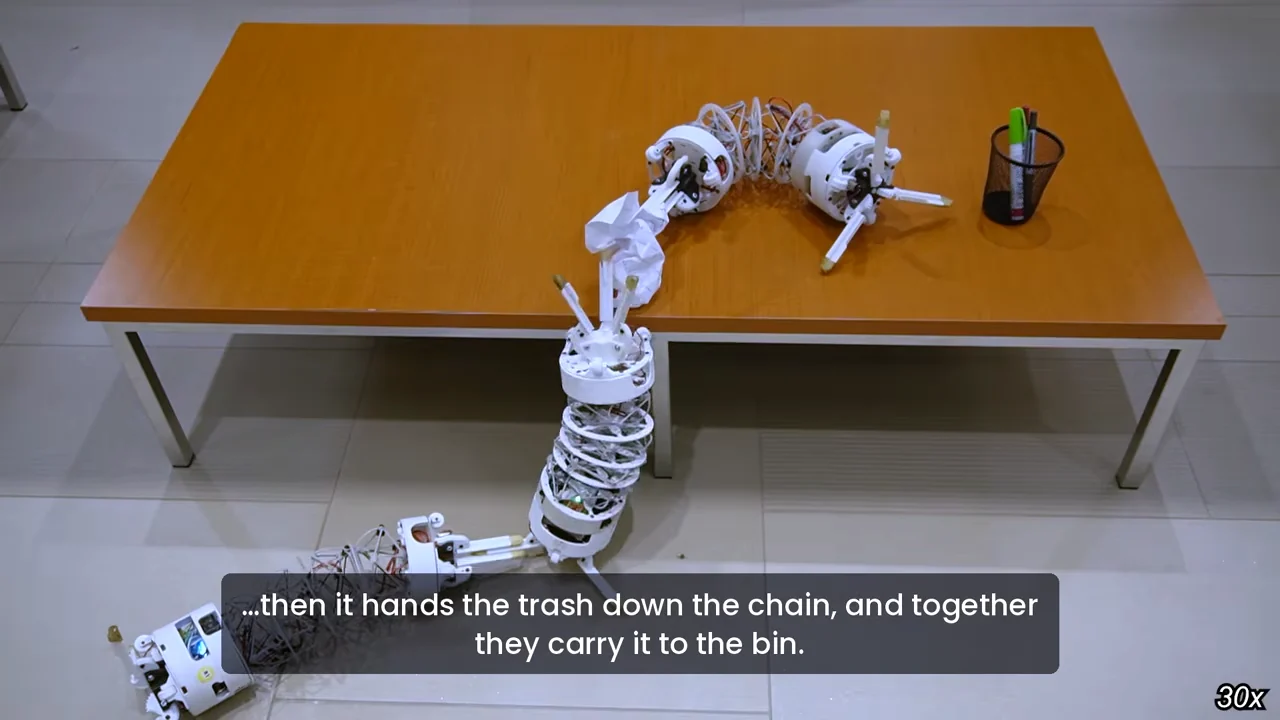
Researchers at Colorado State University's Adaptive Robotics Lab have developed a shape-shifting robot called the Tensegrity-based Continuum Robot, or TeCoBot, that uses design principles borrowed from architecture to navigate rough terrain on other worlds.
TeCoBot measures approximately 2 feet long and weighs around 600 grams. Its body consists of four stacked icosahedral tensegrity modules, a structure that uses rigid rods suspended within a flexible lattice and held in place by tension cables. Three cables made of 40-pound braided fishing wire run through the robot's center. Small motors pull these cables to bend the robot in any direction, like an elephant's trunk, or compress it to half its original length.
The robot can inch along like a caterpillar, roll sideways, and climb vertically. It exhibits what roboticists call embodied intelligence, meaning its body naturally absorbs impacts without requiring active control adjustments.
The design's modularity proves most novel. The robot features swappable claws at either end. Engineers can attach soft-padded claws for delicate handling or heavy-duty grippers that use a worm gear to clamp onto another gripper without drawing battery power. Multiple TeCoBots can connect via their claws to self-configure into different shapes. The paper describes three robots wrapping around a pipe and forming an H-shaped walker to traverse tight spaces.
The research appears in a paper in Nature Machine Intelligence. The underlying adaptability would suit exploration of lunar craters or Martian caverns, though engineers currently control the robots manually via WiFi. The team plans upgrades including faster motors and swarm intelligence to coordinate multiple robots working together.