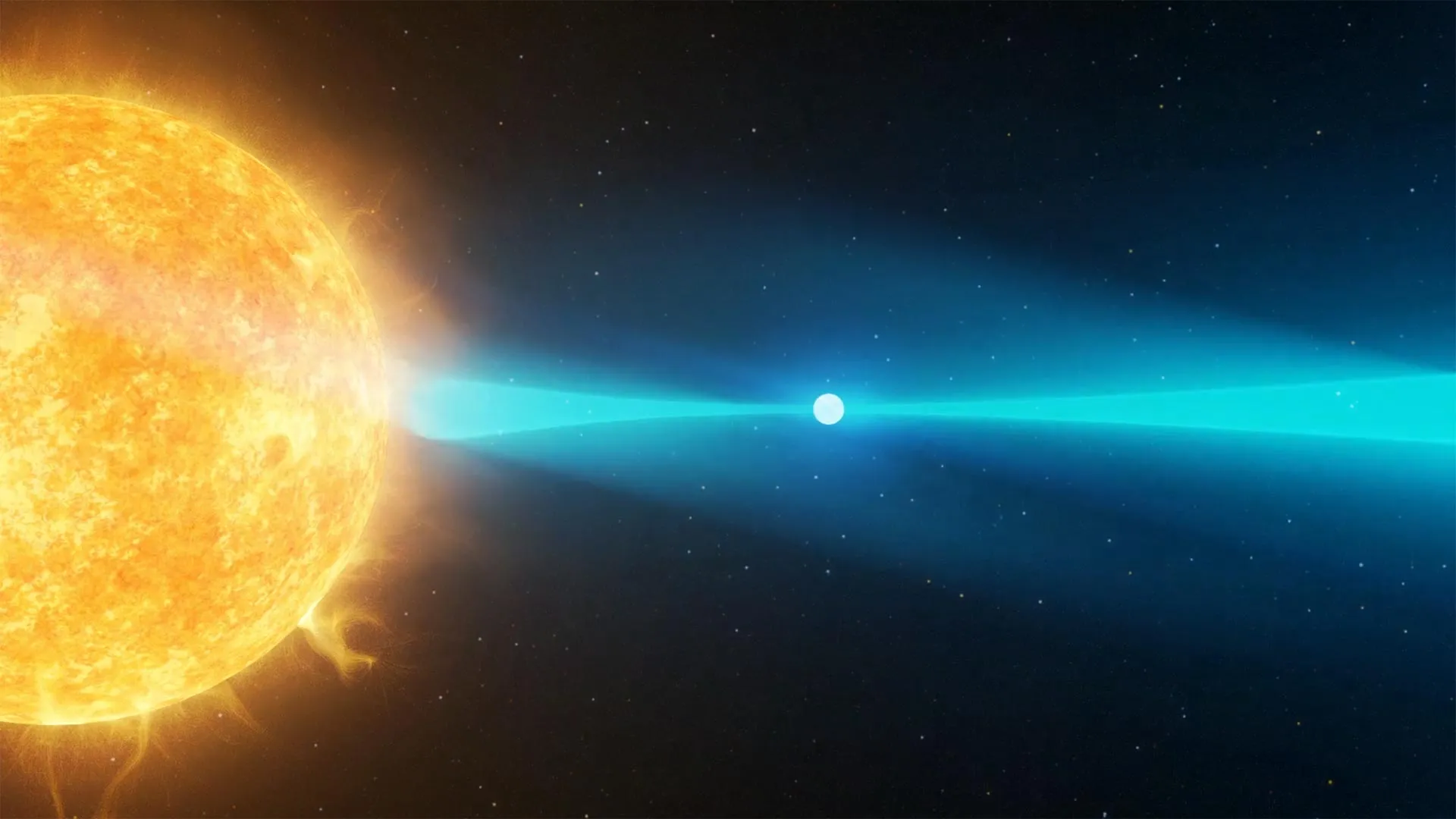
Astronomers at the International Centre for Radio Astronomy Research traced mysterious radio signals to a stellar system 5,000 light-years away. The system, designated GPM J071507−114153, contains a white dwarf rotating every eight minutes and a Sun-like G-type star orbiting together.
This marks the first detection of radio pulses from a white dwarf paired with a Sun-like companion. Previous observations found similar signals only in systems where white dwarfs orbit smaller red dwarfs. The discovery belongs to a rare class of objects called long-period transients, which produce radio emissions that appear and disappear over minutes to hours. Only about a dozen have been identified since the first known example in 2021.
Radio observations detailed enough to track the white dwarf's orbital motion revealed the pulses originate near or from the white dwarf itself. "This is the first time the pulses are clear enough to see the white dwarf moving in its orbit around its companion, so we know that the pulsations are coming from a region close to the white dwarf, or possibly even from the white dwarf itself," said lead author Dr. Sam McSweeney of the Square Kilometre Array Observatory.
The observations also exposed magnetic activity on the companion star, including stellar flares and a stellar prominence, a large loop of plasma held by magnetic fields. The white dwarf passed behind this magnetically active region, allowing astronomers to detect these features across thousands of light-years.
Researchers used the Murchison Widefield Array in Western Australia to initially detect the system, then the MeerKAT radio telescope in South Africa to pinpoint its location. The W.M. Keck Observatory in Hawaii confirmed the presence of a G-type star through optical observations. Over 100 hours of radio observations were analyzed using computing resources at the Pawsey Supercomputing Research Centre.
The findings were published in Nature Astronomy. Both the MWA and MeerKAT are precursors to the Square Kilometre Array telescopes being developed in Australia and South Africa, which will offer greater sensitivity for discovering similar rare systems.