The European Space Agency's Euclid space telescope has discovered 31 ancient quasars, including two that break records as the earliest ever observed. The two record-holding quasars, EUCL J172902.75+641018.1 with a redshift of 7.77 and EUCL J125308.55+705432.3 with a redshift of 7.69, existed when the Universe was only 670 million years old, about 5 percent of its current age. Both objects sit just over 13 billion light-years from Earth.
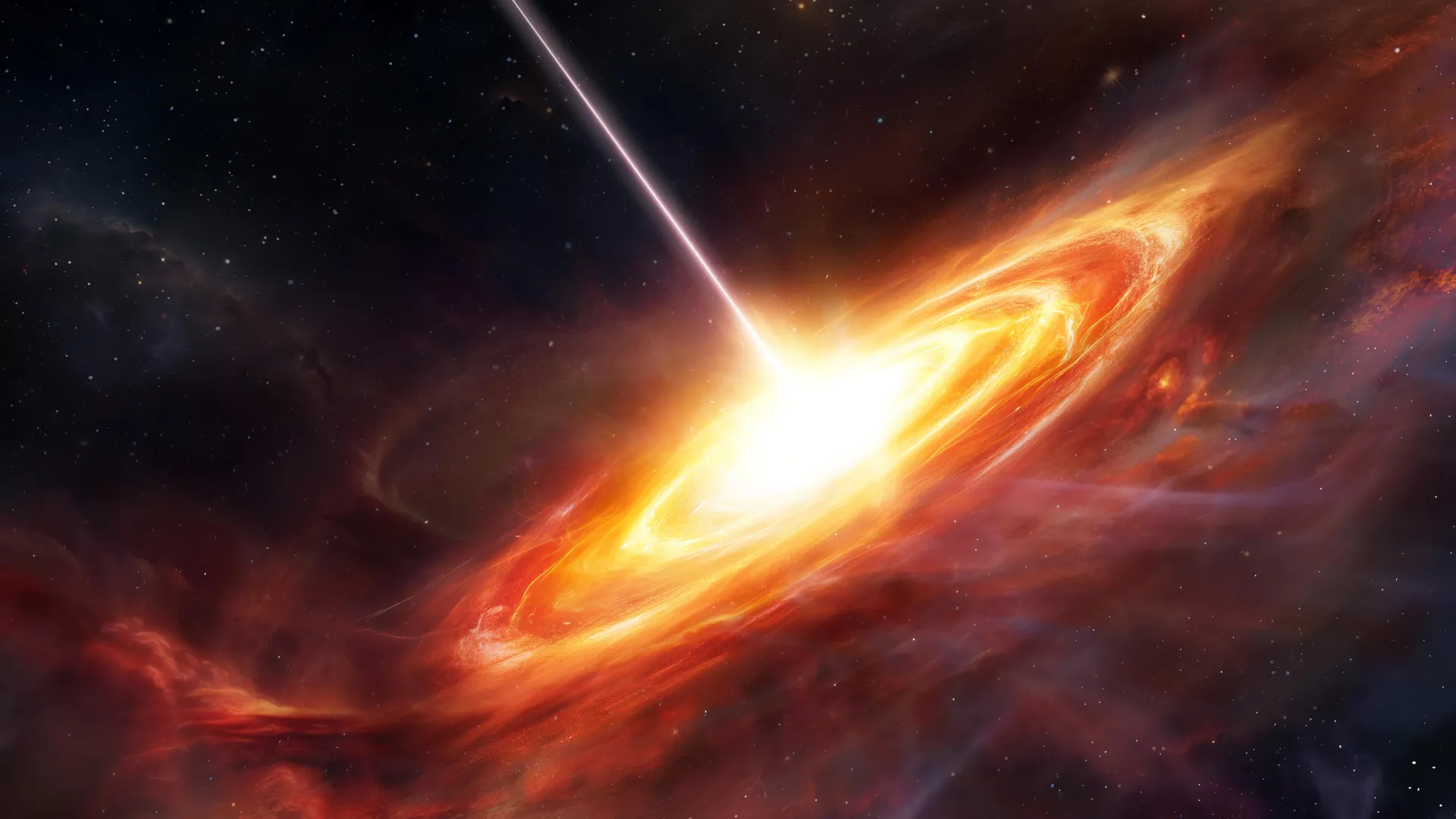
Quasars are galactic cores powered by supermassive black holes. As material spirals toward the black hole, the process releases energy that causes the galaxy's center to shine hundreds or thousands of times brighter than the rest of the galaxy. These objects radiate as much light as a trillion Suns.
The previous record for earliest known quasars belonged to an object discovered in 2021 with a redshift of 7.64. Euclid's finding more than doubles the number of quasars known to be this ancient. Among the 31 newly identified objects, 12 have a redshift of 7 or greater, placing them within the Universe's first 770 million years.
Euclid launched in 2023 and surveys enormous sky regions while detecting faint infrared light from distant objects. Astronomers needed more than a decade to identify roughly the first 10 quasars with redshifts of 7 or higher. Euclid surpassed that count in just one year.
Daming Yang of Leiden University, lead author of the discovery paper, states that these objects "can better understand how these enormous systems formed and grew so quickly - one of the greatest mysteries in astrophysics." The quasars exist during the epoch of reionization, a period when radiation from energetic sources ionized cold gas and shaped conditions in the early Universe.
All 31 quasars were identified through the Euclid Wide Survey, which will eventually examine more than one-third of the entire sky.