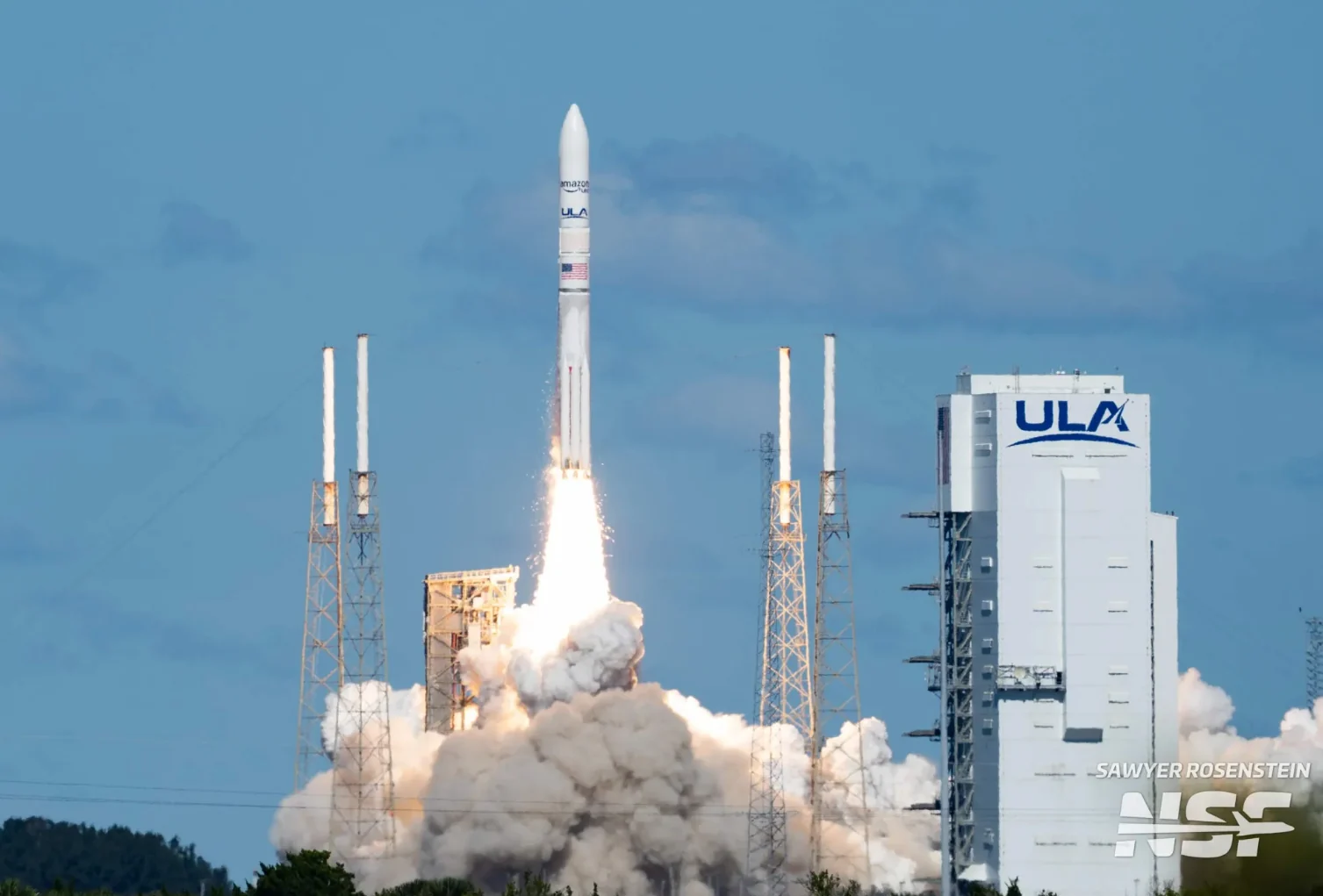
United Launch Alliance's Vulcan returned to flight on Nov. 15 after a four-month grounding caused by recurring nozzle issues with its GEM-63XL solid rocket boosters. The VC6L configuration, the most powerful variant with six boosters and a low-Earth orbit-optimized Centaur V upper stage, launched from Space Launch Complex 41 at 12:40 PM EST carrying 40 Amazon Leo satellites. An anomaly occurred 10 minutes into flight during the Centaur V's first burn, preventing the satellites from reaching orbit.
The flight marked the first operational use of the low-Earth orbit-optimized Centaur V. The 65-meter-tall rocket generated 17.2 MN of thrust using six GEM-63XL solid boosters and two Blue Origin BE-4 engines burning liquid oxygen and methane. It carried the most satellites on any Amazon Leo mission to date and was the first of up to 38 Vulcan launches booked by Amazon for its broadband constellation.
The LV-01 mission had been delayed twice due to a commodity flow issue and a communications problem. At the first launch attempt, a pressure-reducing valve anomaly held the countdown at T-20 seconds before resolution allowed launch within the 29-minute window.
Northrop Grumman had successfully tested a modified GEM-63XL with enhanced nozzle design and manufacturing fixes in April following the February USSF-87 mission nozzle event. The investigation identified three credible causes of the nozzle liberation issue. LV-01 appeared to have no nozzle liberation events during launch.
Amazon Leo currently has 368 satellites in operational orbit after six reentered Earth's atmosphere. The constellation requires 578 satellites at 630 km altitude to begin initial regional service. Amazon obtained an FCC extension in June allowing constellation completion by July 30, 2029, with a possible limitation on operational satellites if not met by that date. LV-01 was processed in Amazon's new Vertical Integration Facility dedicated to Amazon Leo missions.