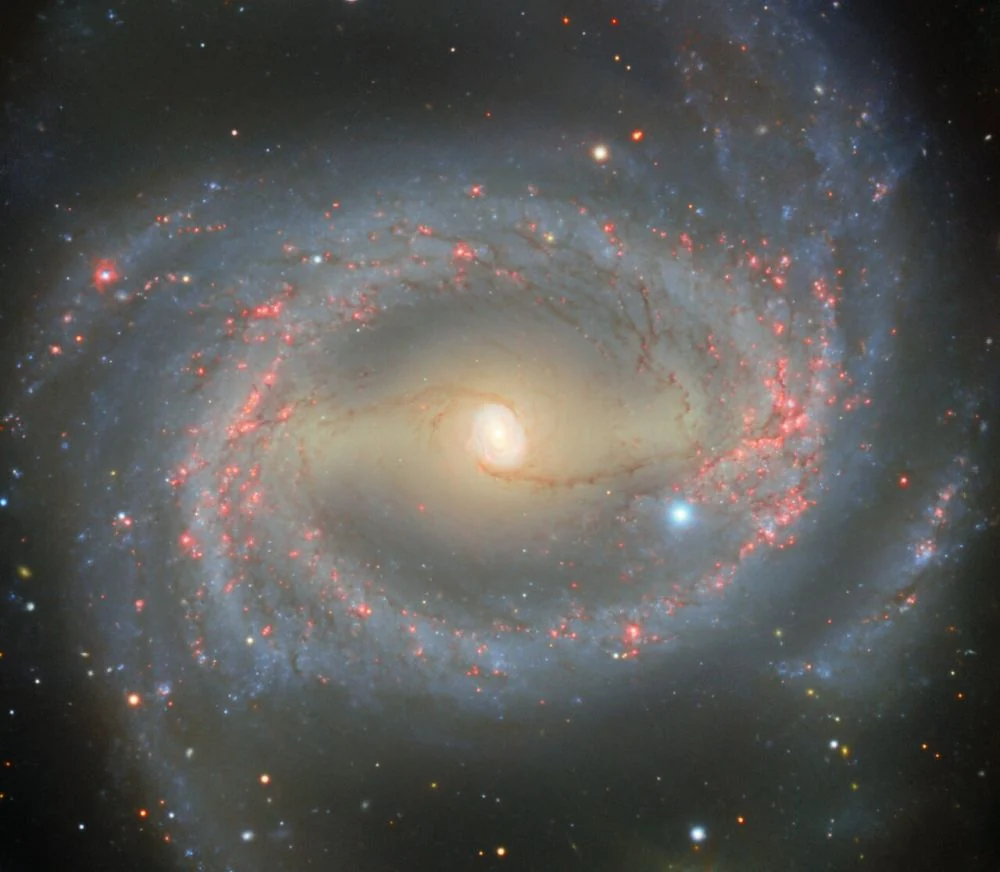
A Type Ia supernova has been discovered in NGC 1433, a spiral galaxy 50 million light years away. The ATLAS survey detected the object on November 2, naming it SN 2026ahvu. At discovery, the supernova had an apparent magnitude of 17. Within days, it brightened to magnitude 13.5, making it accessible for detailed observation.
In a Type Ia supernova, a white dwarf draws material from a companion star until the white dwarf reaches the Chandrasekhar limit of about 1.44 solar masses, then explodes completely. The explosion's peak brightness comes from the decay of Nickel-56, followed by a dimmer phase powered by Cobalt-56 decaying into Iron-56.
The proximity and early detection enable astronomers to track the supernova's evolution from an earlier phase than typical. Within two to three months after the explosion, the expanding ejecta will thin enough to form a nebula, revealing the chemical composition of the entire exploded star through spectral analysis.
The Dark Energy Camera on the Víctor M. Blanco 4-meter Telescope and the Gemini South telescope have already captured images. ATLAS operates five 0.5-meter telescopes across Hawaii, Chile, South Africa, and the Canary Islands, designed primarily to detect near-Earth objects but also discovering other transients.
Type Ia supernovae serve as standard candles for the cosmic distance ladder, the system astronomers use to measure distances to distant galaxies. Each additional observation refines the accuracy of these distance measurements.