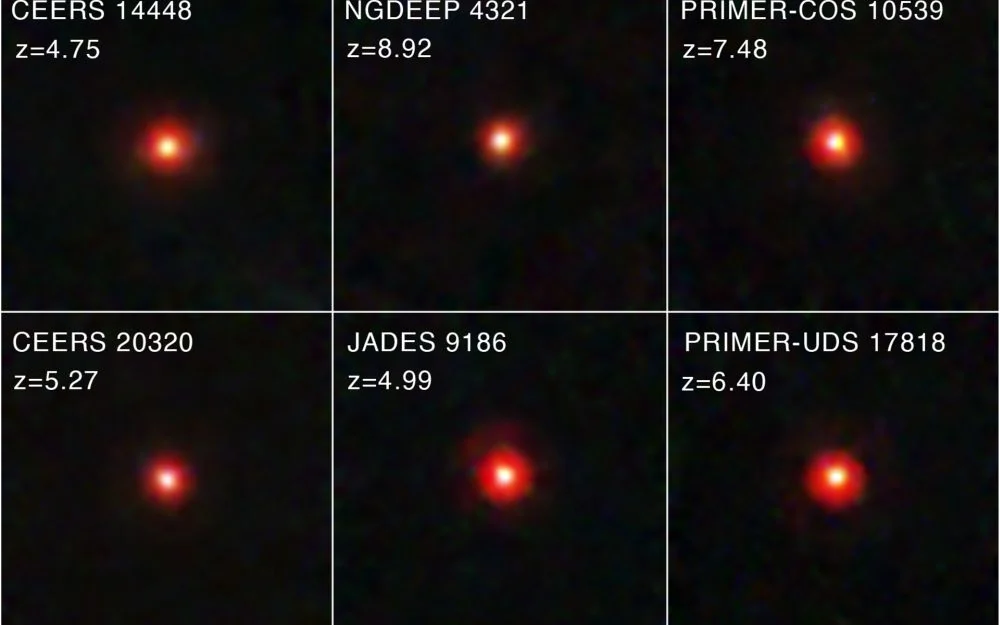
Computer simulations led by Dr. Daniel Whalen at the University of Portsmouth suggest that the James Webb Space Telescope's mysterious "Little Red Dots" are galaxies powered by massive black holes formed from collapsed supermassive primordial stars.
The James Webb observations revealed numerous bright, red galaxies in deep field surveys far more abundant than cosmological models predicted. Their unusual spectral signatures and lack of detectable X-ray and radio emissions puzzled astronomers. Previous theories, including Direct Collapse Black Holes, struggled to explain all observed characteristics simultaneously.
Whalen's international team, including researchers from United Arab Emirates University, Aristotle University of Thessaloniki, the University of Edinburgh, and the Harvard & Smithsonian Center for Astrophysics, ran advanced cosmological simulations published in The Astrophysical Journal Letters. Their model shows that dense, massive gas discs surrounding these black holes trap high-energy X-rays while allowing visible, ultraviolet, and infrared light to escape. This matches Webb's observations.
The simulations indicate these galaxies contain roughly 100 million stars packed into regions only 500 light-years across, with central black holes of approximately 10 million solar masses. This is several orders of magnitude lower than previous estimates of 100 million solar masses.
"What makes this discovery so exciting is that we may be witnessing the birth of the first supermassive black holes," Whalen said. "For decades, simulations have predicted that these objects should exist, and now the James Webb Space Telescope may finally be allowing us to see them."