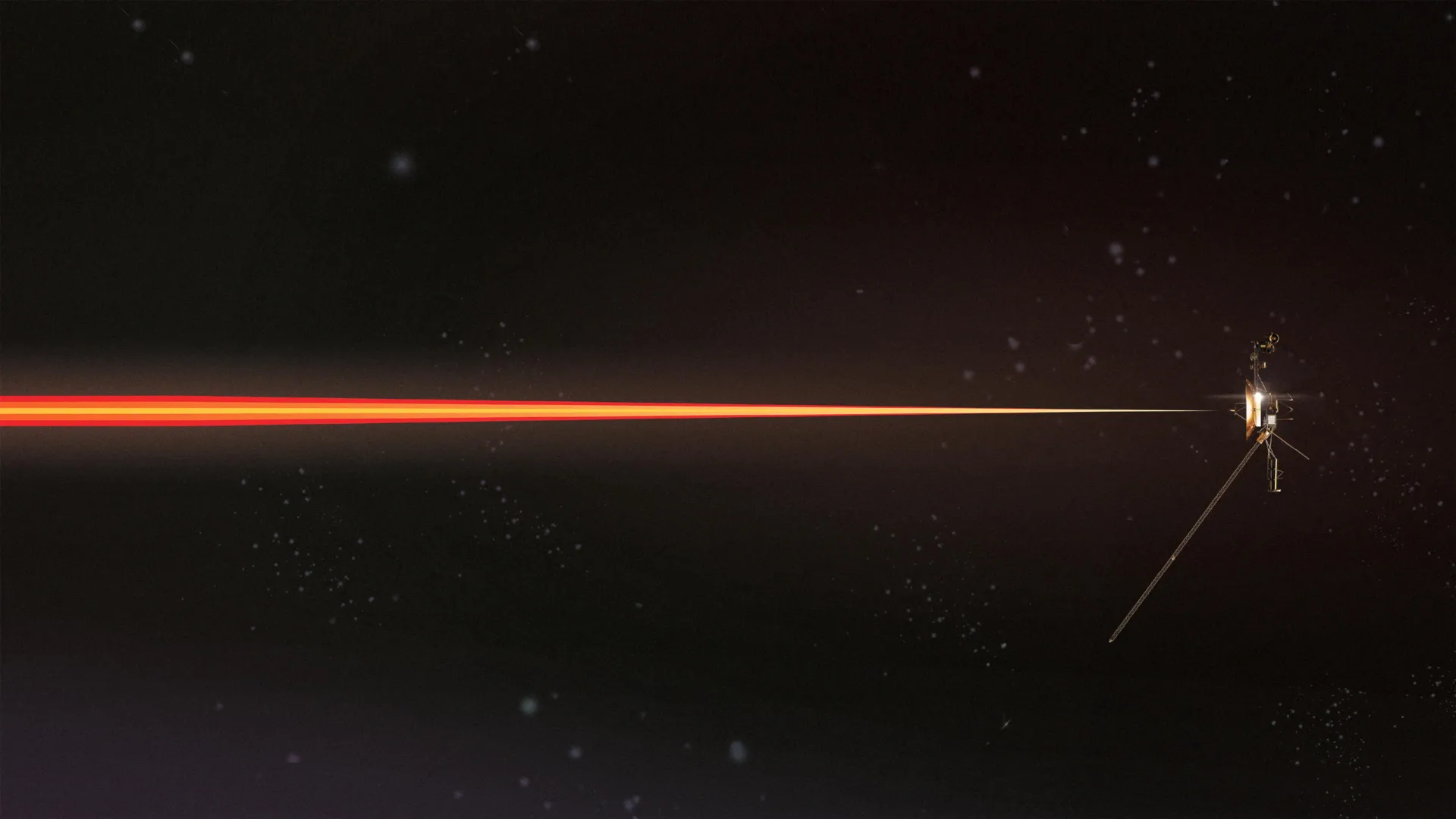
NASA's Voyager 1 reached a distance of one light-day from Earth on November 18 at 2:16 a.m. PST. The spacecraft now sits approximately 16.1 billion miles (25.9 billion kilometers) away, making it the first spacecraft to achieve this milestone after nearly 50 years of travel.
At this distance, signals traveling at the speed of light require a full day to reach Voyager 1 from Earth. Mission controllers at NASA's Jet Propulsion Laboratory in Southern California received confirmation of the achievement exactly 24 hours after the spacecraft crossed the threshold.
The milestone creates operational challenges. Sending a command to Voyager 1 takes 24 hours, and receiving a response takes another 24 hours, making a complete exchange span two full days even at light speed.
NASA has not received scientific or engineering data from Voyager 1 since November 14, though the probe continues transmitting a carrier signal. Mission specialists used this signal and trajectory calculations to verify that Voyager 1 had crossed the one light-day mark. Engineers are investigating why expected data is not arriving.
Voyager 1 and its twin Voyager 2 launched in 1977 to exploit a rare alignment of outer planets. Voyager 1 became the first spacecraft to visit Jupiter and Saturn and delivered the first high-resolution images of these planets. In 2012, it crossed the heliosphere boundary into interstellar space, becoming the first spacecraft to enter the region beyond the Sun's protective bubble. Voyager 2 followed into interstellar space in 2018.
The probes carry Golden Records with images and sounds from Earth, designed as messages for potential extraterrestrial civilizations. Voyager 1 travels at approximately 38,000 mph. Both spacecraft continue monitoring conditions in interstellar space and revealing how the Sun's influence extends farther into that region than scientists previously understood.