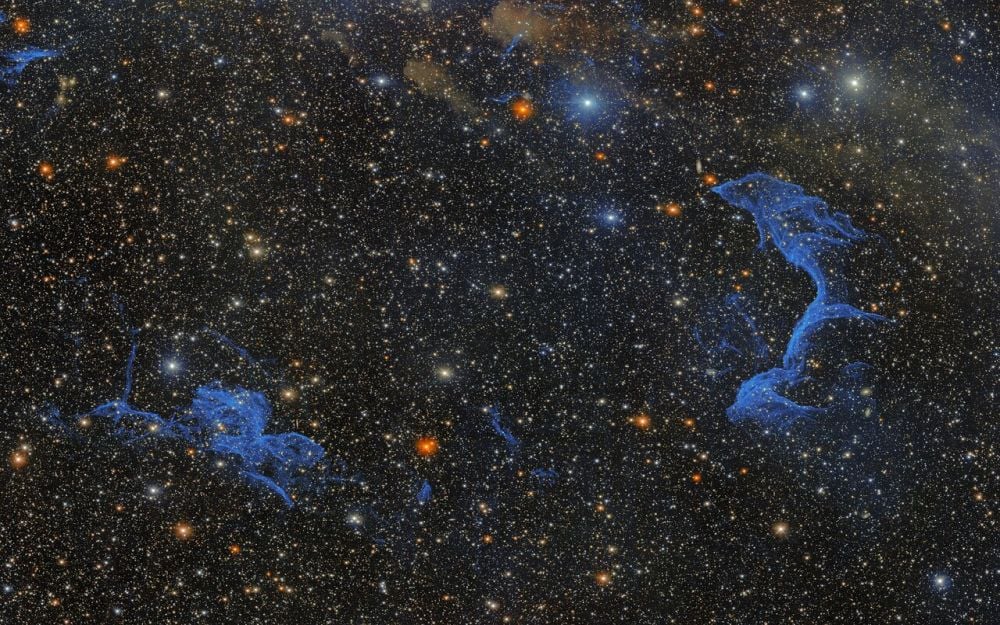
The Dark Energy Camera captured a new image of the Betta Fish Nebula, a supernova remnant located 6,800 light years away in the Centaurus constellation. A massive star exploded between 7,000 and 10,000 years ago, expelling its outer layers into the interstellar medium. The shock energy from that collision illuminates the gas visible today.
DECam is a 570-megapixel wide-angle camera mounted on the Víctor M. Blanco 4-meter Telescope at Cerro Tololo Inter-American Observatory in Chile. Its primary purpose is the Dark Energy Survey, which studies dark energy and the expansion of the universe. The camera occasionally captures images for public interest outside its main scientific mission.
Astronomers study supernova remnants to learn how heavy elements disperse into the interstellar medium and how those explosions shape star formation dynamics. The remnant reveals details about its progenitor star.
At the nebula's center lies a neutron star, roughly 20 kilometers across. The collapsed stellar core functions as a pulsar with unusual properties. It is radio-quiet, detectable only in x-rays, and lacks a pulsar wind nebula. Some researchers consider it a possible example of a low-mass bare strange star.
Only part of the nebula visually resembles the betta fish, the colorful aquarium species also called Siamese Fighting Fish, which gave the nebula its name. DECam has produced similar public-interest images over more than a decade, including photographs of the cometary globule CG4, the Rosette Nebula, and the Corona Australis Molecular Cloud.