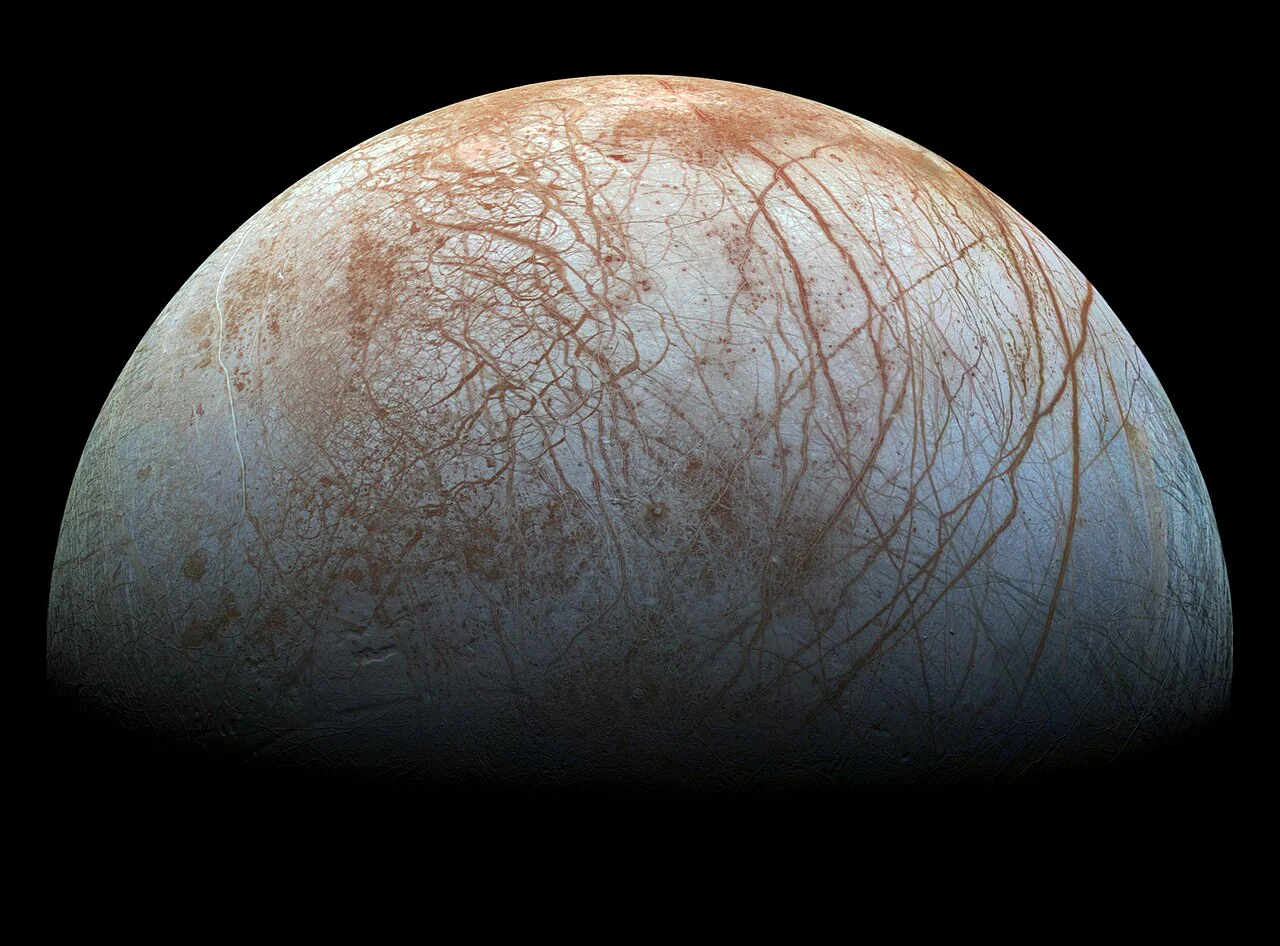
Observations from the W.K. Keck Observatory in Hawai'i have connected Europa's diffuse sodium cloud to material originating from the moon's subsurface ocean. A team led by Boston University compared sodium measurements taken high above Europa with observations near its surface, publishing results in the Journal of Geophysical Research: Space Physics.
The sodium cloud extends over 46,800 kilometers in diameter, roughly 30 times Europa's radius, with an oblong shape elongated east-west. Using Keck's High Resolution Echelle Spectrometer (HIRES) across two decades of observations, researchers mapped the cloud's distribution and found it remained stable despite powerful forces in Jupiter's environment.
The team overcame the challenge of Europa's highly reflective ice by observing the moon as it passed through Jupiter's shadow, eliminating direct sunlight interference. They measured sodium's distinctive spectral fingerprint using HIRES in a high-resolution, long-slit configuration and combined new data with archival observations from 1999.
A key finding emerged: Europa's sodium abundance remained constant despite changes in Jupiter's plasma environment and neighboring volcanic moon Io's activity. Carl Schmidt, a researcher at Queen's University Belfast and Boston University, stated: "The neighboring volcanic moon Io sprays sodium around the Jupiter system, and we've often wondered if Io paints Europa's surface. The stable sodium abundance in these Keck data shows that Europa is indifferent to Io's volcanic activity. What we observe originates in Europa's saltwater and not in Io's volcanoes."
On September 29, 2022, NASA's Juno spacecraft passed behind Europa, enabling the team to study the sodium cloud alongside local plasma measurements. This allowed testing of Jupiter's magnetosphere and Io's volcanic effects on the cloud.
Emma Lovett, the study's lead author and a graduate student at Boston University, explained: "We don't know a lot about Europa's hidden ocean and icy surface, but its atmosphere offers a window into this potentially habitable world." The team is now using the Hubble Space Telescope to search for magnesium in Europa's atmosphere, another possible element in the moon's ocean salts. NASA's Europa Clipper and the ESA's JUpiter ICy Moons Explorer (JUICE) are en route to study the icy moon further.