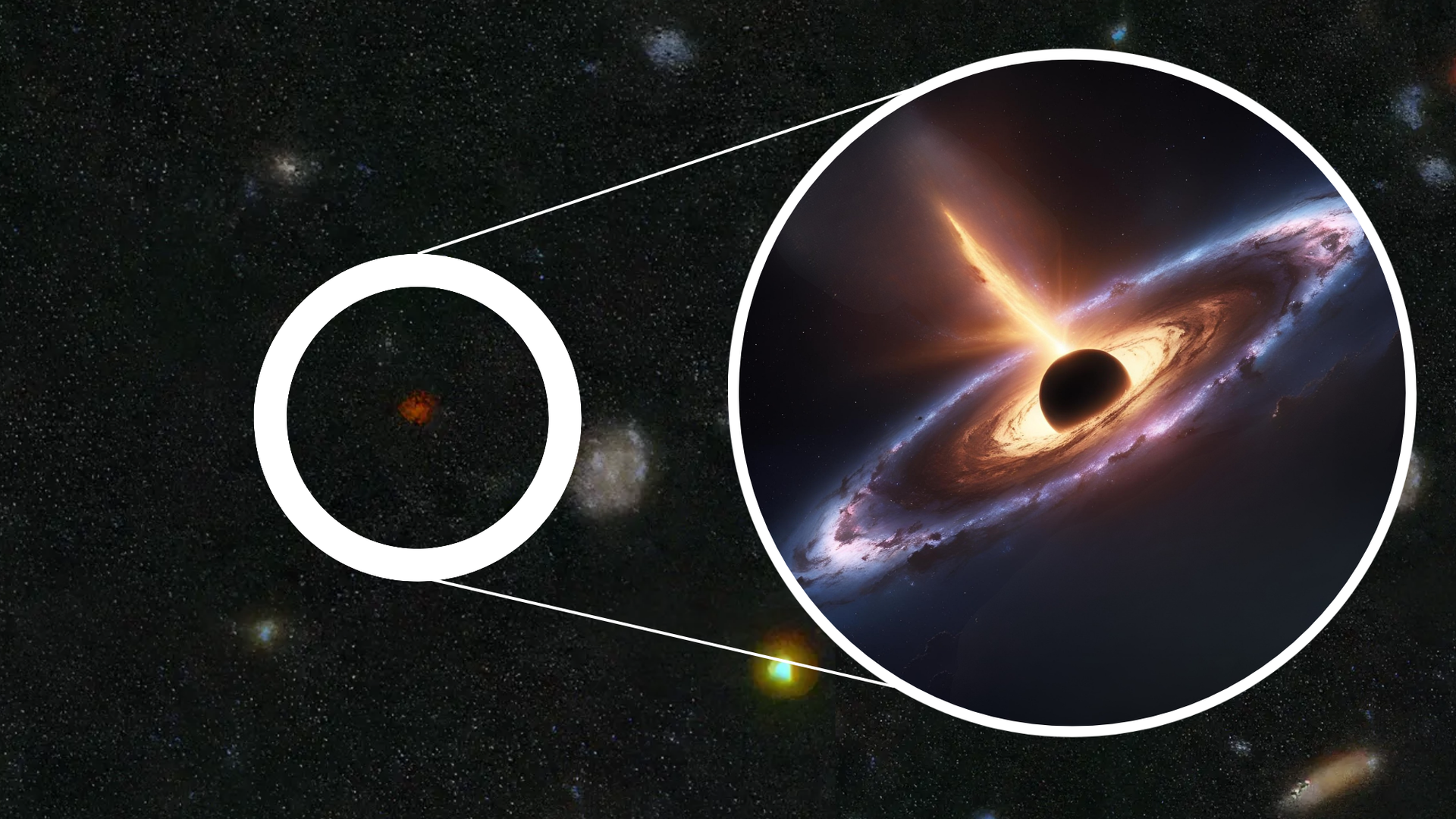
The Euclid space telescope has identified the most distant and ancient quasar yet observed, powered by a supermassive black hole containing 360 million times the sun's mass. The black hole existed just 630 million years after the Big Bang, pushing back the previous record by 40 million years.
This discovery compounds a puzzle in astrophysics. Scientists previously theorized that supermassive black holes required roughly 1 billion years of feeding and merging to reach their massive sizes. The newly found quasar, designated J1504+6252 and nicknamed Dún Aonghasa, contradicts that timeline.
Quasars form when supermassive black holes consume vast amounts of surrounding gas and dust. The black hole's gravity heats this accretion disk until it glows brighter than all the stars in the entire host galaxy.
Euclid detected Dún Aonghasa among millions of objects in 18 months of observations. The W.M. Keck Observatory, the Large Binocular Telescope Observatory, the Hubble Space Telescope, and the James Webb Space Telescope all performed follow-up observations. The JWST determined the black hole's mass.
The black hole feeds relatively slowly, unlike other supermassive black holes observed at similar epochs. This suggests any period of rapid consumption has ended or paused, adding complexity to models of black hole growth.
Euclid has also discovered at least 12 quasars dating back around 13 billion years. The research was published November 24 in Astronomy & Astrophysics.