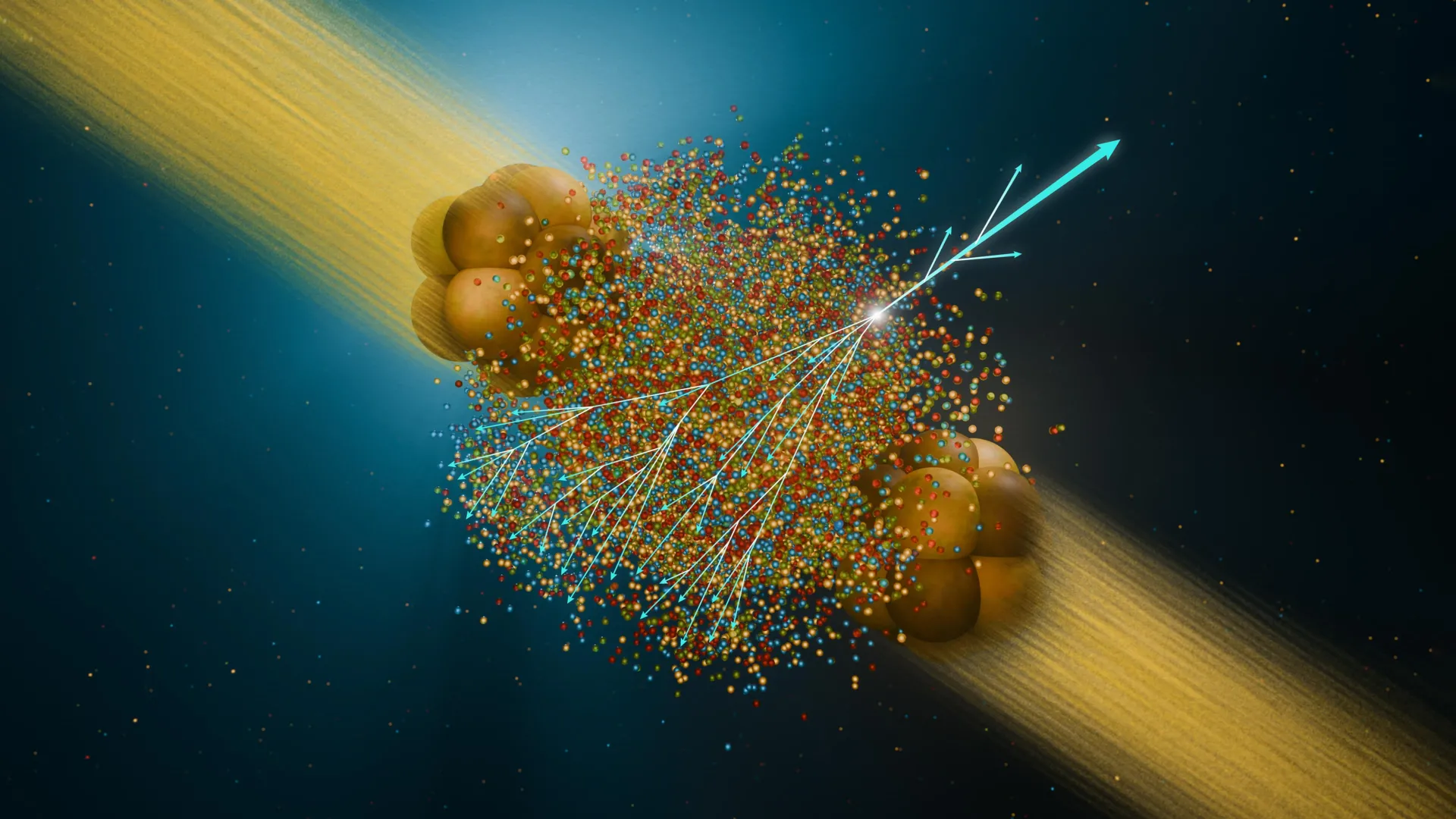
The STAR experiment at the Relativistic Heavy Ion Collider has detected quark-gluon plasma in collisions between oxygen nuclei at substantially lower energies than previously required. Researchers smashed oxygen nuclei together at nearly the speed of light and observed jet quenching, a phenomenon where high-energy particles lose energy as they travel through the matter created by the collision.
The findings, published in Physical Review Letters, establish a new lower boundary for the conditions that produce quark-gluon plasma. Each oxygen nucleus contains eight protons and eight neutrons, making it far smaller than the gold nuclei traditionally used in RHIC experiments.
Li Yi, a professor of physics at Shandong University who oversaw the STAR analysis, stated that quark-gluon plasma is believed to be the form of matter that filled the early universe before protons and neutrons formed. "Understanding its properties is essential for uncovering how the early universe evolved in its first microseconds," Yi said.
Jet quenching had been observed before in collisions involving larger atomic nuclei at RHIC and in oxygen collisions at CERN's Large Hadron Collider. The new findings at RHIC push these observations to smaller collision systems. Rongrong Ma, a STAR physicist at Brookhaven Lab, noted that this analysis is "pushing the boundaries to an extreme case to help us learn something about this jet quenching phenomenon and the conditions needed to generate a QGP."
The quark-gluon plasma created in these collisions survives for less than a billionth of a billionth of a second before quarks and gluons recombine into more familiar particles. Because scientists cannot examine it directly, they analyze the particles that emerge from the collision using instruments like the STAR detector.