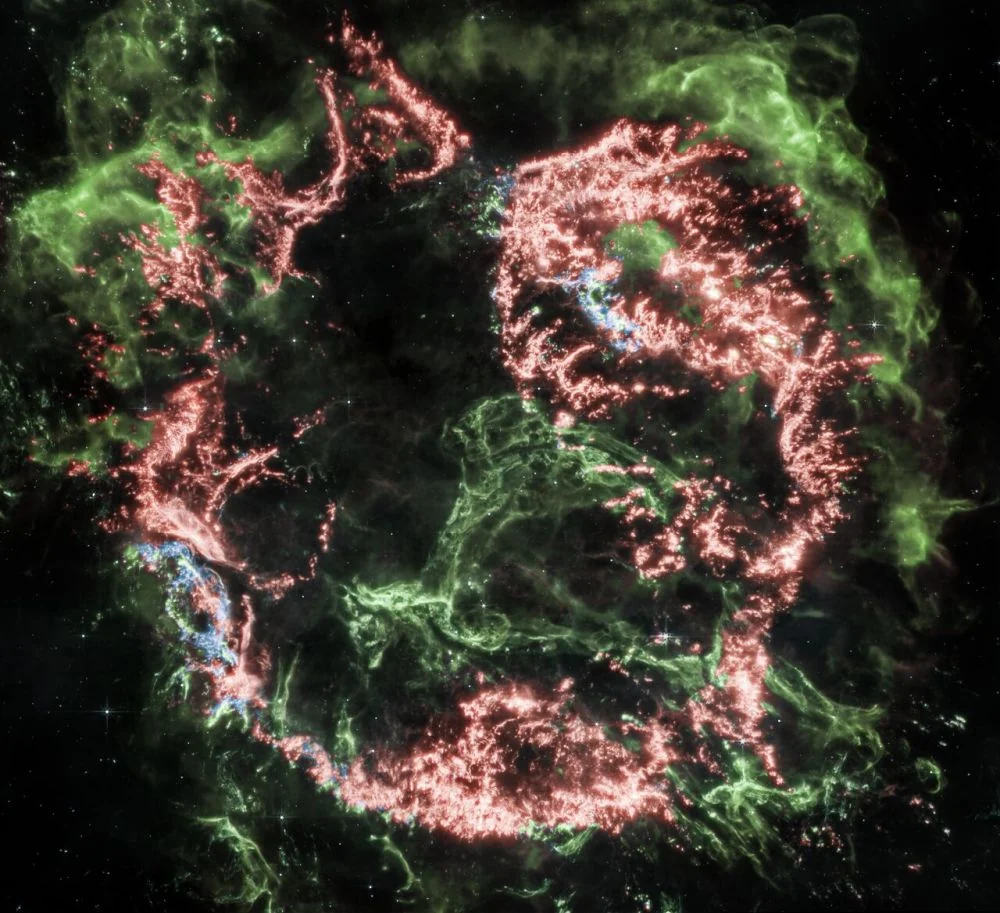
The James Webb Space Telescope used its Mid-Infrared Instrument and Medium-resolution Spectrometer to map dust chemistry across Cassiopeia A, a supernova remnant about 11,000 light years away. Tea Temim of Columbia University led the research, published in The Astrophysical Journal Letters.
The JWST's unprecedented mid-infrared resolution allowed researchers to isolate dust emission from individual clumps of supernova ejecta as large as our Solar System. By examining three chemically distinct regions, they identified different dust species. Region P1 showed silica grains with bright argon emissions. Region P2, associated with Cassiopeia A's "Green Monster" structure, contained mostly magnesium silicate from circumstellar material. Region P3 displayed neon-rich emissions linked to carbon dust.
These findings point to shell mergers in the progenitor star shortly before its explosion. Temim explained in a press release that material within stellar shells can churn and merge before detonation, changing the star's internal structure and altering the chemical abundances visible in the ejected supernova remnant.
Ilse De Looze, associate professor at Ghent University, noted that identifying dust grain types in chemically distinct stellar layers reveals how much dust supernovae contribute to the interstellar dust reservoir and how well grains survive the powerful reverse shocks sweeping through supernova debris.