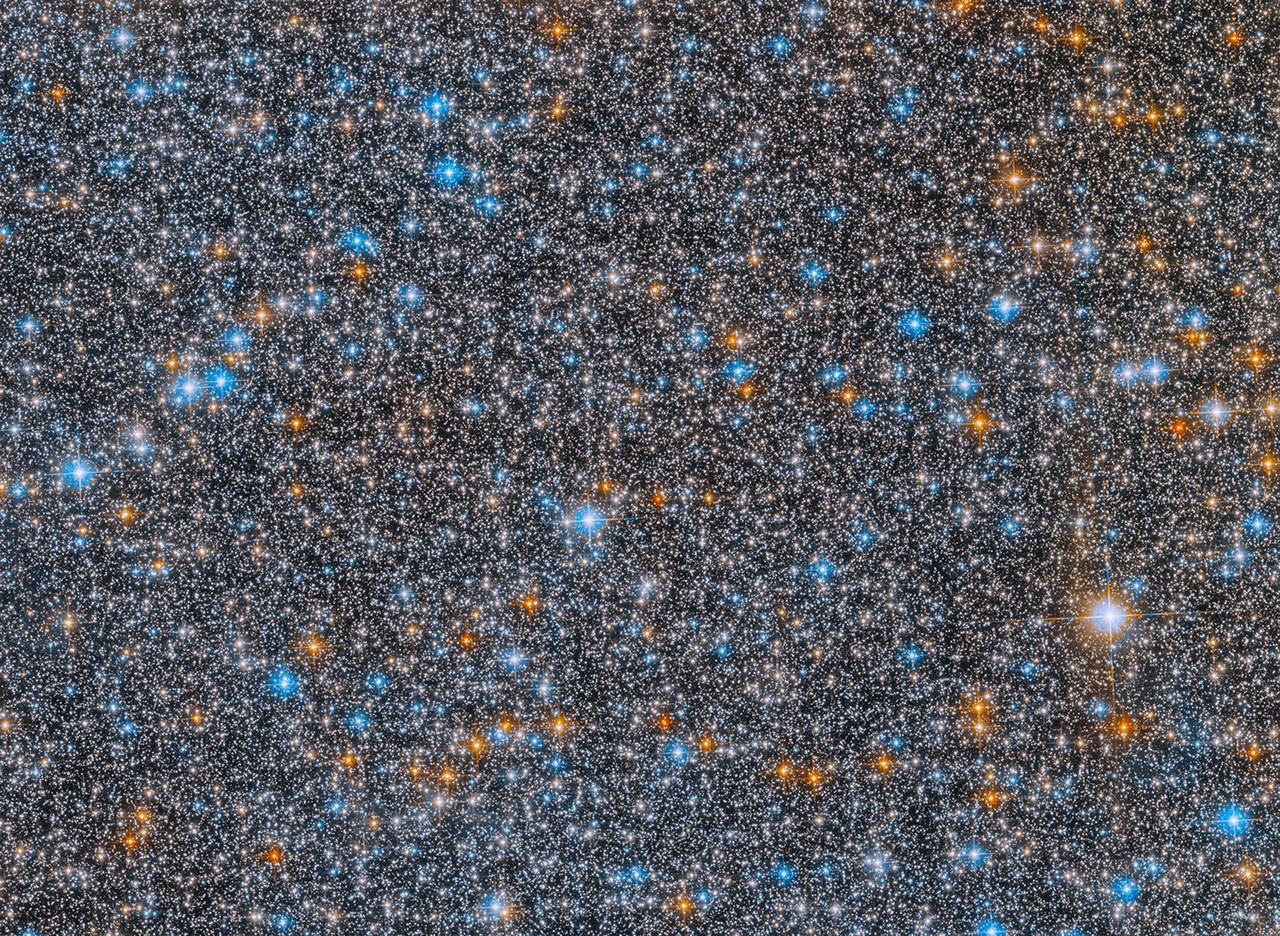
NASA's Hubble Space Telescope has observed a densely packed region of stars in the Milky Way's galactic bulge to prepare for future observations by the Nancy Grace Roman Space Telescope.
Hubble captured high-resolution images of the galactic bulge, the spherical region of stars surrounding the galaxy's disk that holds nearly a quarter of the Milky Way's stellar mass. The observations focused on wavelengths that overlap with Roman's sensitivity range, the red end of the visible spectrum and near-infrared light, allowing researchers to compare the two telescopes' data.
The galactic bulge provides a unique opportunity for study. Although we can see the glow from crowded star regions in other galaxies, they are too jam-packed and far away to resolve individual stars. The Milky Way's proximity allows astronomers to examine individual stars in detail and search for exoplanets while learning how galaxies form, evolve, and interact over billions of years.
Hubble's high resolution collects data on star brightness, ages, composition, and motion over time. This information will help astronomers search for exoplanets, locate black holes or dark matter, and understand galactic environment and evolution.
Roman will search for exoplanets by capturing microlensing events, a type of gravitational lensing in which light from a distant object becomes magnified and distorted by the mass of a closer object along the line of sight. Hubble's pre-existing observations of stars in the region will help characterize them before a lensing event occurs. When Roman later captures a microlensing event, researchers can compare Hubble data to Roman data to interpret the results more easily.
The observing program, part of Hubble's legacy of high-precision galactic bulge surveys including the WFC3 Galactic Bulge Treasury Program and the Sagittarius Window Eclipsing Extrasolar Planet Search (SWEEPS), will aid Roman's search for exoplanets, black holes, neutron stars, and other objects.