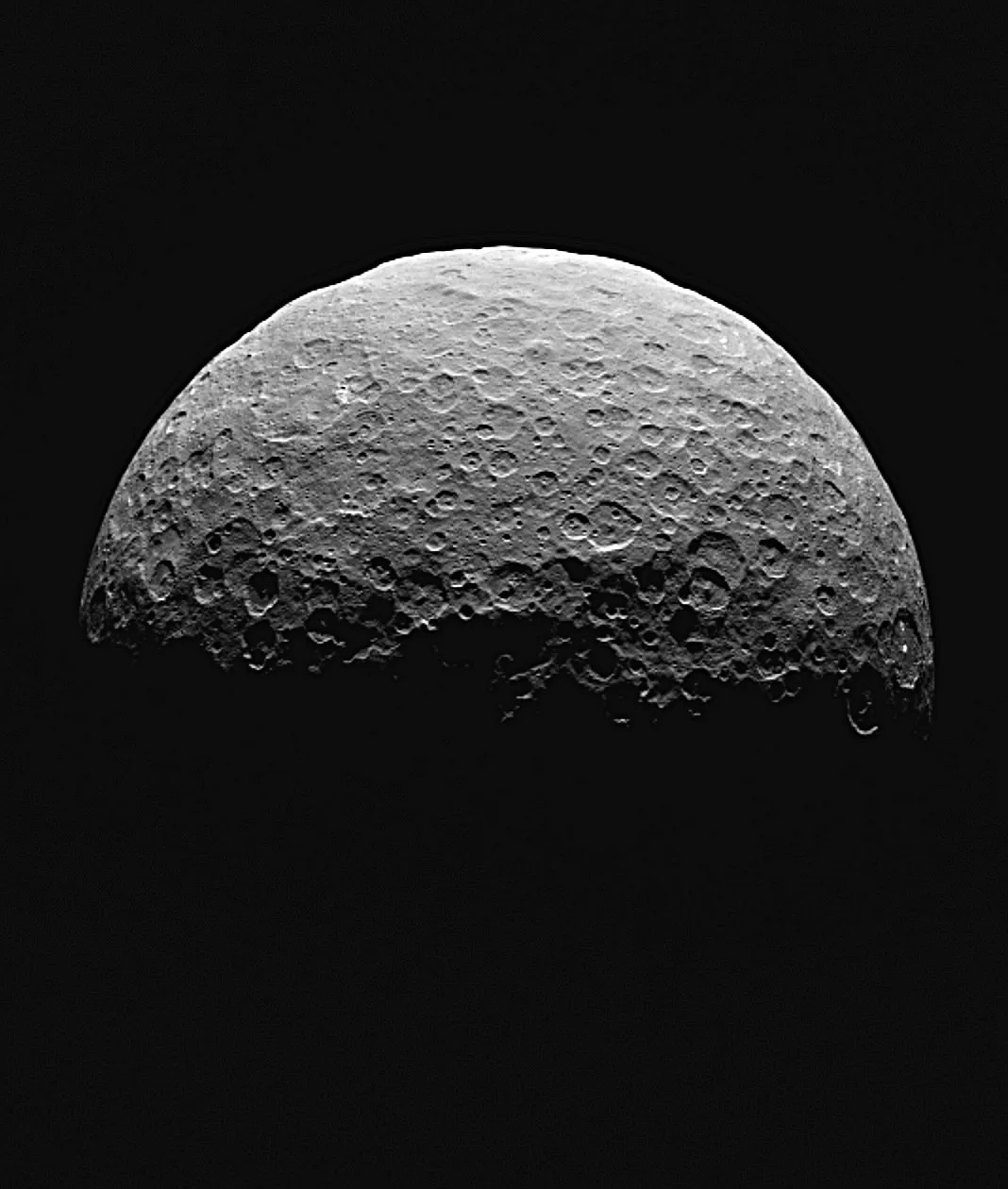
NASA's Dawn mission detected subsurface water ice, ammonia, nitrogen, and hydrogen at the dwarf planet Ceres. A new proposal by astrophysicist Pete Worden and aerospace engineer Fred Kennedy would use those resources to establish humanity's first interplanetary transport node at Ceres, serving as a refueling hub for deep-space missions.
Project CERES (Ceres-Earth Resource Exchange System) calls for a Pathfinder mission launching in January 2037 and arriving a little over a year later using nuclear thermal propulsion. The spacecraft would consist of a Dawn-class orbiter, a lander, a sample capsule, and a new engine. The five-year Pathfinder mission would map Ceres from orbit, land on an ice-rich site, extract water as a demonstration, and return samples to Earth by May 2041.
Nuclear thermal propulsion replaces a rocket's combustion chamber with a small fission reactor. Liquid hydrogen is pumped through the reactor core, heated to around 2,700 degrees Kelvin, and expelled through a nozzle at roughly twice the speed of chemical rocket exhaust. This allows a trip to Ceres in a little over a year rather than a decade, Worden said. The technology is mature. NASA's Rover and NERVA programs ran more than twenty reactors and engines at full power between 1959 and 1972, Kennedy said.
The transport node would extract and sell propellant from Ceres. Water can be burned directly as steam in a nuclear engine, split into hydrogen and oxygen, or combined with local nitrogen into ammonia. A vehicle refueling at Ceres launches 60 percent less mass per round trip, Worden said.
Ceres offers water, nitrogen and carbon. The Moon has essentially none of the last two, Worden said. Dawn found water ice at about ten percent by weight in the top meter of Ceres' regolith at mid-to-high latitudes, plus ammoniated clay minerals, carbonates, organic compounds, and sodium carbonate brine deposits in Occator crater. Whether that water ever hosted microbial life is a question the Pathfinder's samples can answer, Worden said.