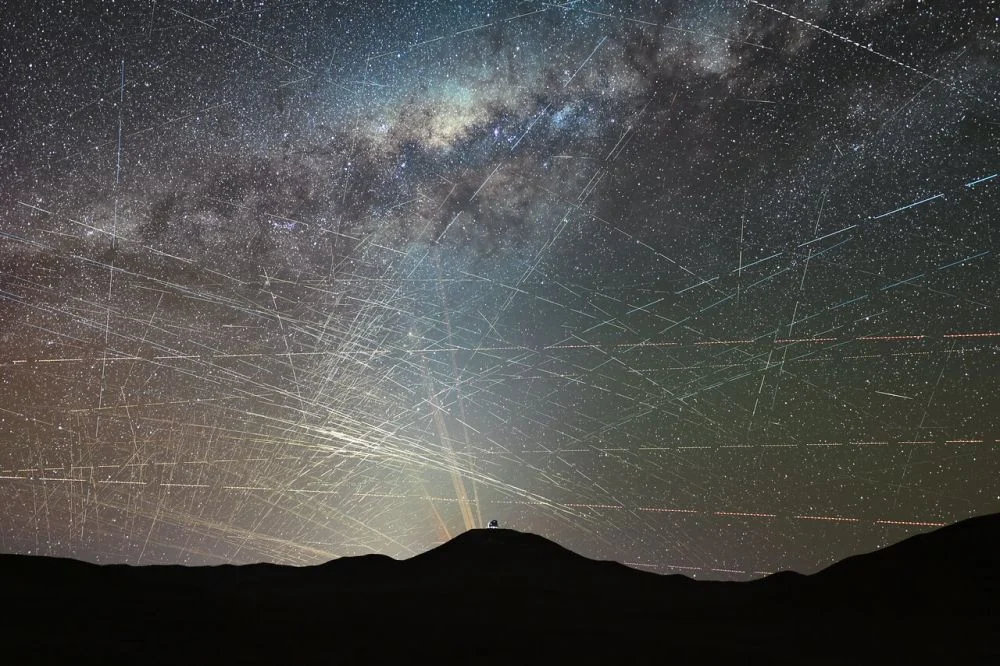
The Federal Communications Commission approved SpaceX's application to launch one million satellites into Low-Earth Orbit as part of a system called Starmind, designed to operate as an orbital artificial intelligence data center. The satellites would use solar power and laser communication with each other.
The European Southern Observatory expressed deep concern about the project's impact on astronomical observations. In a peer-reviewed study published in Astronomy and Astrophysics in March 2026, ESO researchers analyzed how satellite constellations affect telescopes.
The ESO's analysis found that constellations with up to about 60,000 satellites have negligible effects on observations. Above that number, the impact worsens significantly. One million satellites would render satellite trails pervasive, affecting the majority of long exposures, which are critical for modern astronomy, particularly when observing faint or distant objects.
The study examined effects on specific telescopes. For the Very Large Telescope, more than half the sky would remain affected by satellite streaks even 1.3 hours after astronomical twilight ends, with an average of more than eight satellite trails per 300-second exposure at zenith. The Vera Rubin Observatory's LSST camera would experience similar degradation in 15-second exposures.
Andreas Kaufer, Director General at the ESO, stated that the approval "would not only have profound consequences for astronomy, but also fundamentally alter the night sky for everyone on the planet." He called for international mechanisms to assess activities whose impacts extend beyond national borders.
The ESO analysis noted that current proposals would launch 1.7 million new satellites overall. Many breach the threshold of V 550km = 7, meaning they would be visible to the naked eye and would substantially degrade astronomical observations.