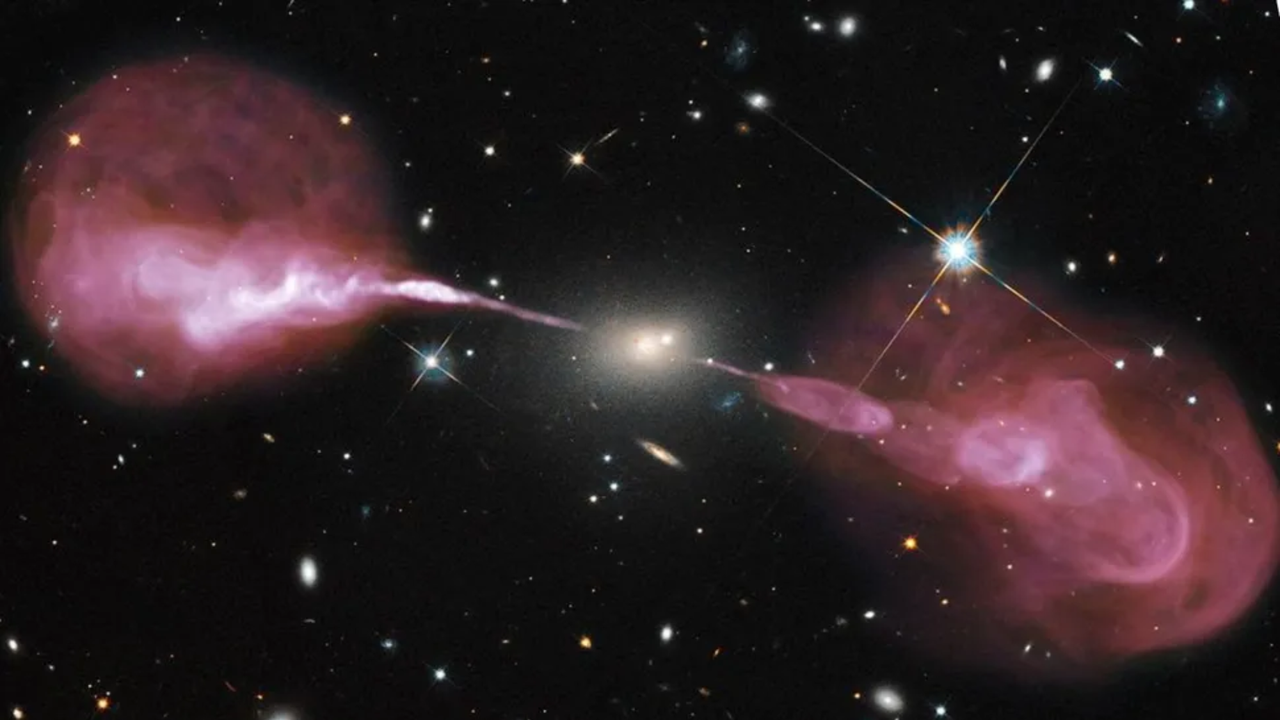
# When Cosmic Engines Cut Out: Dying Radio Galaxies Reveal Black Hole Shutdown
Astronomers have identified a new population of galaxies undergoing a dramatic transformation. Radio galaxies, powered by jets streaming from supermassive black holes at their cores, are switching off. When these cosmic engines stall, their radio lobes fade. This discovery offers the first direct observational evidence of what happens when a black hole's accretion disk shuts down, revealing one of the least understood phases of galactic evolution.
Radio galaxies are among the universe's most violent objects. Supermassive black holes at their centers, containing millions or billions of solar masses, funnel infalling material into accretion disks. As material spirals inward, magnetic fields accelerate jets of plasma to near-light speed. These jets, sometimes stretching millions of light-years across space, collide with the surrounding intergalactic medium and produce radio emissions bright enough to detect across billions of light-years.
This cosmic party cannot last forever. Eventually, black holes starve. When the supply of infalling material diminishes, the jets weaken and finally cease. The radio lobes, cut off from their energy source, fade away. Yet astronomers have struggled to observe this transition phase directly. Most radio galaxies appear either fully active or completely dead, leaving a gap in observational knowledge.
The newly discovered fading radio galaxies fill that gap. These objects show radio lobes that are dramatically dimmer than active galaxies but still detectable, revealing a transitional state that typically lasts tens of millions of years. The detection required sensitive radio telescopes and careful analysis to distinguish these dying objects from background noise.
Understanding this shutdown phase matters for several reasons. When black hole jets turn off, the infalling gas can settle and cool, potentially fueling new star formation. This process shapes how galaxies evolve over cosmic time. Radio galaxies often sit at the centers of massive galaxy clusters, and their jets significantly impact their surroundings. Studying the transition from active to inactive states reveals how black holes regulate their galaxies and influence large-scale structure in the universe.
The discovery also refines models of black hole feeding and accretion. Astronomers now understand that the process is not simply binary, active or inactive. Instead, black holes experience varying fueling rates, triggering episodic outbursts separated by quiescent periods. These episodes reshape galaxies fundamentally. Over billions of years, repeated accretion-jet cycles heat gas, suppress star formation in massive systems, and distribute energy across the intergalactic medium.
Future observations with next-generation radio telescopes, including upgrades to the Karl G. Jansky Very Large Array and the Square Kilometre Array under construction, will expand this census significantly. Better sensitivity will reveal fainter, older fading galaxies, extending the observed timeline of black hole shutdown and providing tighter constraints on how long this transition lasts.
This research transforms our view of supermassive black hole behavior from a simple on-off switch to a complex dynamic process. Each fading radio galaxy represents a moment frozen in deep time when a cosmic engine ran dry, its jets slowly dimming as the black hole's fuel supply exhausted. These dying objects teach us how black holes age, how galaxies transform, and how the universe builds its largest structures.