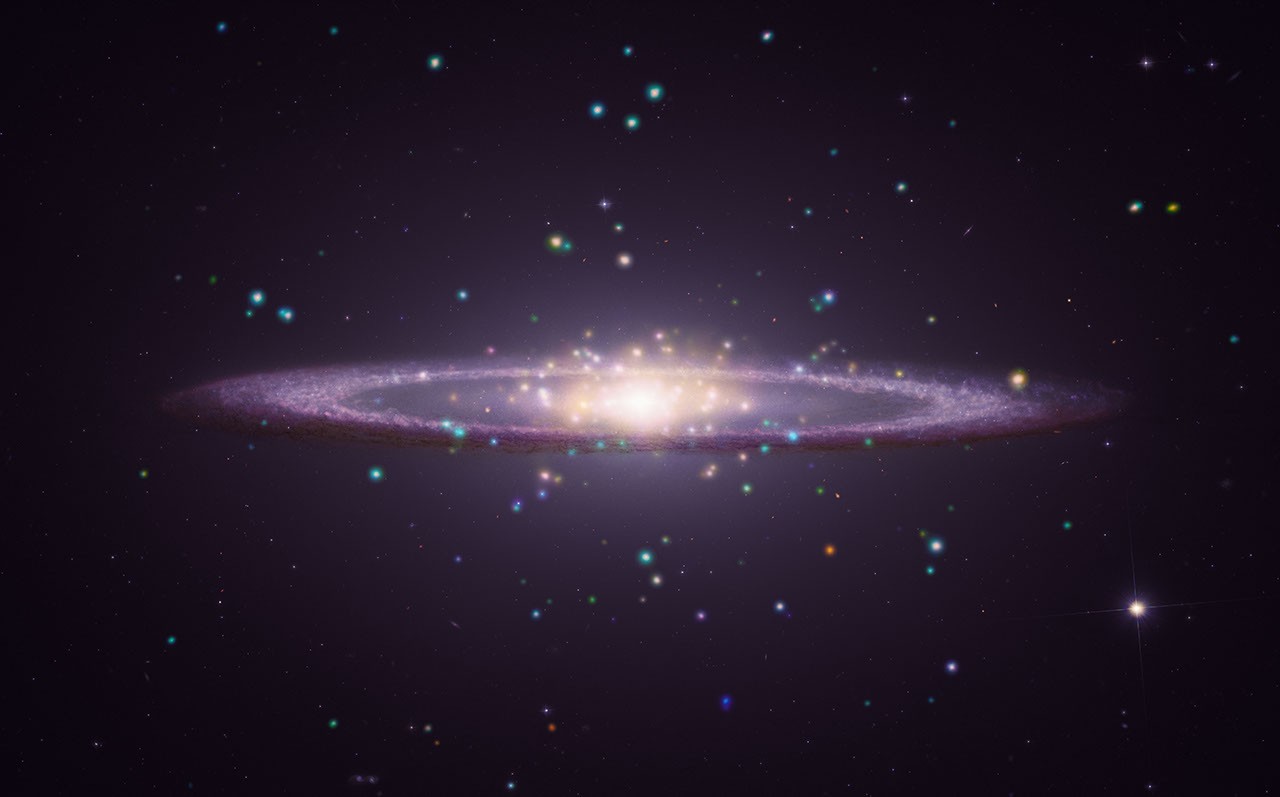
NASA's Chandra X-ray Observatory has released a new gallery of galactic images that reveals the stunning diversity of galaxies across the universe. The collection showcases how galaxies function as distinct cosmic objects, each defined by unique characteristics in size, shape, and structure.
The Chandra X-ray Observatory, launched by NASA in 1999, observes the universe in high-energy X-ray wavelengths. This perspective captures phenomena invisible to visible-light telescopes, including hot gas, supermassive black holes, and energetic particle emissions from galactic centers and active nuclei. By combining Chandra's X-ray data with observations from other telescopes across the electromagnetic spectrum, astronomers construct a comprehensive portrait of galactic architecture and evolution.
The gallery organizes galaxies into three primary morphological categories that form the foundation of galactic classification. Spiral galaxies, including our own Milky Way, feature rotating disks with elegant arms of stars and gas spiraling outward from central bulges. Elliptical galaxies range from nearly spherical to highly elongated shapes and typically contain older stellar populations with minimal ongoing star formation. Lenticular galaxies represent a hybrid form, possessing disk structures similar to spirals but lacking the prominent spiral arms.
Chandra observations reveal how X-ray emissions trace the most violent and energetic processes occurring within galaxies. Hot gas at millions of degrees fills galactic halos and clusters. Supermassive black holes at galactic centers actively feed on infalling material, accelerating particles to relativistic speeds and generating intense X-ray radiation. Supernova explosions leave expanding shells of superheated gas detectable in X-rays long after their visible light fades.
The multi-wavelength approach combining Chandra data with observations from other NASA missions like the Hubble Space Telescope, Spitzer Space Telescope, and ground-based observatories provides complete context. Visible-light data reveals stellar populations and dust structures. Infrared observations penetrate dust clouds obscuring star-forming regions. Radio data traces jets ejected from active galactic nuclei. Together, these datasets construct three-dimensional models of galactic structure, dynamics, and evolution.
This gallery serves multiple purposes for astronomical research. Educational outreach helps the public appreciate the universe's beauty and complexity. For researchers, systematic collections of well-characterized galaxies enable comparative studies of galactic evolution, classification refinement, and discovery of unusual objects. Identifying rare galaxy types or unexpected X-ray signatures often leads to new investigations into physical processes previously underestimated or misunderstood.
Chandra continues operating nearly 25 years after launch, maintaining capabilities exceeded by no other X-ray observatory in spatial resolution and spectroscopic sensitivity. Its ongoing mission produces thousands of observations annually, with archival data available to researchers worldwide through NASA's High Energy Astrophysics Science Archive Research Center.
The release of such galleries underscores NASA's commitment to advancing both scientific discovery and public engagement. Galaxies remain laboratories for understanding how stars form, how black holes shape their surroundings, and how the universe assembled its current structure over billions of years. Each image in the collection represents real data from real cosmic objects, transformed into visual representations that communicate the observable universe's genuine majesty.