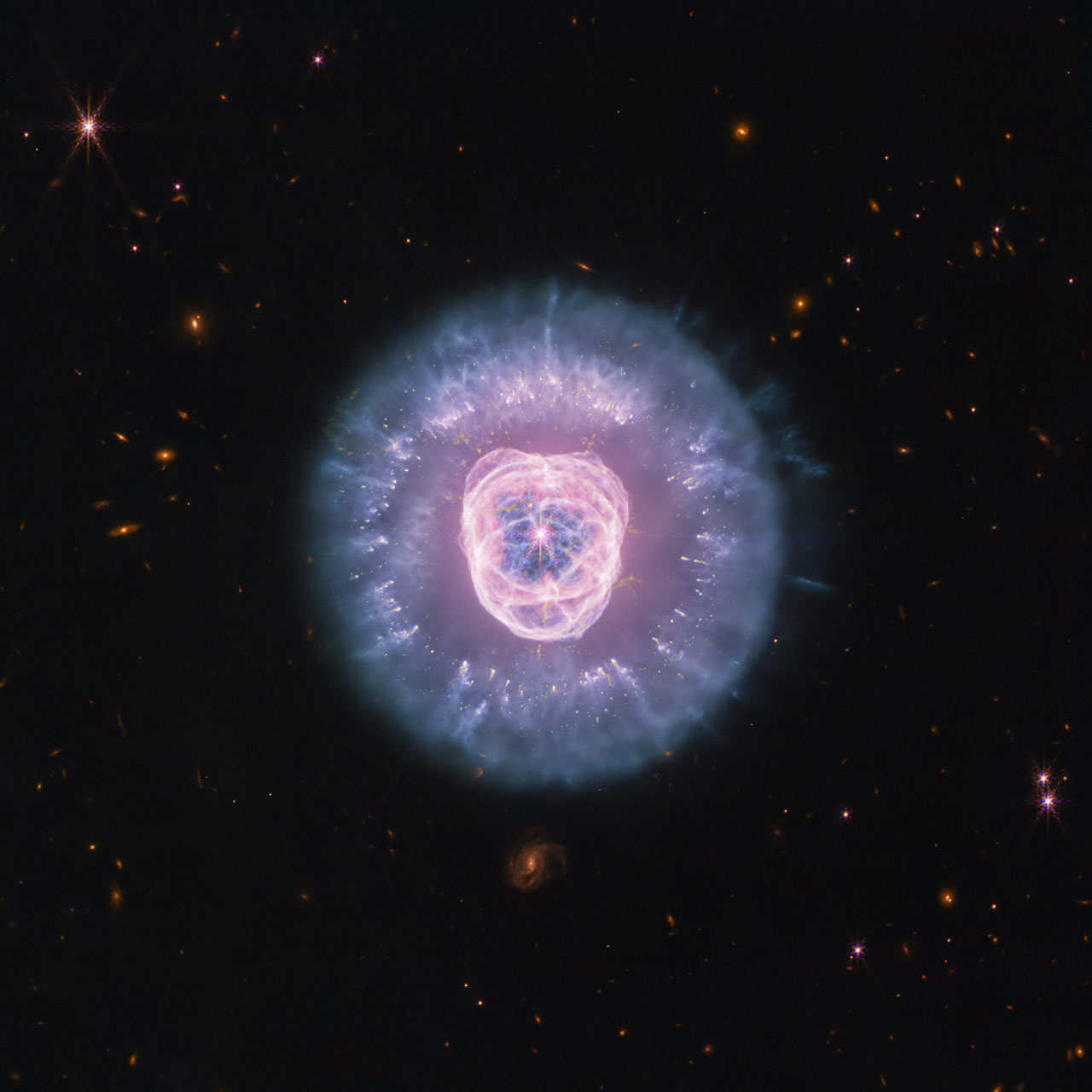
# James Webb Space Telescope Captures Detailed Portrait of the Lion's Head Nebula
The James Webb Space Telescope has turned its infrared instruments toward the Lion's Head Nebula, revealing structures within the stellar nursery that ground-based observatories cannot resolve. JWST's ability to observe at infrared wavelengths pierces through dust clouds that block visible light, exposing the regions where stars actively form.
The Lion's Head Nebula lies within a region of active star formation. Within its boundaries, gas and dust collapse under gravity to create new stars. Traditional telescopes observing in visible wavelengths encounter a wall of obscuring material. JWST operates at infrared frequencies where photons pass through the same dust that blocks visible light, offering astronomers an unobstructed view of stellar nurseries.
JWST's infrared cameras detect heat radiation emitted by warm dust and young stellar objects embedded in nebulae. The telescope's 6.5-meter primary mirror collects far more light than Hubble, while its infrared detectors reach wavelengths between 0.6 and 28 micrometers. This combination reveals fine structures invisible to other instruments. Filamentary dust lanes appear in sharp relief. Protostars glow against dark backgrounds. The geometry of collapsing gas becomes visible.
Understanding star formation in regions like the Lion's Head Nebula informs theories about how stars assemble from interstellar material. The observations show how radiation from newborn stars shapes surrounding gas clouds. Feedback processes where young stars alter their birth environments become apparent in high resolution. Astronomers measure the mass and temperature of stellar populations to test models of star formation efficiency.
The Lion's Head Nebula observations also contribute to JWST's broader mission of mapping the infrared universe. Since its launch in December 2021, the space telescope has transformed infrared astronomy. Its primary mirror consists of 18 hexagonal segments coated with beryllium and gold. The gold coating reflects infrared light while remaining transparent to infrared radiation that the telescope's instruments detect. A large sunshield protects the telescope's instruments and keeps them at approximately 40 Kelvin, cold enough for sensitive infrared detection.
Each JWST observation adds data points to catalogs of star-forming regions across the galaxy. These datasets reveal how environmental factors shape stellar populations. Density, radiation fields, and magnetic fields influence the distribution of stellar masses. JWST measurements of these variables across multiple star-forming regions enable astronomers to construct more complete physical models.
The timing of JWST's observations of regions like the Lion's Head Nebula follows a strategic observation schedule balancing the demands of thousands of competing research proposals. Each observation moment represents allocation decisions made by review panels assessing scientific merit. The data from these observations becomes available to the astronomy community through public archives, enabling decades of follow-up analysis.
JWST's infrared view of the Lion's Head Nebula demonstrates how advanced space-based observatories continue to refine humanity's understanding of the cosmos. The telescope operates in the infrared spectrum where the universe reveals processes hidden from optical telescopes. Future observations will extend JWST's survey of star-forming regions, building comprehensive inventories of how stars come into existence throughout the galaxy.