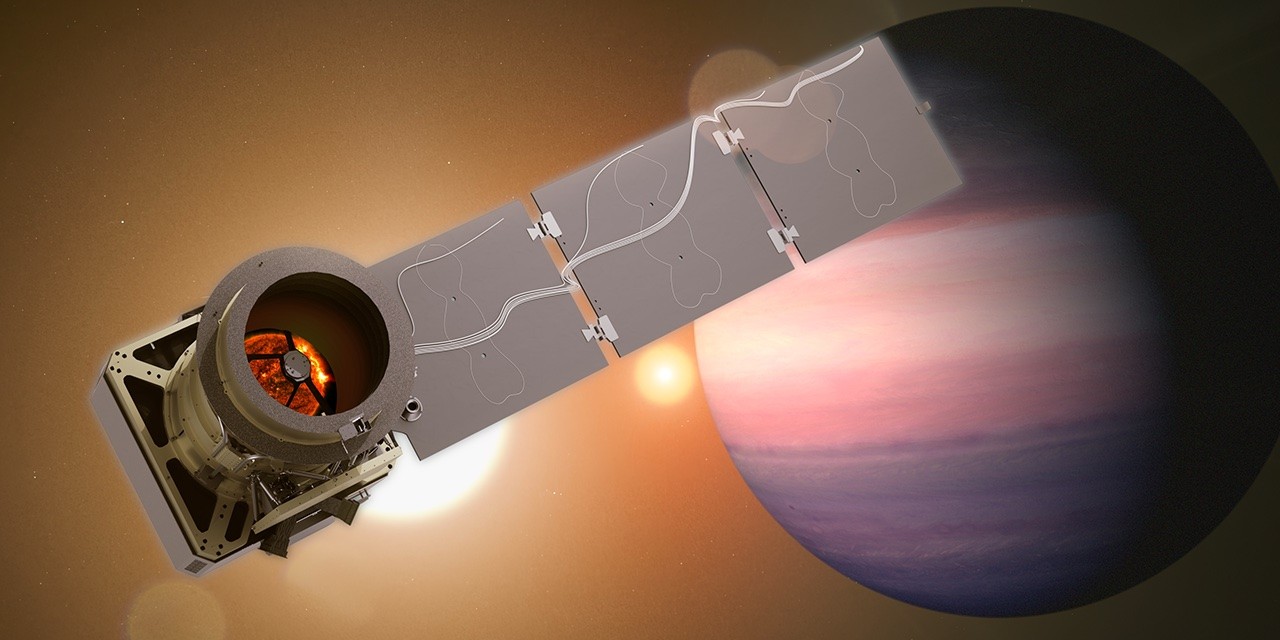
NASA's Pandora mission has begun observations of exoplanet atmospheres, marking the first spacecraft to launch through the Astrophysics Pioneers program. The satellite will determine the atmospheric composition of at least 20 exoplanets, identifying hazes, clouds, and water vapor around worlds orbiting distant stars.
Pandora represents a departure from traditional exoplanet observation methods. While most current techniques measure starlight passing through planetary atmospheres as worlds transit their host stars, Pandora studies the light that stars themselves emit as starlight reflects off planetary atmospheres and surfaces. This approach allows the mission to examine planets around unusually active, variable stars, a category largely inaccessible to conventional survey methods.
The distinction matters because many exoplanet discoveries orbit young, magnetically active stars that produce significant starspots and stellar flares. These stellar variations introduce noise into traditional transmission spectroscopy measurements, making atmospheric characterization difficult or impossible. Pandora sidesteps this limitation by analyzing reflected light and thermal emissions, techniques less susceptible to stellar activity interference.
NASA's Astrophysics Pioneers program emphasizes innovative, cost-efficient missions led by principal investigators at universities and research institutions. Pandora, managed by Johns Hopkins University Applied Physics Laboratory, exemplifies this approach. The program's structure accelerates the development and deployment of specialized observatories addressing gaps in scientific capability.
Atmospheric characterization of exoplanets directly informs habitability assessments and the search for biosignatures. Water vapor, oxygen, methane, and other compounds indicate environmental conditions potentially suitable for life. The presence of clouds and hazes affects temperature regulation and chemistry in planetary atmospheres, fundamentally shaping whether worlds could sustain biology.
Pandora's sample of 20-plus exoplanets concentrates on systems within approximately 250 light-years of Earth, making these targets observable with current space-based and ground-based infrastructure. The mission coordinates with other observatories including the James Webb Space Telescope, creating synergies between different observation techniques and wavelength regimes.
The satellite observes primarily in visible and near-infrared wavelengths, regions where reflected starlight dominates. This spectral range reveals compositional signatures distinct from those detected in other wavelength bands. The combination of Pandora's reflected-light spectroscopy with James Webb's transmission spectroscopy creates a comprehensive atmospheric profile impossible with either method alone.
Results from Pandora will establish which exoplanet classes retain substantial atmospheres and which lose their volatile inventories to space. Young planets orbiting close to active stars face intense radiation and stellar winds that strip away light gases. Characterizing atmospheres around such worlds reveals the timescales and mechanisms of atmospheric loss, essential for understanding planetary evolution across the galaxy.
The mission also examines how stellar properties influence planetary atmospheres. Different star types emit radiation at different intensities and wavelengths. Pandora's focus on active, variable stars provides data on how extreme stellar environments shape the atmospheric chemistry and escape rates of orbiting exoplanets.
Results from Pandora will guide target selection and observation strategies for future missions including the Habitable Worlds Observatory, NASA's next-generation flagship exoplanet characterization facility. Early data help identify which exoplanets merit intensive follow-up observation and which atmospheric features merit deeper investigation.