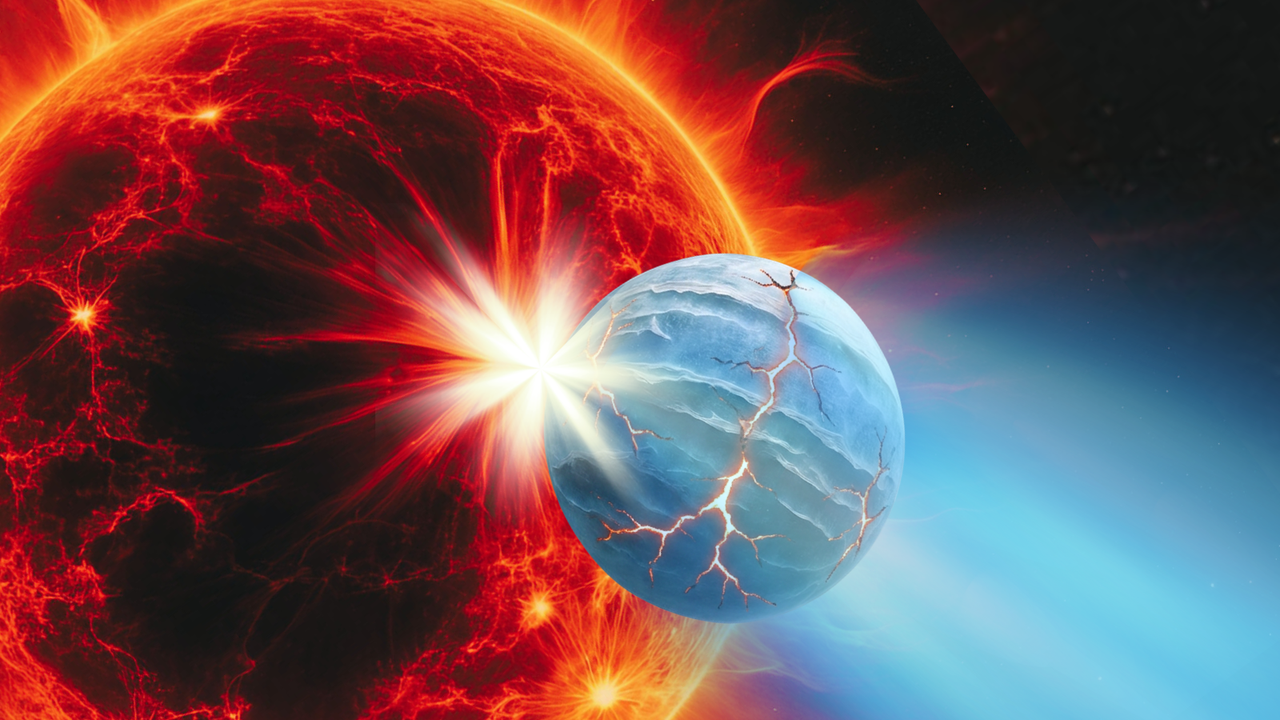
Astronomers have identified an exoplanet dominated by water that orbits perilously close to its host star, locked in a death spiral that will ultimately result in the planet's destruction. The discovery adds to a growing catalog of planetary systems showing evidence of dramatic orbital decay and stellar consumption events.
The exoplanet, detected through observations by ground and space-based telescopes, exhibits an atmosphere and composition rich in water vapor and liquid water. Its orbital parameters place it in an extreme configuration where the star's gravitational forces are gradually pulling the world inward. Over time, spanning millions of years, tidal forces will tear the planet apart, with its material eventually consumed by the star's photosphere.
This type of planetary fate represents an increasingly common discovery in exoplanet science. As detection methods improve, astronomers routinely identify planets in unstable orbits far closer to their stars than anything in our solar system. Mercury, the closest planet to the Sun, orbits at 0.39 astronomical units. Many of these doomed worlds orbit within fractions of an AU, experiencing surface temperatures hundreds of times hotter than Earth.
The discovery was likely made using data from missions such as NASA's Transiting Exoplanet Survey Satellite (TESS), which identifies planets by measuring the dimming of starlight as worlds pass in front of their hosts. Follow-up observations from ground-based observatories provided additional constraints on the planet's properties, atmosphere, and orbital mechanics.
Water-dominated exoplanets present particular research interest. Their existence challenges theories about planetary formation and migration. Planets forming beyond the frost line, where water accumulates, should remain in those outer regions. Yet observations show water-rich worlds orbiting scorching close to their stars. This suggests planets migrate inward through gravitational interactions with protoplanetary disks or other planets during system development.
The eventual consumption of this exoplanet offers researchers a glimpse into planetary destruction mechanisms. As the world approaches its star, tidal heating will intensify, potentially unlocking geological activity and atmospheric escape. The final moments of the planet's existence will produce distinctive spectroscopic signatures that astronomers may detect from Earth-based observatories or future space telescopes.
Understanding these extreme systems informs broader questions about planetary stability and system architecture. The universe contains many more planets in unstable orbits than previously expected. Some will survive their encounters with stars and planets through orbital migration outward. Others face inevitable consumption.
This discovery underscores the violent dynamism governing planetary systems. Our solar system, with its stable planetary orbits and extended habitable zone, represents one possible configuration among countless others. The exoplanet destined for stellar consumption stands as a cautionary example of less fortunate worlds.