# Hubble Discovery in a Commute: New Clues to Dark Matter's Nature
A serendipitous moment during a morning train ride has yielded an unexpected astronomical breakthrough. A former scientist, reviewing archival data from the Hubble Space Telescope, spotted an anomaly in decades-old imagery that now promises fresh insights into dark matter, the invisible substance that comprises roughly 85 percent of the universe's matter content.
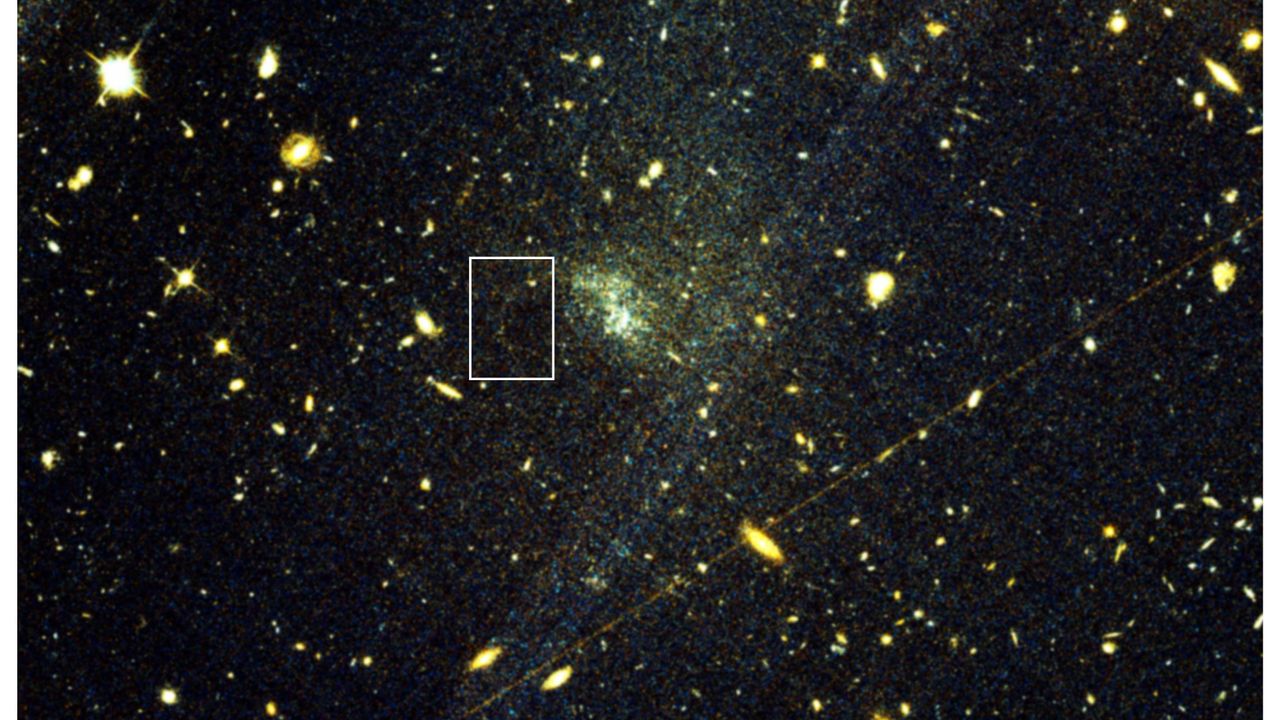
The discovery emerged from careful examination of Hubble observations originally captured years ago but never thoroughly analyzed through the lens of current dark matter research frameworks. What the researcher noticed was an unusual gravitational lensing signature, a phenomenon where massive objects bend light from distant sources, creating distorted or magnified images. This particular lensing pattern suggested the presence of dark matter concentrations in unexpected configurations or distributions within a galaxy cluster.
Hubble, launched in 1990 by NASA and the European Space Agency, has revolutionized astronomy by providing unprecedented ultraviolet, visible, and near-infrared imaging of the cosmos. Its archive contains millions of observations spanning three decades. Most images receive immediate scrutiny from research teams, but the sheer volume of data means some observations languish in databases awaiting future analysis, often when new detection methods or theoretical frameworks make them newly relevant.
The timing here proved critical. Advances in computational modeling and dark matter theories over the past several years have equipped astronomers to extract meaning from older Hubble data that previous analyses might have overlooked. The researcher's fortuitous rediscovery of this particular image, combined with modern analytical techniques, transformed an overlooked observation into potential evidence about dark matter's clumping behavior and distribution throughout galactic structures.
Dark matter remains one of astronomy's deepest mysteries. Unlike ordinary matter, which radiates or absorbs light, dark matter interacts almost exclusively through gravity. Detecting its presence depends almost entirely on observing gravitational effects on visible matter and light. Gravitational lensing provides one of the most direct windows into dark matter's location and density. By mapping how light bends around galaxy clusters, astronomers can infer the dark matter's three-dimensional structure with remarkable precision.
This discovery illustrates why maintaining and analyzing space telescope archives proves invaluable. The Hubble archive, managed by the Space Telescope Science Institute, receives constant queries from researchers worldwide. Each reexamination of archived data, especially using refreshed theoretical models or novel computational approaches, can unlock new knowledge embedded in observations made decades ago.
The finding also underscores the value of open science and data accessibility. Had the Hubble observations remained restricted or poorly catalogued, this accidental discovery would never have occurred. Instead, systematic archival access enabled a researcher to stumble upon evidence that could refine dark matter models and inform future observations with Hubble's successor, the James Webb Space Telescope, and ground-based instruments like the Vera C. Rubin Observatory.
What happens next depends on follow-up observations and theoretical work. The research team will likely publish detailed analysis of the lensing signature, submit proposals for complementary observations, and collaborate with dark matter theorists to interpret what the geometry implies about dark matter's fundamental properties. Other astronomers may revisit related Hubble archival images seeking similar signatures.
This commute-triggered discovery exemplifies how sometimes the most impactful scientific breakthroughs arrive not from planned investigations but from curiosity applied to overlooked data. In astronomy, the universe's secrets often hide in plain sight, waiting for the right moment and the right observer.