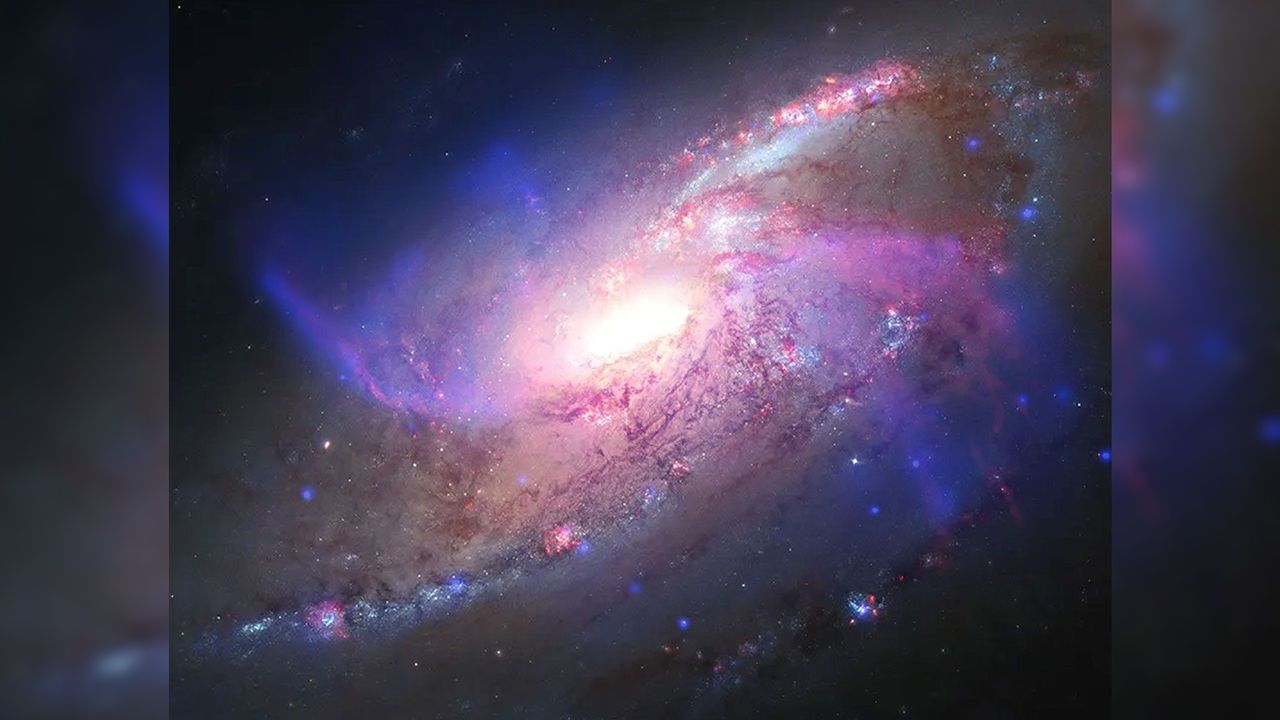
NASA's space telescope trio has imaged NGC 4258, a spiral galaxy 23.5 million light-years away in the constellation Canes Venatici, revealing the structure that makes it one of astronomy's most peculiar objects. The galaxy displays not the standard two or four major spiral arms found in typical spiral galaxies, but six distinct arms. The extra pair remains unexplained by conventional galactic dynamics.
The James Webb Space Telescope, Chandra X-ray Observatory, and Spitzer Space Telescope coordinated observations to construct a composite view of NGC 4258. This multi-wavelength approach penetrates dust that obscures visible light, exposing stellar populations and energetic phenomena across infrared and X-ray bands. The combined dataset reveals the galaxy's architecture with unprecedented clarity.
NGC 4258 earned the catalog designation M106, drawing attention from observers for more than two centuries. The anomalous arms first caught scientific notice in the 1990s when radio observations detected them extending beyond the visible spiral structure. Their origin remains contested among astrophysicists. Some researchers propose that a supermassive black hole at the galaxy's core generates jets that compress surrounding gas, triggering star formation along unexpected paths. Others suggest gravitational interactions with nearby companion galaxies warped NGC 4258's disk, creating the additional spiral patterns.
The central engine of NGC 4258 operates as a Seyfert 2 active galactic nucleus. The supermassive black hole at its heart feeds voraciously, emitting jets that blast outward at relativistic speeds. These jets interact with the surrounding interstellar medium, creating shock waves and heating gas to millions of degrees. The Chandra X-ray observations trace this high-temperature plasma, mapping the energetic environment immediately around the black hole.
Spitzer's infrared sensitivity reveals dust-enshrouded star formation regions that visible-light telescopes cannot penetrate. Young stars embedded in dusty clouds emit most of their radiation at infrared wavelengths. By combining Spitzer's thermal data with Webb's higher-resolution infrared imaging, astronomers resolve stellar nurseries with exquisite detail. This reveals where gas flows concentrate and star formation peaks relative to the galaxy's structure.
JWST contributes near-infrared observations that resolve individual stellar populations. The telescope's 6.6-meter mirror and diffraction-limited optics allow it to distinguish between old, cool stars and young, hot ones scattered throughout NGC 4258. This stellar archaeology traces the galaxy's history, showing where bursts of star formation occurred and how the galactic environment has evolved.
Understanding NGC 4258 extends beyond mere catalog curiosity. The galaxy serves as a laboratory for studying black hole feedback mechanisms. The jets from the central black hole clearly influence star formation rates and galactic structure across scales of thousands of light-years. This demonstrates how supermassive black holes shape their host galaxies, a connection that proves essential for understanding galaxy evolution across cosmic time.
The three-telescope collaboration exemplifies modern astronomy's power. No single observatory captures the complete picture of complex objects like NGC 4258. By combining visible, infrared, and X-ray data, astronomers construct multi-dimensional models that test theoretical predictions and reveal physical mechanisms that single-wavelength observations would miss entirely.