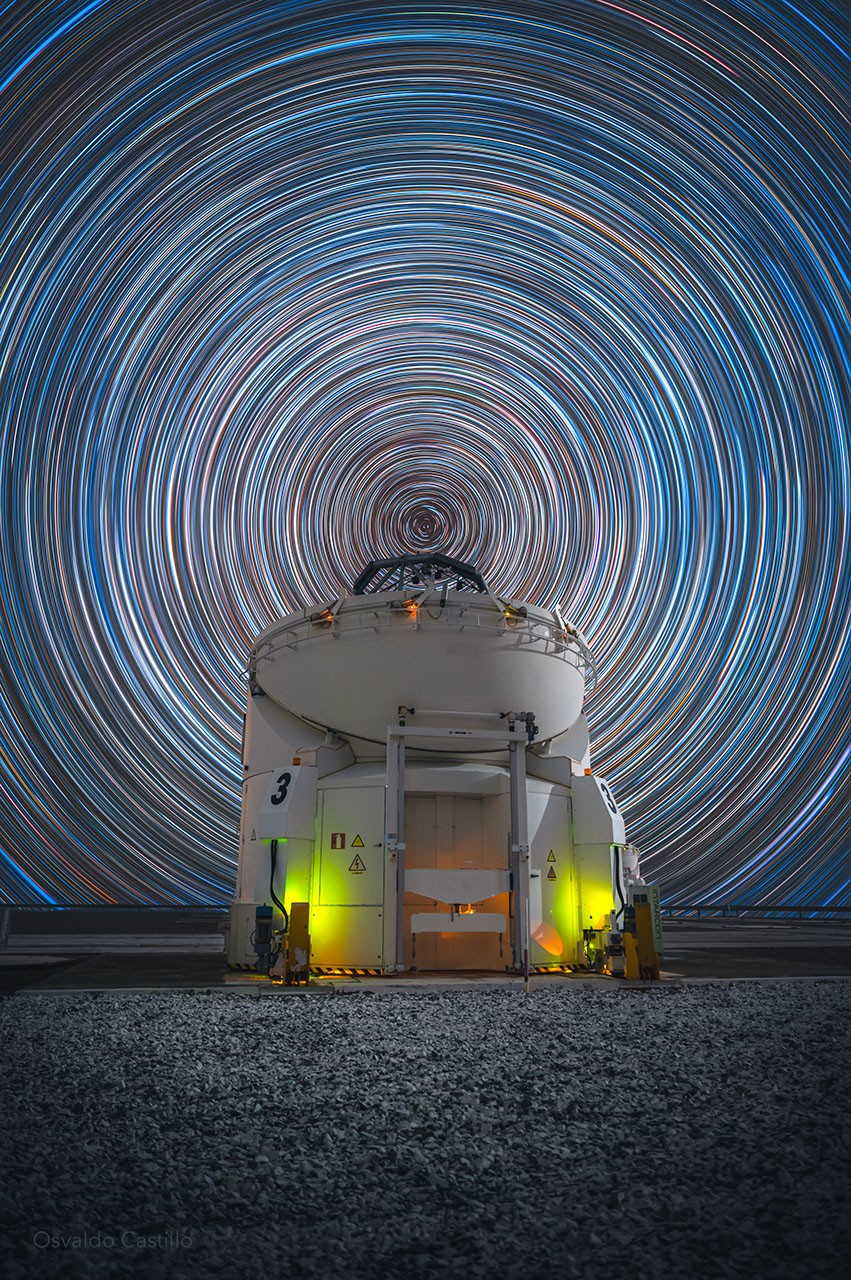
# The Sky Turns Above Paranal Observatory in Chile
The Paranal Observatory in Chile's Atacama Desert captured a stunning photograph of Earth's rotation written across the night sky. Star trails curve in concentric arcs above one of the world's most advanced ground-based observatories, a visual record of Earth spinning on its axis during a long camera exposure.
Paranal sits at 2,635 meters elevation in the driest place on the continent, chosen precisely for these conditions. The European Southern Observatory operates the facility, home to the Very Large Telescope (VLT) array. Four eight-meter Unit Telescopes work independently or combine as an interferometer, enabling observations with resolving power equivalent to a single 130-meter instrument. This raw capability makes Paranal one of the planet's most productive astronomical research centers.
The star trail photograph documents something simultaneously simple and profound. As Earth rotates counterclockwise when viewed from above the North Pole, stars appear to move across the sky in concentric circles centered on Polaris, the North Star. Long exposures reveal these paths as continuous arcs. The geometry is pure and elegant, a direct translation of planetary motion into visible light.
Paranal's location matters beyond the visual drama of its night skies. The Atacama Desert receives less than one millimeter of rainfall annually in some regions. Clouds rarely obstruct observations. Water vapor, which absorbs infrared radiation, remains minimal. These conditions enable infrared astronomy impossible from most other locations on Earth. The VLT's instruments detect everything from exoplanet atmospheres to the most distant galaxies in the early universe.
The observatory houses multiple specialized instruments. SPHERE, the Spectro-Polarimetric High-contrast Exoplanet Research instrument, directly images planets around other stars by blocking stellar glare. GRAVITY measures gravitational effects around the supermassive black hole at the Milky Way's center. MUSE, the Multi Unit Spectroscopic Explorer, maps entire galaxies in detailed spectral data with single exposures.
The ESO operates Paranal in partnership with numerous institutions and nations. Chile contributes the land and favorable regulatory environment. Astronomers from across Europe, North America, and beyond compete for observing time. This model has proven remarkably productive. Thousands of peer-reviewed papers emerge from Paranal observations annually, advancing exoplanet science, galactic archaeology, supernova cosmology, and fundamental physics.
The star trail image represents more than artistic composition. It documents human infrastructure positioned to extract knowledge from the universe. The curved paths record photons that traveled light-years to reach Earth, redirected by precision mirrors into instruments designed by thousands of engineers and scientists. Each exposure at Paranal represents accumulated investment in understanding our cosmic context.
Ground-based observatories like Paranal remain essential despite advances in space telescopes. They observe continuously across the electromagnetic spectrum. They track transient events like supernovae and gravitational wave sources. They follow up discoveries made by satellites. The combination of space and ground-based assets creates a complete observational toolkit.
Future upgrades will expand Paranal's reach. The Extremely Large Telescope, currently under construction on a nearby peak, will feature a 39-meter primary mirror. When operational, it will surpass all current ground-based facilities in raw collecting power, enabling direct spectroscopy of exoplanet atmospheres and observations of the universe's first galaxies. The sky above Paranal will continue turning, while human instruments below reach deeper into space and backward through time.