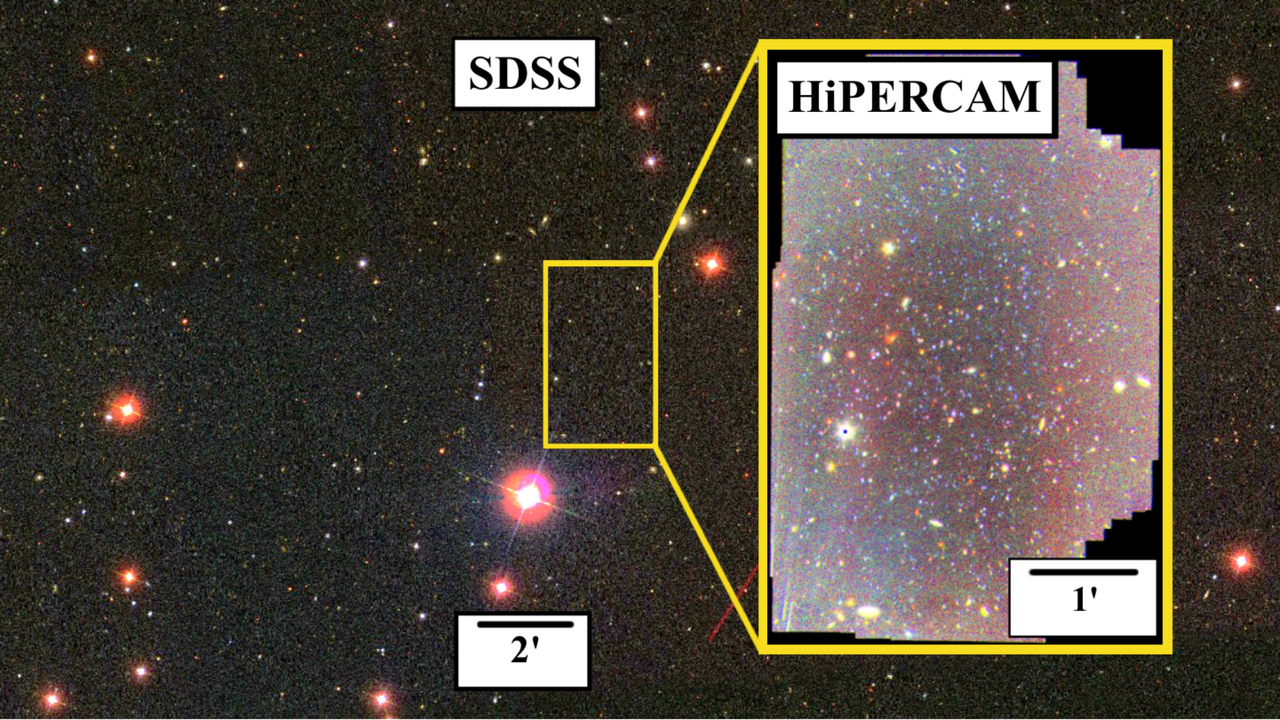
Astronomers working with advanced telescopic observations have moved closer to confirming what would be a revolutionary discovery. A galaxy appears to contain almost no stars, instead consisting primarily of dark matter and gas. This object, if confirmed, would represent the first known "starless" or "failed" galaxy.
The detection challenges conventional models of galaxy formation. Astronomers have long assumed that whenever sufficient dark matter collects to form a gravitational well, stars inevitably form within it. This object contradicts that assumption. It contains the gravitational mass expected of a galaxy, along with detectable gas, yet remains conspicuously devoid of stellar objects.
The discovery emerged through observations using current generation telescopes capable of detecting extremely faint objects across vast cosmic distances. Researchers identified an galaxy-sized structure with all the hallmarks of a normal galaxy except one. Where billions of stars should populate the structure, the observations reveal near-total darkness in visible wavelengths.
Dark matter constitutes roughly 85 percent of the matter in the universe, yet astronomers cannot directly observe it. Its presence becomes evident through gravitational effects on visible matter. This candidate starless galaxy offers an unprecedented laboratory for studying how dark matter behaves independent of stellar populations. The galaxy's composition suggests that under certain conditions, the standard pathways leading from dark matter accumulation to star formation can fail.
Multiple explanations exist for why this galaxy might lack stars. Perhaps the initial conditions during formation prevented gas from cooling sufficiently to collapse into stellar objects. Alternatively, an ancient cataclysm may have destroyed all existing stars, leaving only their dark matter halo intact. Some theories suggest that the galaxy's size or environmental factors prevented normal star formation processes from initiating.
The implications ripple through astrophysics. If such starless galaxies exist in measurable numbers, galaxy formation models require substantial revision. Current models rely on feedback mechanisms where supernovae and black holes regulate star formation rates. A starless galaxy suggests these mechanisms might fail entirely under certain circumstances, or that alternative pathways to galaxy assembly exist beyond current theoretical frameworks.
Confirming this discovery requires ruling out observational artifacts and systematic errors. Astronomers must verify that the absence of starlight reflects reality rather than instrumental limitations or analysis mistakes. Spectroscopic data can confirm the presence of gas and measure velocities, providing independent verification of the galaxy's existence. Follow-up observations using the James Webb Space Telescope and ground-based facilities like the Very Large Array offer paths toward definitive confirmation.
The search for additional starless galaxies has already begun. If they prove common, the cosmic distribution of such objects would reshape understanding of how universes assemble their large-scale structure. If rare, their discovery still transforms astrophysics by demonstrating that nature permits galaxy formation without stars.
This finding demonstrates how observational astronomy continues to surprise theoreticians. Even well-established models contain hidden assumptions. A single anomalous object, rigorously confirmed, can overturn decades of consensus and open new research frontiers.