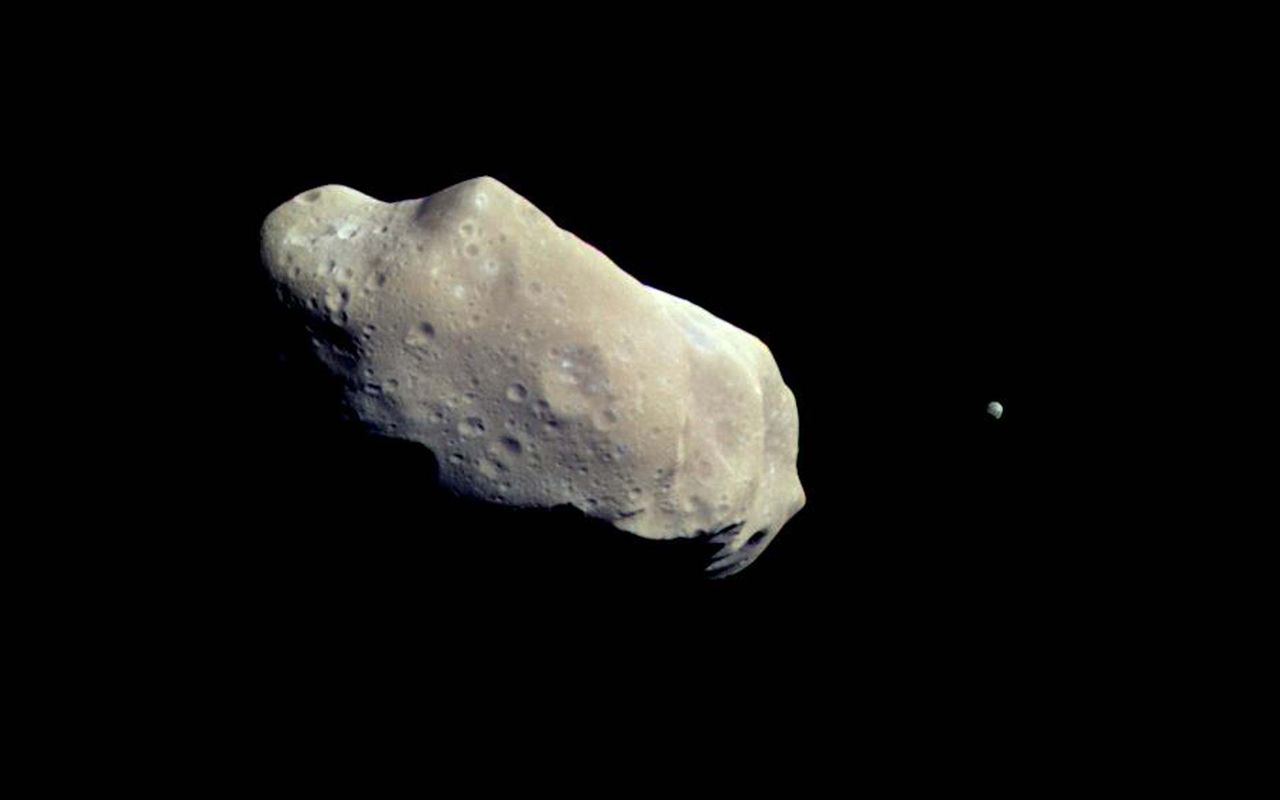
NASA's Galileo spacecraft achieved an unexpected discovery on August 28, 1993, when it flew past the asteroid Ida at a distance of 2,408 kilometers. The encounter revealed something nobody anticipated: Ida possessed a moon.
The spacecraft detected Dactyl, a potato-shaped satellite orbiting the 56-kilometer-long asteroid. This marked the first confirmed discovery of a moon around an asteroid. Dactyl measures just 1.4 kilometers across, making it a minuscule companion to its host body. The finding transformed scientific understanding of asteroid systems and demonstrated that small bodies in space could harbor gravitational companions.
Galileo captured high-resolution images during the Ida encounter, showing the asteroid's cratered surface and irregular geometry. Scientists analyzed the spacecraft's camera data and radiometric instruments to confirm Dactyl's orbital characteristics. The moon orbited Ida at roughly 100 kilometers from the asteroid's center, held in place by the asteroid's weak gravitational field.
This discovery arrived during Galileo's unprecedented six-year journey to Jupiter. The spacecraft launched from the Space Shuttle Atlantis in October 1989 and executed a complex path through the inner solar system. The Ida flyby represented one of several asteroid encounters along the spacecraft's trajectory. Two years earlier, Galileo had passed by asteroid Gaspra, but without finding any moons.
The implications extended beyond simple discovery. The presence of Dactyl suggested that binary or multiple asteroid systems might be common throughout the solar system. Later observations by other space missions confirmed this hypothesis. Astronomers subsequently identified thousands of asteroid moon systems using ground-based telescopes and spacecraft data.
Understanding asteroid moon systems held practical value for future exploration. If humanity planned asteroid mining operations or deflection missions to prevent impacts, engineers needed to account for gravitational effects from secondary bodies. The Ida-Dactyl system provided the first laboratory for studying these dynamics.
Galileo continued toward Jupiter, ultimately spending eight years orbiting the gas giant and sending back transformative data about its atmosphere, radiation belts, and Galilean moons. The spacecraft's instruments studied the Io plasma torus, detected lightning in Jupiter's storms, and confirmed the presence of water beneath Europa's icy crust. These discoveries fueled subsequent missions like the James Webb Space Telescope's observations and the upcoming Jupiter Icy Moons Explorer mission.
The Ida-Dactyl encounter exemplified how space exploration generates unexpected findings. Missions designed for specific scientific objectives frequently uncover phenomena that reshape entire fields of study. The asteroid moon discovery rippled through planetary science for decades, influencing how astronomers model asteroid formation and evolution.
Galileo's legacy extended through its entire 14-year operational lifespan. NASA deliberately crashed the spacecraft into Jupiter's atmosphere in September 2003 to prevent contaminating the potentially habitable moon Europa. That controlled destruction ended an era, but the asteroid moon discovery from 1993 remained a cornerstone of small-body science.