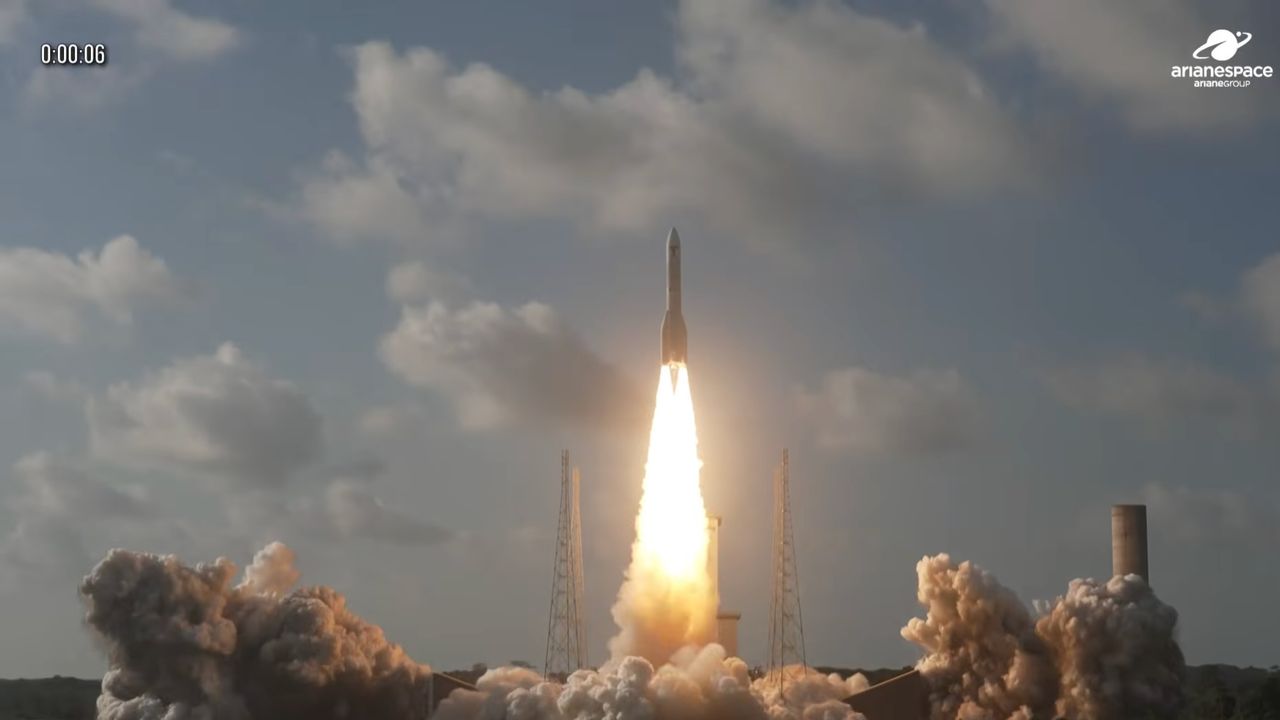
Europe's Ariane 6 rocket successfully lifted off on August 27, carrying the Meteosat Third Generation Imaging 2 (MTG-I2) satellite into orbit. The launch marks the fourth operational flight for Ariane 6 and extends the European Space Agency's commitment to advanced Earth observation and weather forecasting capabilities.
MTG-I2 joins its sister satellite MTG-I1, which launched in January 2024, as part of the Meteosat Third Generation constellation. These imaging satellites represent a generational leap in European weather monitoring technology, equipped with high-resolution imaging instruments that capture Earth's atmosphere, land, and ocean surfaces with unprecedented clarity and speed.
The MTG-I series satellites carry the Flexible Combined Imager (FCI), an instrument that observes Earth in 16 spectral bands compared to the 12 bands on the previous Meteosat Second Generation satellites. This expanded spectral capability enables forecasters to detect atmospheric phenomena with finer detail, improving prediction accuracy for severe weather events, including thunderstorms, heavy precipitation, and tornado development. The satellites image the full Earth disk every 10 minutes, with rapid-scanning capabilities over specific regions every 2.5 minutes when needed.
Ariane 6, developed by European launch provider Arianespace, conducted this mission from Europe's Spaceport in French Guiana. The heavy-lift launcher demonstrates Europe's independent access to space for deploying critical infrastructure to high-altitude orbits. MTG-I2 entered a geostationary orbit approximately 36,000 kilometers above the equator, where it maintains a fixed position relative to Europe and Africa, providing continuous weather surveillance for the continent.
The Meteosat program operates through a partnership between the European Space Agency (ESA), the European Organisation for the Exploitation of Meteorological Satellites (EUMETSAT), and the European Union. MTG satellites supply real-time data to the European Centre for Medium-Range Weather Forecasts and national meteorological services across Europe and Africa, directly supporting emergency response operations and public safety decisions.
MTG-I2's arrival in orbit completes half of the four-satellite imaging constellation planned for the Meteosat Third Generation program. Two additional sounding satellites, designed to profile atmospheric temperature and humidity profiles, remain in development for future launch. The complete constellation will position Europe at the forefront of weather observation through the 2030s, with data freely available to meteorological services worldwide under the EUMETSAT Earth observation data policy.
Ariane 6's increasing operational cadence demonstrates the launcher's readiness for routine deployment missions. The rocket completed its first four operational flights within one year of its inaugural launch in July 2023, establishing a reliable cadence for European space infrastructure deployment. This operational tempo positions Ariane 6 as a cornerstone platform for ESA's scientific missions and EUMETSAT's Earth observation requirements.
The MTG-I2 launch reinforces European commitment to weather observation independence and climate monitoring capabilities essential for understanding atmospheric dynamics and improving forecast models that inform disaster preparedness across multiple nations.