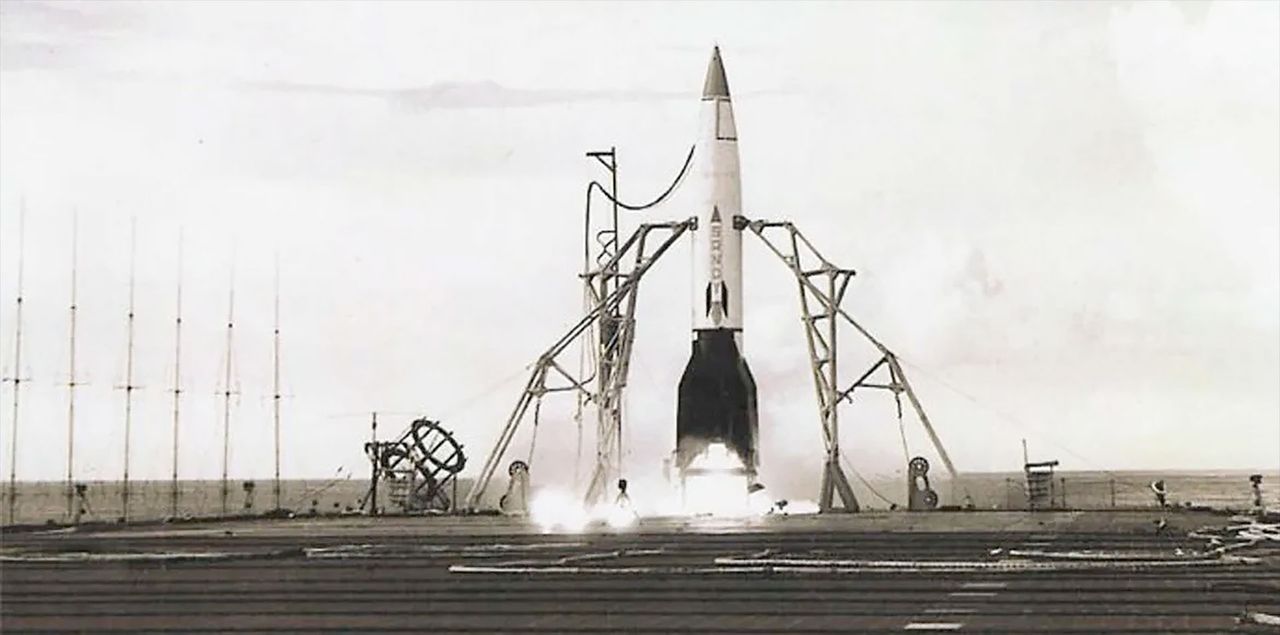
On September 6, 1947, the U.S. Navy launched a captured German V-2 rocket from the deck of the aircraft carrier USS Midway (CVB-41) in the Atlantic Ocean. This test marked the first ballistic missile launch from a naval vessel and represented a watershed moment in Cold War military technology and American space exploration.
The V-2 itself was Nazi Germany's most advanced weapon of World War II. Developed under Wernher von Braun at Peenemünde, the liquid-fueled rocket terrorized London and Antwerp in the final months of the war. After Germany's surrender, the United States captured intact V-2 missiles, technical documentation, and German engineers. The Soviets secured their own stockpile and scientists. Both superpowers recognized the strategic value of this technology immediately.
The Navy's decision to launch from USS Midway came from a specific tactical concern. The service branch wanted to test whether ballistic missiles could operate effectively at sea, where mobile platforms offered survivability advantages over fixed ground installations. A moving ship presented far more complex launch challenges than a stationary test site. Engineers had to solve problems of deck stability, ship motion compensation, fuel management in maritime conditions, and seawater corrosion on sensitive components.
The V-2 lifted off from a specially constructed launch ramp aboard the carrier and climbed toward the Atlantic sky. The test succeeded in proving that naval ballistic missile operations were physically feasible. This single launch seeded decades of naval ballistic missile development that would define Cold War deterrence strategy.
The USS Midway test led directly to the Fleet Ballistic Missile program, which produced the Polaris, Poseidon, and Trident missile systems. These weapons would eventually arm American ballistic missile submarines, creating an undetectable second-strike nuclear deterrent that defined mutual assured destruction doctrine. The submarine-based leg of the nuclear triad emerged partly from this moment in 1947.
Beyond military implications, the Navy's V-2 tests contributed to early American rocket science and engineering. Engineers gained hands-on experience with liquid-fueled propulsion systems, guidance mechanisms, and high-altitude flight dynamics. Data from these launches informed the emerging civilian space program. Wernher von Braun, who eventually led America's moon program at NASA's Marshall Space Flight Center, drew on lessons from these Navy tests throughout his career.
The USS Midway launch also represented American technological capture and adaptation. Rather than developing ballistic missiles from scratch, the United States leveraged German expertise and hardware to compress development timelines. This pragmatic approach to technology transfer during the Cold War proved extraordinarily efficient, though it raised complex questions about scientific talent that had served the Nazi regime.
By the late 1950s, submarine-launched ballistic missiles had become operational reality. The USS George Washington (SSBN-598) conducted the first successful test launch of a Polaris missile from a submerged submarine in 1960. That capability flowed directly from the foundation laid aboard USS Midway in 1947. The Navy's ballistic missile capability remained central to American strategic defense through the Cold War and continues today with the Ohio-class submarines carrying Trident missiles.
That September day in 1947 established the technical and tactical framework that would reshape military force projection and nuclear deterrence for generations. A single V-2 launch from a carrier deck proved the feasibility of something the world had never attempted before.